The three major indices of the U.S. New York stock market showed a simultaneous decline in early trading on the 7th (local time) as concerns over prolonged tightening persisted due to stronger-than-expected economic indicators and crude oil prices. The sharp drop in the stock price of Apple, the largest company by market capitalization, following reports of a ban on iPhones by Chinese authorities, also had a negative impact on technology stocks overall that day.
At around 10:05 a.m. at the New York Stock Exchange (NYSE), the Dow Jones Industrial Average, composed of blue-chip stocks, was trading at around 34,434, down 8.84 points (0.03%) from the previous close. The S&P 500 index, centered on large-cap stocks, fell 33.21 points (0.74%) to 4,432, while the tech-heavy Nasdaq index recorded 13,653, down 218.75 points (1.58%).
Currently, technology, materials, and industrial stocks within the S&P 500 are declining, while utilities and healthcare-related stocks are rising. In particular, as concerns over tightening increase, technology stocks sensitive to interest rates are nearing a 2% drop. Apple fell more than 3% from the previous close following foreign media reports that China plans to expand the iPhone ban to state-owned enterprises beyond government officials. Tesla, Nvidia, and AMD are also down by around 2%. Qualcomm dropped more than 6%. AI software company C3.ai fell over 13% due to disappointing earnings. ChargePoint Holdings also fell more than 21% after missing forecasts. McDonald's showed an increase of nearly 1% as Wells Fargo upgraded its investment rating.
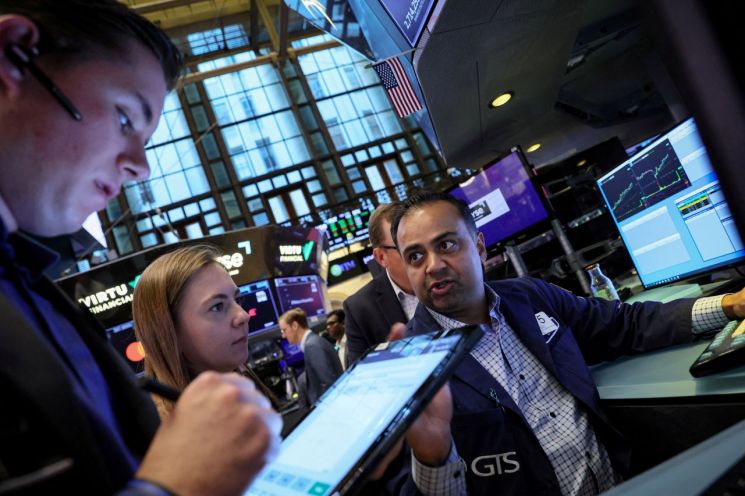
Investors are closely watching international crude oil prices, government bond yields, and key economic indicators to gauge the direction of the Federal Reserve's (Fed) monetary policy amid the weakness in technology stocks including Apple. Recently, stronger-than-expected economic data, rising oil prices, and increasing government bond yields have combined to heighten market concerns over monetary tightening. Additionally, foreign media reports that China plans to expand the iPhone ban from certain departments to state-owned enterprises have further dampened investor sentiment across technology stocks. Edward Moya, senior market analyst at OANDA, said, "The Nasdaq is sinking as Apple's weakness negatively impacts technology stocks," adding, "Apple's growth story heavily depends on China, so if sanctions intensify, it will pose significant problems for other big tech companies reliant on China."
The weekly initial jobless claims released that morning indicated that the labor market remains robust. According to the U.S. Department of Labor, initial jobless claims for the week of August 27 to September 2 totaled 216,000, down 13,000 from the previous week. This is the lowest level in seven months and below Wall Street expectations. Continuing claims, which count those filing for unemployment benefits for at least two weeks, decreased by 40,000 to 1.68 million compared to the previous week.
David Russell, global market strategist at TradeStation, commented, "Today's jobless claims report raises concerns about interest rate hikes," adding, "Even if the Fed does not raise rates again at the September meeting, the likelihood of a hawkish dot plot has increased."
International crude oil prices, which had been rising amid concerns over production cuts by major oil-producing countries, are currently declining within a narrow range. This is interpreted as a kind of correction following the recent rise and the impact of economic uncertainty caused by previously released Chinese economic data. West Texas Intermediate (WTI) crude oil prices are currently trading around $87 per barrel, more than 11% higher than at the beginning of the year. Investors are also awaiting data such as U.S. crude oil inventories released by the Energy Information Administration that morning.
According to the CME FedWatch tool, federal funds futures markets are still pricing in over a 93% chance that the Fed will hold rates steady in September. The probability of a rate hold in November stands at around 51%, down from the mid-58% range a week ago. The chance of a "baby step" rate hike (a 0.25 percentage point increase) in November has risen from the mid-37% range a week ago to the mid-45% range currently.
As a result, attention is focused on the Consumer Price Index (CPI) for August, to be released on the 13th. If the CPI increase exceeds market expectations, the possibility of additional rate hikes will gain renewed momentum. The remaining Federal Open Market Committee (FOMC) meetings this year are scheduled for September, November, and December.
Chris Zaccarelli, Chief Investment Officer at Independent Advisor Alliance, told CNBC that with recent oil price increases and confirmation of a strong labor market, the need for Fed action is likely to grow. He said, "People hoped the Fed would hold rates steady for the rest of the year, but there is a possibility of one or two more hikes," adding, "This has somewhat negative implications for a market that expected the Fed to finish all its work within this year."
In the New York bond market, government bond yields are moving within a narrow range. The 2-year Treasury yield, sensitive to monetary policy, has fallen back below 5%. The benchmark 10-year yield is trading around 4.28%. The dollar index, which measures the value of the U.S. dollar against six major currencies, rose 0.2% to around 105. The dollar is being supported by heightened tightening concerns and weak economic data from Europe and China, unlike the U.S. CNBC noted that the dollar has been rising for eight consecutive weeks and analyzed that this dollar strength could pose another headwind for the stock market in September.
European stock markets are showing mixed trends within a narrow range. Germany's DAX index is down 0.3% from the previous close, France's CAC index is down 0.05%, while the UK's FTSE index is up 0.17%.
© The Asia Business Daily(www.asiae.co.kr). All rights reserved.