Unusual Large Ice Holes Occur in Arctic Offshore
Arctic Sea Ice Growth Hindered...Extreme Cold Wave Feared on Korean Peninsula
The Korea Institute of Ocean Science and Technology (KIOST) announced on the 6th that an unusually large ice hole (Polynya) occurred in the offshore sea ice north of Eastern Siberia in the Arctic last July.
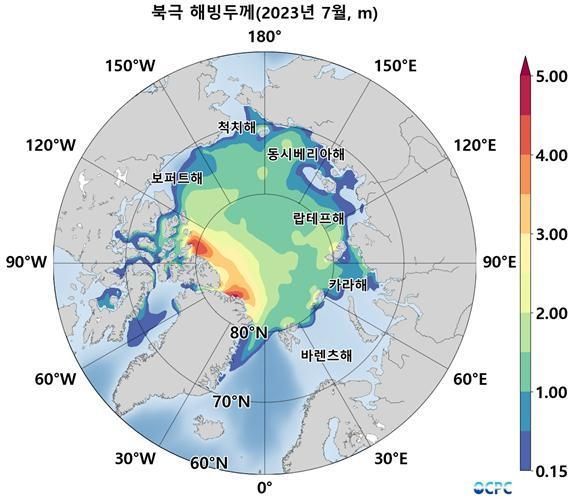
Arctic sea ice develops during the fall to winter seasons and shrinks in width during the spring to summer seasons, with its smallest size typically occurring around early September. There is also "perennial sea ice" that remains frozen and does not melt even in summer.
A Polynya refers to a large hole formed when the wide frozen sea melts in the middle.
KIOST noted that the sea ice around the Polynya could melt over a wider area, potentially causing abnormal weather on the Korean Peninsula during winter.
Generally, Polynyas occurring in the Arctic during summer form as the ice melts from the coast inward due to strong winds and high temperatures. However, the Polynya that occurred this time is notable for forming offshore, away from the coast.
This phenomenon is presumed to have occurred due to global warming, with the global sea surface temperature rising by 0.3 degrees compared to the previous year in July (from 18.5°C to 18.8°C), allowing warm seawater to flow along currents and melt the sea ice.
KIOST explained, "As of July, the thickness of sea ice around the Arctic has thinned to within 1 meter, so if warm seawater flows in, there is concern that Polynyas will occur more frequently in the Arctic in the future. If Polynyas persist for a long time, they could hinder the expansion of Arctic sea ice in winter, which in turn could trigger cold waves on the Korean Peninsula during winter."
This result was analyzed by the KIOST Ocean Climate Prediction Center (OCPC) based on monthly average sea ice data provided by the U.S. National Snow and Ice Data Center (NSIDC).
Meanwhile, the OCPC regularly provides analysis and forecast information not only on the seas around Korea but also on the state and trends of the global oceans.
© The Asia Business Daily(www.asiae.co.kr). All rights reserved.

















