Opening of Data Center in Riyadh, Saudi Arabia
Aligned with Saudi's Goal for Digital Transformation
Rumors of Middle East Headquarters Moving to Riyadh
Huawei, which recently launched a 5G-supported smartphone despite US sanctions, is turning its attention to the Middle Eastern market. The company has established a cloud data center in Riyadh, the capital of Saudi Arabia, laying the groundwork for expanding its business in the Middle East and Africa.
According to the Hong Kong South China Morning Post (SCMP) on the 5th, Huawei opened its first data center in the Middle East on the 4th (local time) in Riyadh. The company announced plans to support 200,000 local developers over the next five years and collaborate with about 1,000 local companies and 2,000 startups. Earlier this year, Huawei mentioned it would invest $400 million (approximately 532.8 billion KRW) over five years to establish the center.
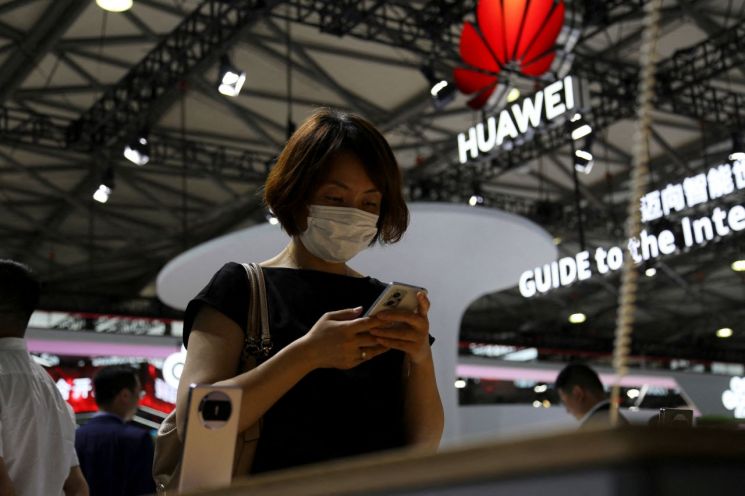
The data center will serve as the hub for cloud services offering various functions, including artificial intelligence (AI). Steven, Huawei’s representative for the Middle East and Central Asia region, explained, "Our goal is to help Chinese companies pioneer the Saudi market and support Saudi companies in entering the global market."
At the opening ceremony held locally in Riyadh, Huawei also introduced the 'Pangu AI' model trained in Arabic. Steven emphasized, "This technology will act as a catalyst to accelerate the growth of local companies," adding, "Cloud services will not be limited to Saudi Arabia but will grow throughout the Middle East and Africa in cooperation with local companies."
The Riyadh data center is Huawei’s 30th data center and leverages Saudi Arabia’s national strategic project, 'Vision 2030,' which aims to reduce oil dependency and achieve digital transformation. This aligns with Huawei’s situation, as it faces sanctions such as the blocking of its 5G networks in the US and European markets. Given the increasing restrictions on its global business, the company appears to be aiming to expand its presence in cloud computing and broaden its market reach into the Middle East and Africa.
According to Huawei, the company has already signed contracts with over 200 government-related clients in the Middle East. Among them, more than 150 are internet companies, and over 30 are financial service institutions. Huawei’s cloud business revenue reached 45.3 billion yuan (approximately 8.26 trillion KRW) last year and recorded 24.1 billion yuan in the first half of this year.
Bloomberg reported that Huawei is considering relocating its Middle East headquarters from Bahrain and Dubai to Riyadh. Huawei first entered the Saudi market in 2002 and has since collaborated with local telecom operators to build Saudi communication networks and launch 5G connectivity. Traditionally a US ally, Saudi Arabia has recently strengthened economic cooperation with China, signing a $50 billion agreement last year and deepening ties.
© The Asia Business Daily(www.asiae.co.kr). All rights reserved.
![Clutching a Stolen Dior Bag, Saying "I Hate Being Poor but Real"... The Grotesque Con of a "Human Knockoff" [Slate]](https://cwcontent.asiae.co.kr/asiaresize/183/2026021902243444107_1771435474.jpg)
















