[China Finding Loopholes in US Sanctions]①
Contemplating Workarounds for Electric Vehicle Batteries
Joint Ventures Abroad and Production Base Relocation
Following semiconductors, China has also begun establishing various bypass routes in the electric vehicle (battery) sector. As the Joe Biden administration moves to exclude China through the Inflation Reduction Act (IRA), Chinese companies have launched an all-out effort to neutralize the U.S. blockade by evading regulations through joint ventures, relocating production bases, and technological cooperation.
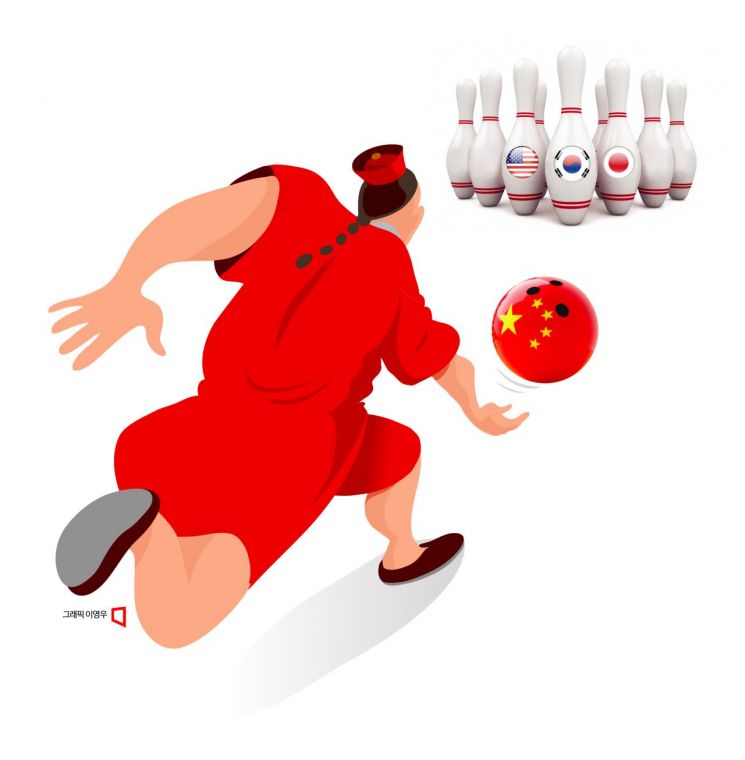
According to industry sources on the 6th, Chinese battery and material companies are securing domestic production bases through joint investments with Korean companies. This is a measure to receive IRA subsidies provided when batteries produced in North America or countries with Free Trade Agreements (FTA) are installed in electric vehicles assembled domestically in the U.S.
China’s Huayou Cobalt is investing 1.2 trillion won each in LG Chem and POSCO Future M to build precursor and nickel raw material plants in Saemangeum and Pohang, respectively. China’s CNGR is partnering with POSCO Holdings and POSCO Future M to invest 1.5 trillion won to construct a nickel smelting plant in Pohang. Additionally, Gelingmei has decided to establish a precursor plant in Saemangeum through a joint investment worth 2.2 trillion won with SK On and others.
The raw materials produced by Chinese battery material companies through joint ventures in Korea meet the core mineral requirements under the IRA. As a result, they can fully enjoy subsidy benefits when exporting to the U.S. Chinese companies are circumventing the U.S. blockade aimed at excluding China from the battery supply chain by utilizing the Korea-U.S. FTA.
Attempts to directly penetrate the U.S. market through overseas subsidiaries or technological cooperation are also actively underway. Chinese battery electrolyte company Tianqi Advanced Materials announced earlier this year that, based on a shareholding structure of 'Singapore subsidiary → Netherlands subsidiary → U.S. subsidiary,' it will invest $260 million (approximately 346 billion won) to produce electrolytes in Texas and Louisiana. The world’s largest battery manufacturer, China’s CATL, has also entered the U.S. market through a joint venture with Ford. Ford owns 100% of the factory shares, while CATL provides technology and receives royalties. The Michigan state government approved a subsidy of $123 million (approximately 164 billion won) for the CATL-Ford joint venture.
There is also analysis that Chinese automotive industry investments in Mexico have increased following the U.S. blockade against China. According to the Mexican Automotive Parts Association, 40% of Mexico’s investments last year were made by companies relocated from China. This is attributed to Mexico’s trade agreement with the U.S. and the United States-Mexico-Canada Agreement (USMCA), which offers various tax benefits when establishing local factories in Mexico. In fact, parts exported by China to Mexico last year reached $300 million (approximately 400 billion won) per month, doubling the amount from five years ago. The British magazine The Economist analyzed, “The process of decoupling trade and investment between the U.S. and China paradoxically could strengthen financial and commercial ties between China and U.S. allies,” adding, “The U.S. has not been able to sever ties with China.”
In line with these observations, there is speculation that the U.S., monitoring China’s responses, may move to block these bypass routes. The Korea International Trade Association stated, “The U.S. Congress criticizes the subsidy of Chinese companies with American taxpayers’ money as unreasonable and may introduce countermeasures against bypass entry.”
© The Asia Business Daily(www.asiae.co.kr). All rights reserved.

















