[China Finding Loopholes in US Sanctions]①
Raids, Operating Secret Factories and Talent Poaching
Advance, Self-Reliance in Next-Generation Technology and Equipment Development
Counterattack, Retaliation with Essential Mineral Export Restrictions
The time and room for technological negotiations needed for this appear to be secured through export sanctions on essential minerals for semiconductor manufacturing. This is also a counter-operation against U.S. semiconductor sanctions. As China's response strategy becomes increasingly visible, the U.S. is showing new moves to 'secure dialogue channels with China.' However, no breakthrough to narrow the gap between the two countries is in sight. The U.S. has sent high-level officials to China, persuading that it is engaging in 'competition' with China, but China interprets this as 'conflict.' With no expected change in China's response strategy, the market is watching with keen interest whether China's semiconductor rise will succeed.
"Salary is not an issue upon acceptance"
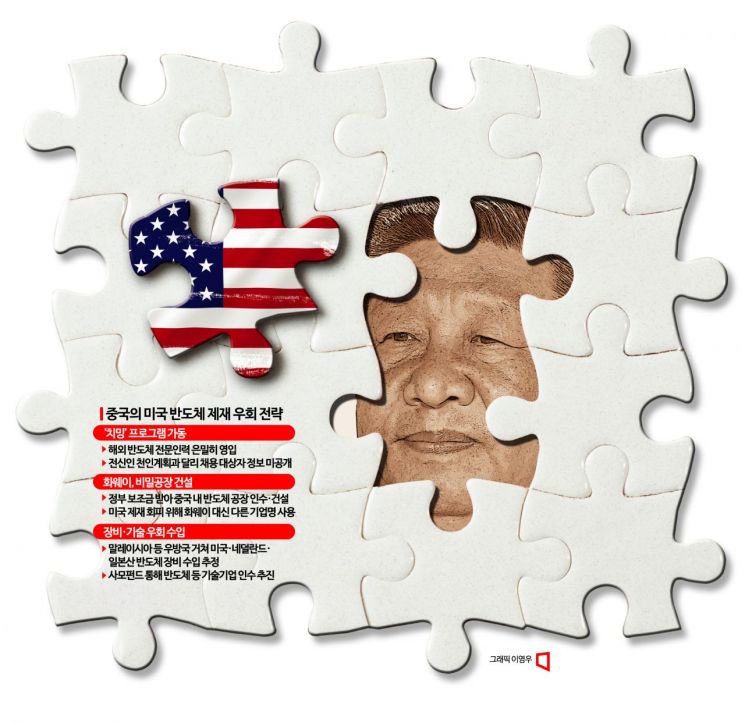
Recently, an anonymous job posting from a Chinese semiconductor company on a recruitment site included this statement regarding compensation. China, which secretly restarted its overseas talent recruitment program halted due to U.S. pressure, is reportedly recruiting semiconductor specialists domestically while hiding the company’s name. Furthermore, China is mobilizing all possible means and loopholes to secure talent, technology, and equipment, including building secret factories and importing equipment through allied countries to evade U.S. surveillance.
‘Qiming’ replaces the name of the Thousand Talents Plan… China’s covert talent recruitment
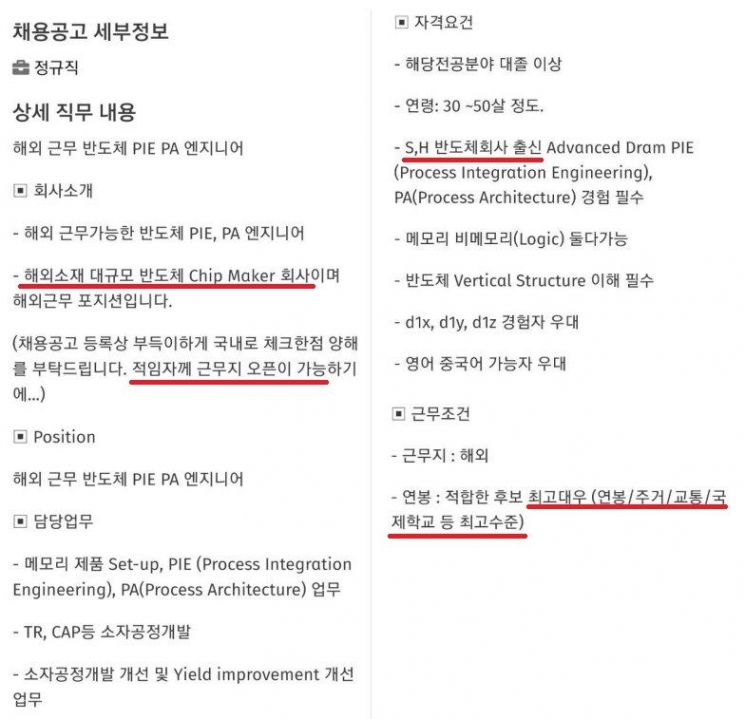
According to industry sources on the 6th, domestic headhunting firms are increasingly not disclosing company names when recruiting semiconductor specialists to work for Chinese local companies. One firm posted a job ad seeking personnel with D-RAM mass production (PIE) and development (PA) experience from S (Samsung Electronics) and H (SK Hynix) semiconductor companies. However, while the job location was listed as 'Seongnam Bundang (domestic)' in the title, the body of the posting specified 'overseas.' It also stated a preference for candidates proficient in Chinese. This effectively indicates that the hiring entity is a Chinese semiconductor company.
The firm explained, "Due to unavoidable reasons in the job posting registration, the location was checked as domestic," adding, "It is a large-scale semiconductor company overseas, and the position is overseas. The work location can only be disclosed to suitable candidates." They also promised top-level treatment regarding salary, housing, transportation, and international schools for children.
Another recruitment site also posted a job ad seeking semiconductor specialists to work in China. This firm similarly did not specify the company name but only mentioned that it is a company located in Guangdong Province with about 1,000 employees. The posting stated that they are scouting candidates with 8 to 10 years or more experience in various fields such as semiconductor electrostatic chucks (ESC), ceramic powder, and electronic paste. Regarding salary, it hinted at exceptional treatment by stating, "Salary is not an issue upon acceptance."
China's 'talent hunting' is not new. However, its pattern has changed due to U.S. sanctions and pressure. Whereas in the past talent was openly poached, recently China has been conducting covert recruitment to avoid the eyes of major countries.
Especially after the U.S. blocked China's overseas talent recruitment program called the 'Thousand Talents Plan,' China is reported to have restarted the program under the new name 'Qiming.' This program recruits personnel in sensitive or confidential science and technology fields such as semiconductors. Unlike the Thousand Talents Plan operated from 2008 to 2018, the Qiming program does not disclose recruitment target information on government websites. Foreign media have analyzed this as a measure taken in response to the U.S. criticism of the Thousand Talents Plan as a government-led industrial espionage program and the ban on employment of U.S. citizens and permanent residents in China's advanced semiconductor sector.
Chinese authorities are said to offer overseas talent recruitment through the Qiming program with housing purchase subsidies and contract bonuses worth 3 to 5 million yuan (approximately 545 million to 910 million KRW). They reportedly also provide extravagant perks such as diamonds, bags, and cars.
Alias companies, secret factories, detour imports of equipment
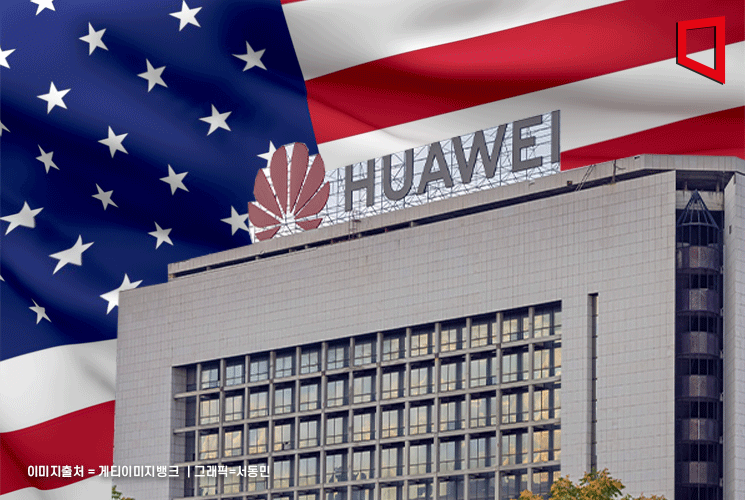
China is mobilizing various means not only to recruit overseas talent but also to import semiconductors and equipment and secure technology. The goal is to evade U.S. scrutiny. Huawei, which is on the U.S. export blacklist, is reportedly building semiconductor manufacturing facilities secretly across China since last year with strong support from Chinese authorities. According to the Semiconductor Industry Association (SIA), Huawei has received about $30 billion (approximately 40 trillion KRW) in support from the Chinese government and Shenzhen city, acquiring more than two existing factories and constructing more than three new factories.
Notably, SIA explained that Huawei is acquiring and building factories under other companies' names. Since the U.S. government banned transactions between Huawei and U.S. companies from 2019 citing national security threats, this is a strategy to deceive the U.S. by using different company names.
There are also speculations that China imported semiconductor equipment controlled by the U.S. through allied countries. According to UN trade statistics, Malaysia's imports of semiconductor equipment from the world's top three exporters?the U.S., the Netherlands, and Japan?increased by $580 million (approximately 770 billion KRW) last year, a 127.7% increase compared to the previous year.
Interestingly, the scale of semiconductor equipment China imported from Malaysia also increased by $590 million (approximately 780 billion KRW). The market believes China has secured additional semiconductor equipment through Malaysia to circumvent U.S. export sanctions on semiconductor equipment.
Within China, a black market has even formed where Nvidia's advanced semiconductor 'A100,' which is banned from export to China, is being traded through loopholes. Overseas companies sell leftover inventory to Chinese dealers who then sell them in cities like Shenzhen. It is also reported that companies have established subsidiaries in India, Taiwan, and Singapore to import A100 chips indirectly. However, the black market price is about $20,000 (approximately 26 million KRW), twice the normal price, and the volume is insufficient to resolve China's supply shortage.
Additionally, China continues to attempt acquisitions of semiconductor and technology companies through capital. Before U.S. semiconductor export restrictions on China became overt, Chinese private equity firm Wise Road Capital attempted to acquire Korea's MagnaChip Semiconductor in 2021. MagnaChip, listed on the New York Stock Exchange, required U.S. approval for the sale, but U.S. authorities rejected it citing national security threats, and the sale was ultimately canceled. Recently, China's sovereign wealth fund China Investment Corporation (CIC) reportedly acquired technology companies in the U.S. and the U.K. under the name of U.S. investment bank Goldman Sachs, sparking controversy.
The market is closely watching who will emerge as the winner in the U.S.-China semiconductor hegemony battle. The New York Times (NYT) described the U.S. semiconductor blockade against China as an 'act of war,' stating, "If the controls succeed, China will be at a disadvantage for a generation, but if they fail, it could accelerate the very future the U.S. desperately seeks to prevent, causing tremendous backlash."
© The Asia Business Daily(www.asiae.co.kr). All rights reserved.



















