Continued Visit to Bali for G20, Second Year in a Row
Gratitude to the Korean Community Settled in Indonesia Since the 1960s
Overseas Koreans Office Connects Homeland and Diaspora, Serving as a Supportive Network
President Yoon Suk-yeol, on the 5th, during his first schedule visiting Jakarta, Indonesia to attend the ASEAN (Association of Southeast Asian Nations) related summit, met with the Indonesian Korean community and urged them to "join forces in realizing the vision of a global pivotal state that fulfills its responsibilities and contributions in the international community."
In his opening remarks at a dinner meeting with the Indonesian Korean community held at a hotel in Jakarta that afternoon, President Yoon stated, "South Korea’s increased contribution to the international community and its more active role in addressing the challenges facing all humanity are aimed at contributing to freedom, peace, and prosperity for the entire world," emphasizing this point.
President Yoon first evaluated Indonesia as "the world's fourth most populous country and an economic powerhouse representing ASEAN," and regarded it as a key partner in the Korea-ASEAN solidarity initiative. He added, "When diplomatic relations were established 50 years ago, the annual trade volume between the two countries was less than 200 million dollars, but last year it reached 26 billion dollars," emphasizing, "Tens of thousands of Indonesian students are learning Korean, and hundreds of thousands of our citizens visit Indonesia annually."
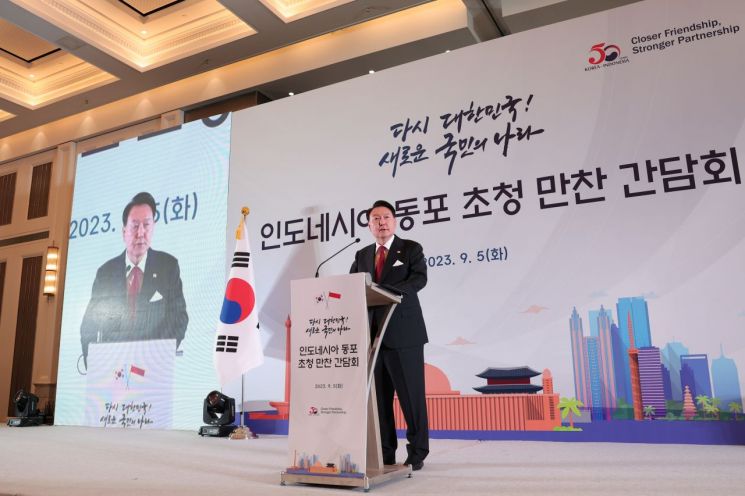
He expressed gratitude for the contributions of the Korean community settled in Indonesia since the 1960s, which deepened the cooperative relationship between Korea and Indonesia. President Yoon recalled, "The Indonesian Korean community, which began to take root in earnest after the 1960s, has developed alongside South Korea’s growth," and added, "Those who initially settled here, as I remember from my student days, were involved in the timber industry." He continued, "Because Korea lacked wood, when apartment construction began in the 1980s, all window and door frames were made from timber imported from Indonesia," and added, "Desks for students and high-end furniture were all imported from Indonesia."
He further stated, "From the 1980s, the community entered the manufacturing sectors such as sewing and footwear, establishing a foothold and laying the foundation for growth. Subsequently, as Indonesia’s economy grew significantly, many entrepreneurs settled here, expanding the scope and scale of the Korean community," and expressed gratitude, saying, "During the COVID-19 crisis, the Korean community supported the Indonesian government and local communities, demonstrating Korea’s spirit of mutual aid and Indonesia’s 'gotong royong' spirit. I am truly proud of the approximately 25,000 Koreans who have established themselves as a model community in Indonesia." 'Gotong royong' means 'carrying together on the shoulders' in Indonesian.
Regarding the recently launched Ministry of Overseas Koreans in June, President Yoon promised to do his best to serve as a protective umbrella for the government and overseas Koreans. He especially pledged to prioritize overseas Koreans in Korea’s pursuit of becoming a global pivotal state and urged them to become a strong bridge connecting the future of Korea and Indonesia. President Yoon emphasized, "The Ministry of Overseas Koreans will closely connect the motherland and you, serving as a global business hub for all overseas Koreans, providing a strong protective umbrella, and firmly supporting multicultural next-generation Koreans to maintain their Korean identity while growing and developing locally."
President Yoon also listened to the difficulties faced by the local Korean community and promised assistance. At the event, a local Korean chef requested attention to the lack of halal certification suitable for Indonesia’s Muslim country characteristics, despite the belief that Korean cuisine would be popular thanks to the popularity of K-culture. There was also a request to extend the visa period from one year to five years for dual nationals raised in multicultural families who have completed Korean military service, as they currently receive a shorter one-year visa compared to the general five-year visa. According to Lee Do-woon, spokesperson for the Presidential Office, President Yoon responded, "I understand that halal certification has seen progress through the recent MOU between the two governments," and "Although dual nationals are exempt from military service, if they have completed service, we will take measures to extend their entry period."
© The Asia Business Daily(www.asiae.co.kr). All rights reserved.

















