Christopher Waller, a Federal Reserve (Fed) board member known as a prominent "hawk" (favoring monetary tightening), delivered a somewhat dovish message on the 5th (local time), stating that "the labor market has started to slow down."
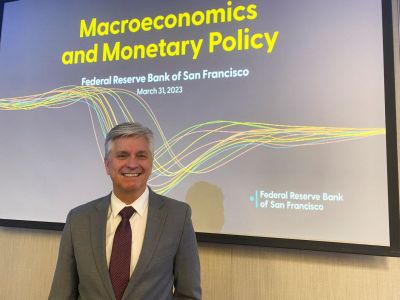
Waller appeared on CNBC's Squawk Box that day and said, "Last week, we saw really good economic indicators." He added, "This allows us to proceed cautiously with (interest rate hike decisions). If this continues, we can just sit back and watch the economic indicators."
In the August employment report released on the 1st, the U.S. unemployment rate rose to 3.8%, the highest level in about a year and a half, and wage growth slowed more than expected. This confirmed signals that the previously hot labor market is cooling due to the cumulative tightening effects of the Fed. The July core Personal Consumption Expenditures (PCE) price index (3.3%), released the same week, showed a slightly higher increase than the previous month but met expectations.
Waller, who had previously delivered strong tightening messages, said, "I cannot say that we need to take any action soon," lending more weight to the possibility of a rate pause in September. He diagnosed, "Looking at last week's data, it is clear that the labor market has started to slow down. If inflation shows a downward trend in the coming months, we will be in a pretty good situation." However, he repeatedly emphasized the need to clearly confirm that the inflation easing trend is not temporary.
When asked whether the Fed would stop raising interest rates, he replied, "It depends on the data." He said, "We need to see if this inflation (easing) trend continues," citing past cases where inflation indicators declined but then surged again. Therefore, his argument is that the Fed must be more cautious in declaring victory in the fight against inflation.
Following the release of the employment report, market expectations for the end of Fed tightening have increased significantly. According to the Chicago Mercantile Exchange (CME) FedWatch, the federal funds futures market on the morning of that day reflected more than a 95% chance that the Fed will hold rates steady in September. Although the June dot plot released by the Fed indicated the possibility of one more rate hike this year, investors are increasingly viewing a scenario with no further rate hikes as likely.
Goldman Sachs also recently lowered the probability of a U.S. recession within 12 months from 20% to 15% based on recent data. It also predicted that the Fed could hold rates steady at this month's Federal Open Market Committee (FOMC) meeting. There are three remaining FOMC meetings this year?in September, November, and December. The Fed has previously raised the U.S. benchmark interest rate to a 22-year high of 5.25?5.50%.
However, Waller said, "If we feel the need to raise rates one more time, a single hike will not push the economy into a recession." This reaffirmed the hawkish stance that rate hikes remain possible if necessary. He emphasized, "It is not clear that even one more rate hike would put us at real risk of causing significant damage to the labor market." This statement can be interpreted as a rebuttal to the Fed's doves (favoring monetary easing), who argue that additional tightening could cause unnecessary recession and job losses.
Meanwhile, Loretta Mester, president of the Federal Reserve Bank of Cleveland, voiced a hawkish view in an interview with German media released the same day, saying, "We may need to raise rates further." Mester said, "From what I have seen so far, I can reasonably suspect that we might need to raise rates more," but added, "There is still plenty of time until the September decision, and we will be able to gather a lot of data and information before then."
© The Asia Business Daily(www.asiae.co.kr). All rights reserved.
![Clutching a Stolen Dior Bag, Saying "I Hate Being Poor but Real"... The Grotesque Con of a "Human Knockoff" [Slate]](https://cwcontent.asiae.co.kr/asiaresize/183/2026021902243444107_1771435474.jpg)
















