International Counterfeit Goods Trade Volume 541 Trillion Won
Accounts for 2.5% of Total International Trade
Increase of 413 Trillion Won and 0.65%P Over 20 Years
Korea's Counterfeit Goods Trade Share 2%
KIIPR Estimates Sales Loss of 22 Trillion Won Due to IP Infringement
Damage Spreading Broadly Across Industries
The proportion of counterfeit goods transactions in international trade is increasing. The distribution of counterfeit goods poses a significant risk to the intellectual property-based global economy, highlighting the seriousness of the issue. In particular, South Korea ranks within the top 10 countries most affected by counterfeit goods transactions, prompting growing calls for urgent government-level countermeasures.
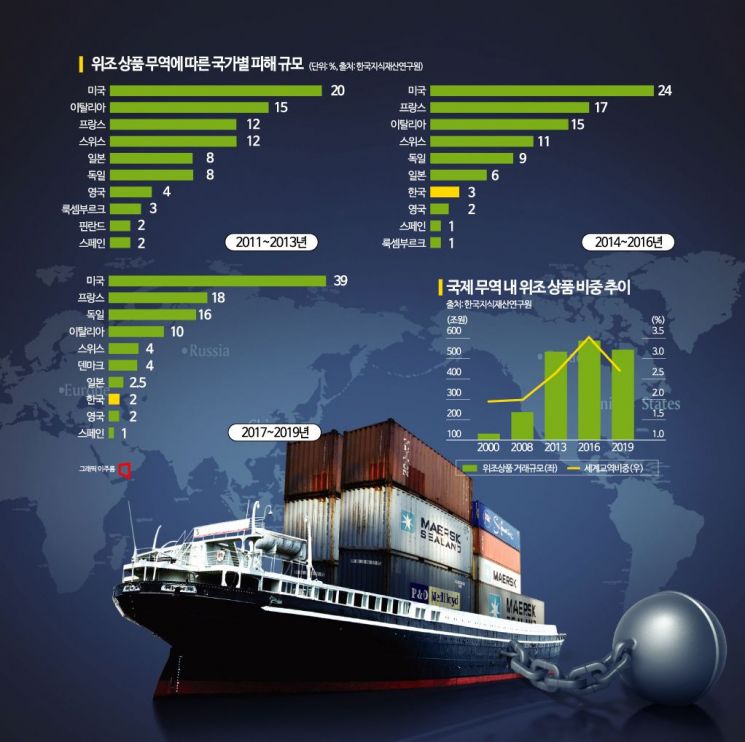
◆Counterfeit goods account for 2.5% of international trade= According to the Korea Intellectual Property Research Institute on the 6th, the estimated scale of counterfeit goods transactions in international trade in 2019 was 541 trillion won, accounting for 2.5% of the total international trade volume.
Considering that the scale of counterfeit goods traded through international trade in 2000 was 128 trillion won with a 1.85% share, counterfeit goods transactions through international trade have increased by 413 trillion won in amount and 0.65 percentage points in proportion over 20 years.
From 2011 to 2019, the top items distributed as counterfeit goods in international trade were consistently shoes, clothing, leather products, and electronic devices, ranking first to fourth. However, the distribution share of these products decreased from 87% in 2011 to around 60% after 2016.
This trend reflects the diversification of counterfeit goods, as explained by the Korea Intellectual Property Research Institute: counterfeit goods, which were previously centered on luxury items such as designer brands, have expanded their distribution to general products consumed by a broad, unspecified audience.
Another notable feature is that counterfeit goods transactions in recent international trade are mainly conducted through international mail and express delivery. In fact, counterfeit goods traded via international mail and express delivery in small quantities (less than 10 items) and small sizes account for 61% of the total counterfeit goods transaction volume.
◆South Korea ranks 7th to 8th among countries affected by counterfeit goods= As counterfeit goods transactions through international trade increase, the scale of damage by country is also growing. The damage from counterfeit goods is clearly concentrated in OECD member countries that rely on innovation and creativity (countries of origin for famous brands).
Based on the number of counterfeit goods transactions detected by customs, the United States, France, Germany, Italy, and Switzerland rank highest in terms of damage scale. Typical types of damage include reduced sales for companies whose intellectual property rights are infringed by counterfeit goods, job losses, and government revenue leakage.
South Korea has also seen an increase in counterfeit goods transactions due to the Korean Wave (Hallyu), resulting in a larger scale of damage. This is confirmed by the country rankings based on damage scale. South Korea entered the top 10 for the first time in the 2014-2016 counterfeit goods damage survey. At that time, South Korea ranked 7th, accounting for 3% of the total counterfeit goods transaction volume.
Fortunately, South Korea improved to 8th place in the 2017-2019 counterfeit goods damage country rankings, and its share of the total counterfeit goods transaction volume decreased to 2%. However, experts point out that considering the recent Korean Wave momentum, it is difficult to be optimistic about the future situation.
Kim Si-yeol, head of the Dispute Research Team at the Korea Intellectual Property Research Institute, stated, “There are no official statistics that aggregate domestic damage caused by global counterfeit goods distribution,” but added, “Some estimates suggest that domestic companies suffer losses of 22 trillion won in sales, 31,753 jobs lost, and 416.9 billion won in government revenue leakage (sum of corporate tax and individual income tax reductions) due to counterfeit goods distribution (intellectual property rights infringement).”
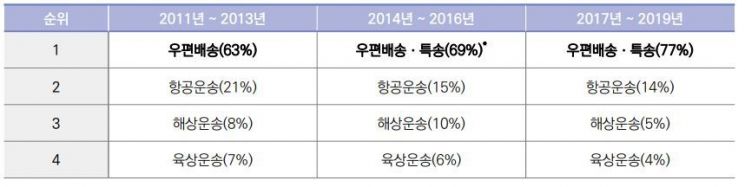 Graph of the ranking and proportion of counterfeit goods transportation means detected by customs by country (region). Source=Korea Institute of Intellectual Property
◆“Government support needed to prevent damage”= Voices calling for active government support in response to the increase in counterfeit goods transactions are growing. On this day, the Korean Intellectual Property Office held the 'K-Brand Counterfeit Goods Exhibition and Seminar' at the National Assembly Members' Office Building to protect the intellectual property rights of companies expanding overseas. This event was jointly hosted by the office of National Assembly member Kim Han-jung of the Industry, Trade, Small and Medium Enterprises and Venture Businesses Committee and the Korean Intellectual Property Office, with the Korea Intellectual Property Protection Agency organizing it. The seminar aimed to explore countermeasures to prevent the distribution of K-Brand counterfeit goods overseas.
Notably, representatives from the National Assembly, government, Food Industry Association, Music Content Association, Cosmetics Association, and other related parties attended to represent the voices of various industries. An industry official stated, “Unlike the past when counterfeit goods damage was concentrated in fashion and electronics, recently it has spread widely to characters, toys, pharmaceuticals, and more,” adding, “Considering this situation, the government should directly step in to support the prevention of industrial damage caused by counterfeit goods transactions.”
Ryu Dong-hyun, deputy director of the Korean Intellectual Property Office, said, “Through the seminar, I deeply realized how important it is for domestic export companies to respond to counterfeit goods,” and added, “The Korean Intellectual Property Office will prepare and promptly implement related measures to do its best to remove obstacles to exports for domestic companies.”
© The Asia Business Daily(www.asiae.co.kr). All rights reserved.


















