Indonesia Electric Vehicle Market Holds 56% Share from January to July This Year
Hyundai Motor Company has risen to the top spot in market share just one year after entering the Indonesian electric vehicle market. The electrification trend is sweeping Indonesia, where Japanese car brands had long monopolized the internal combustion engine market. Hyundai has signaled a shift in the competitive landscape in the ASEAN market, which is on the brink of the electric vehicle era.
On the 5th, Hyundai announced that it sold 3,913 electric vehicles in Indonesia from January to July this year, achieving a market share of 56.5%. The second place went to China's Wuling Motors (28%), followed by Toyota (5%). Until last year, Hyundai ranked second behind Wuling Motors, but thanks to the launch of Ioniq 5 sales this year, it has risen to the top of the industry.
The Ioniq 5 is the first imported electric vehicle produced locally in Indonesia. Indonesian President Joko Widodo personally signed the Ioniq 5 vehicle at the Hyundai Indonesia plant inauguration ceremony last year and remarked, "The Ioniq 5 will be an important milestone in the development of electric vehicles in Indonesia."
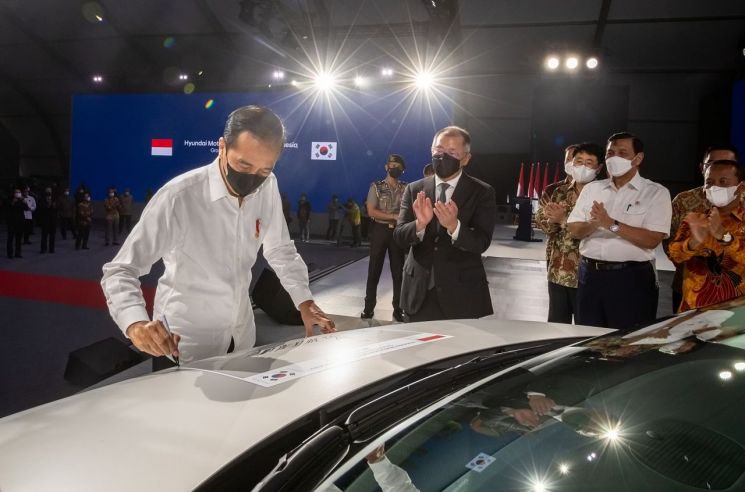 Indonesian President Joko Widodo is leaving a commemorative signature on the Ioniq 5 at the Hyundai Motor Indonesia plant inauguration ceremony last year.
 [Photo by Hyundai Motor]
Indonesia is an important country not only in terms of electric vehicle sales but also in securing raw materials. Indonesia, rich in resources such as nickel, a key material for electric vehicles, is emerging as a core country for the electrification transition. Hyundai Motor Group is constructing a battery cell joint venture plant with LG Energy Solution in Indonesia. Once this plant begins operation next year, it is expected to strengthen its local electric vehicle market strategy based on a stable supply chain.
Hyundai recently launched its second dedicated electric vehicle, the Ioniq 6, at the 2023 Gaikindo Indonesia International Auto Show (GIIAS) held in Jakarta. On the 5th of this month, Hyundai signed a memorandum of understanding (MOU) with Lippo Malls Indonesia, the largest local retailer, to expand electric vehicle charging stations. Through this cooperation, the two companies plan to install electric vehicle charging stations at 52 large shopping malls across Indonesia operated by Lippo Malls.
Meanwhile, Hyundai has set a goal to break the monopoly of Japanese brands in the Indonesian market, where electrification is underway. Hyundai Indonesia's sales corporation rapidly improved its industry sales ranking from 13th in 2021 to 8th in 2022, and 6th this year.
The winds of change were also confirmed at last month's Gaikindo Indonesia International Auto Show. This auto show is not only for new car introductions but also for active purchase contracts. According to local media, Hyundai achieved 3,727 on-site contracts at the show, ranking second after Toyota (5,796 units). Notably, the Indonesian strategic multipurpose vehicle (MPV) Stargazer secured 1,600 contracts, while the Ioniq 5 (776 units) and Creta (768 units) also concluded sales contracts.
Hyundai plans to use Indonesia not only as a sales market but also as an export hub. According to the Association of Indonesia Automotive Industries (GAIKINDO), Hyundai exported 30,114 vehicles to nearby overseas markets such as ASEAN and the Middle East from January to July this year, a 70% increase compared to the same period last year.
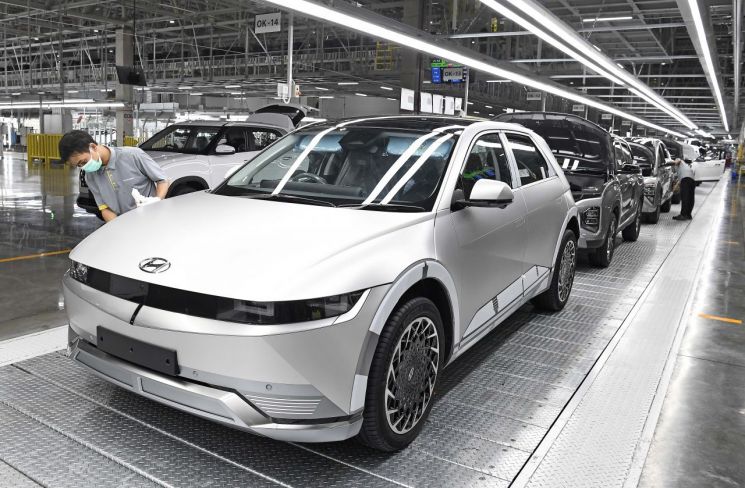 The electric vehicle 'Ioniq 5' is being produced at Hyundai Motor's factory in Indonesia.
 [Photo by Hyundai Motor]
© The Asia Business Daily(www.asiae.co.kr). All rights reserved.
![Clutching a Stolen Dior Bag, Saying "I Hate Being Poor but Real"... The Grotesque Con of a "Human Knockoff" [Slate]](https://cwcontent.asiae.co.kr/asiaresize/183/2026021902243444107_1771435474.jpg)












