High Possibility of Utilizing Surplus Funds Including the Foreign Exchange Stabilization Fund
However, Some Fund Bond Sales May Occur
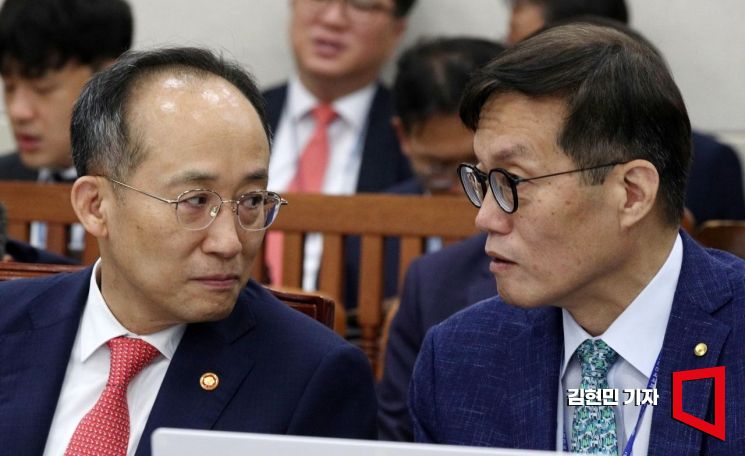 Deputy Prime Minister and Minister of Economy and Finance Choo Kyung-ho and Bank of Korea Governor Lee Chang-yong are conversing at the plenary meeting of the Planning and Finance Committee held at the National Assembly on the 22nd. Photo by Hyunmin Kim kimhyun81@
Myungshil Kim, a researcher at Hi Investment & Securities, stated on the 5th, "Despite the tax revenue shortfall (collecting less tax than expected), the likelihood of the central government executing an additional supplementary budget (supplementary budget) this year is low," adding, "I believe concerns about the supply burden of government bonds in the second half of the year will decrease."
It is expected that part of the tax revenue shortfall (at least 50 trillion won) will be reduced through delays in the execution of local fiscal transfers, and the remaining shortfall will be financed through fund surplus resources and global surplus funds (excess tax revenue and unused money). This means that the possibility of bond yields rising (prices falling) due to increased government bond issuance from supplementary budget formation has diminished.
Researcher Kim said, "If linked to a reduction in net government bond redemptions next year, the easing of issuance burdens will act as a factor for lowering government bond yields," but pointed out, "However, it is necessary to note that for local governments, supplementary budgets may be executed due to delays in local fiscal transfers."
The tax revenue shortfall this year is expected to be at least 50 trillion won. National tax revenue from January to July decreased by 4.34 trillion won compared to the same period last year. Assuming the tax revenue from August to December remains the same as last year (133 trillion won), the estimated tax revenue shortfall for this year is 49.9 trillion won. However, if the results of the corporate tax interim payment conducted by August 31 are poor, tax revenue for the remaining period will fall below last year's level, and the annual tax revenue shortfall is expected to exceed 50 trillion won.
The government's first measure to prevent a tax revenue shortfall is to postpone the central government's local fiscal transfers. Researcher Kim explained, "Assuming that 40% of national tax revenue in 2022 is transferred as local allocation tax and education finance grants, if the tax revenue to be paid to local governments this year is postponed to the next time and local governments secure funds through supplementary budget formation, the central government's tax revenue shortfall is estimated to be at least 30 trillion won."
Specific measures related to the tax revenue shortfall have not yet been announced by the Ministry of Economy and Finance. The government is currently conducting a tax revenue re-estimation. They are reviewing the use of global surplus funds and fund surplus resources, and the possibility of utilizing the Foreign Exchange Equalization Fund's public funds is being raised.
Based on the 2023 budget, the scale of the Foreign Exchange Equalization Fund operation is 136 trillion won. Of this, 57 trillion won is allocated for government expenditures, and 78 trillion won is held for surplus fund management. Researcher Kim explained, "If the resources of the Foreign Exchange Equalization Fund are transferred to the Public Fund Management Fund and then reallocated by the government to the general account, it could cover part of the tax revenue shortfall."
The Foreign Exchange Equalization Fund is money accumulated in the form of funds in foreign currency and Korean won to prepare for exchange rate fluctuations. Using it may expose the foreign exchange market to risks during sudden changes.
Researcher Kim said, "Recently, the Ministry of Economy and Finance announced plans to issue up to 1.3 billion dollars of foreign currency-denominated foreign exchange bonds (not issued since 2021) and 18 trillion won of won-denominated foreign exchange bonds (not issued since 2003) starting in 2024," adding, "This can be interpreted as meaning that the tax revenue shortfall can ultimately be replaced by issuing foreign exchange bonds instead of government bonds." It is highly likely that surplus funds such as the Foreign Exchange Equalization Fund will be used rather than supplementary budgets if there is a tax revenue shortfall next year as well.
Researcher Kim pointed out, "However, as of the end of 2023, 32% of the fund's surplus resources are allocated to domestic bonds, so if the government's utilization of funds increases, it should be noted that this could lead to bond sales by some funds."
© The Asia Business Daily(www.asiae.co.kr). All rights reserved.

















