SK Broadband announced on the 5th that it has become the first domestic operator (based on terms and conditions notification) capable of providing dedicated lines for both Quantum Key Distribution (QKD) and Post-Quantum Cryptography (PQC) technologies.
Quantum secure communication utilizes the principle of uncertainty and the impossibility of replication, which are characteristics of quantum mechanics, and includes technologies such as Quantum Key Distribution (QKD) and Post-Quantum Cryptography (PQC).
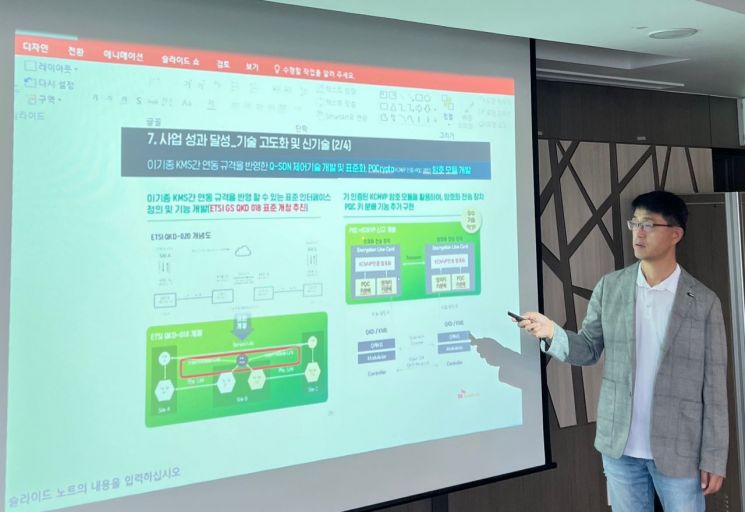 An SK Broadband official explaining a quantum technology demonstration case at Cheongpung Lake Hotel located in Cheongpung-myeon, Jecheon-si.
 [Photo by SK Broadband]
Quantum Key Distribution (QKD) is a hardware-based method where the sender and receiver each use their own quantum key distribution devices to simultaneously generate encryption keys, making physical hacking impossible. Post-Quantum Cryptography (PQC) is based on complex mathematical algorithms that would take hundreds of millions of years to decode. It can also be implemented via software, making it more cost-effective and scalable than QKD. From the perspectives of security, cost efficiency, and convenience, these two technologies are considered complementary.
SK Broadband completed the terms and conditions notification for QKD in July last year and for PQC dedicated line service in June this year, explaining that it can provide customized security services leveraging the advantages of both technologies. For example, large customers such as government agencies, public institutions, healthcare, and finance can choose the highly secure QKD dedicated line, while small and medium-sized enterprises can opt for the more affordable and scalable PQC dedicated line without the need for additional equipment installation.
They can also offer services that integrate QKD and PQC technologies to further enhance security. For instance, in the case of biometric authentication security at banks, QKD technology can be applied within the bank’s internal data center (internal network), and PQC can be used between the customer’s smartphone (mobile terminal) and the authentication server (external network), applying encrypted communication throughout the entire process (End-To-End) to securely protect biometric information.
SK Broadband is the first domestic operator to provide both QKD and PQC dedicated line services using cryptographic modules certified by the National Intelligence Service’s Cryptographic Module Validation Program (KCMVP), in collaboration with SK Telecom. SK Broadband is leading the domestic quantum industry, having been selected as the top operator for four consecutive years from 2020 to 2023 in national projects related to quantum cryptography technology led by the National Information Society Agency (NIA).
Since June, SK Broadband has formed a consortium with SK Telecom and domestic promising small and medium-sized enterprises such as FiveVT to participate in the “Quantum Technology Commercialization Discovery and Demonstration Project” led by the Ministry of Science and ICT and the National Information Society Agency (NIA). This national project aims to discover technologies, equipment, and services applying the principles of quantum mechanics such as quantum communication, sensors, and computing, and to develop business models for commercialization by demand institutions. The project period extends until next year. This year, they advanced QKD technology by miniaturizing the quantum key distribution device and increasing the quantum channel transmission distance from 80km to 120km. They also significantly improved power consumption reduction and investment efficiency in line costs.
Meanwhile, SK Broadband is actively pursuing win-win cooperation with small and medium-sized enterprises through participation in national projects. They plan to develop support for providing 4K high-definition video services and enhanced security for drones by utilizing the “Quantum Cryptography Chip” developed by the domestic SME KCS. The Quantum Cryptography Chip adds quantum random number generation functionality to an existing chip that has received the highest security rating among domestic cryptographic chips, offering strong security advantages. By integrating two chips into one, it improves economic efficiency and ease of installation, making it applicable to various Internet of Things (IoT)-based products and devices. Through this, SK Broadband aims to assist SMEs with technological capabilities in developing new technologies and help domestic equipment gain global competitiveness.
Choi Seung-won, head of ICT infrastructure at SK Broadband, said, “We will enhance security by applying quantum technology-based security services to existing enterprise dedicated lines,” adding, “We will take the lead in providing optimal security services not only to government agencies but also to public and financial institutions that require protection of personal and financial information.”
© The Asia Business Daily(www.asiae.co.kr). All rights reserved.

















