Digital Platform Government Committee Holds Press Briefing on the 4th
Next Year's Budget 926.2 Billion Won...121% Significant Increase
Increasing Cloud Transition and AI Utilization for Enhanced Convenience
The government will invest 10 billion KRW each next year in ultra-large-scale artificial intelligence (AI) and digital twins to enhance the convenience of public services. It will also allocate 75.8 billion KRW to transform outdated government systems into a cloud-native model, strengthening the transition to a digital platform government.
The Digital Platform Government Committee announced this at a press conference marking its first anniversary held on the 4th at the Korea Press Center in Jung-gu, Seoul.
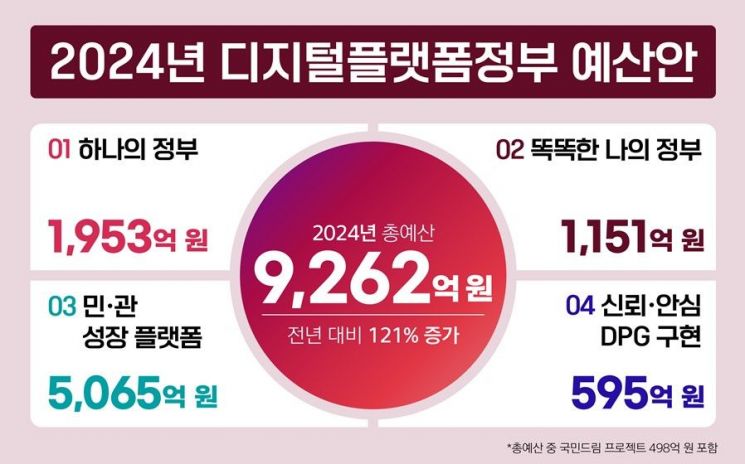
The committee stated that the budget related to the Digital Platform Government (DPG) for next year has been set at 926.2 billion KRW, a 121% increase (507 billion KRW) compared to this year.
Based on the "Plan for Realizing the Digital Platform Government" announced in April, the budget was prepared after reviewing projects worth 1.4 trillion KRW requested by 20 ministries including the Ministry of the Interior and Safety and the Ministry of Science and ICT. This includes the budgets related to the Digital Platform Government announced by each government ministry. The final decision will be made after the National Assembly’s review process.
Chairman Ko Jin said, "Despite difficult fiscal conditions, the budget for next year has been significantly increased," adding, "This means that the Yoon Seok-yeol administration has a strong will to implement the Digital Platform Government." He added, "We are determined to produce results that the public can feel, and we will actively persuade to further increase the budget during the National Assembly’s review process."
Looking at the major budget projects, the largest budget (75.8 billion KRW) will be spent on transitioning government systems to the cloud. The government aims to convert 100% of public sector information resources (13,276 items) to cloud-native by 2030.
The characteristic of cloud-native is applying cloud technology from the design stage to create a small, flexible structure that enables seamless services.
 Chairman Ko Jin of the Presidential Digital Platform Government Committee. Photo by Younghan Heo younghan@
Additionally, 11 billion KRW will be newly invested next year to introduce ultra-large-scale AI-based services. Administrative and public institutions will be supported in developing services that utilize private ultra-large-scale AI to improve policy quality and innovate public services. Through this, 100 administrative and public innovation services are planned to be developed.
Chairman Ko said, "We plan to prepare and distribute technical and operational guidelines soon for the effective and proper use of ultra-large-scale AI in the public sector."
The digital twin competitiveness enhancement project (10 billion KRW) will be newly introduced next year. A digital twin pilot zone will be established to address various regional issues and social problems, including disasters such as flooding and heatwaves.
A new project to build a national disaster management information system will also be promoted with a budget of 11.5 billion KRW. The plan is to integrate disaster and safety information systems and link them with private platforms such as Naver and Kakao to provide services in one place.
The MyData project (14.1 billion KRW), which allows citizens to conveniently view various personal information in one place, has also been expanded in the budget.
The MyData platform will be built to enable easy distribution and utilization of personal information by individuals, and the data transmission methods by industry will be standardized.
The mobile resident registration card, which was previously issued only to some qualified citizens such as those with a driver’s license, will be expanded to all citizens. A budget of 20.5 billion KRW has been allocated next year for the mobile ID platform construction project.
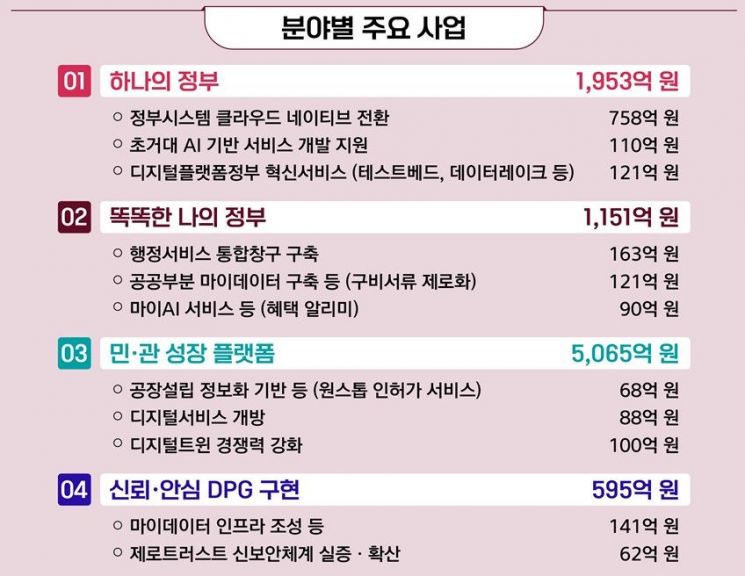
A new project to build an online comprehensive youth policy platform that provides customized services to youth policy users through AI (3.4 billion KRW) will also be introduced.
To simplify corporate licensing procedures in a one-stop manner, a civil service integrated system (500 million KRW) will be operated, while an information infrastructure for factory establishment (2.6 billion KRW) will be built and a factory licensing simulation service (3.7 billion KRW) will be developed.
More than 10,000 Software as a Service (SaaS) companies will be nurtured, and promising SaaS companies with global competitiveness will be discovered.
Meanwhile, the revision of the committee establishment decree, which allows the appointment of a vice chairman of the Digital Platform Government Committee at tomorrow’s (5th) Cabinet meeting, is expected to pass.
Chairman Ko said, "Going forward, the committee plans to expand the discussion venue from meeting rooms to policy sites," adding, "Together with private committee members and officials from responsible ministries, we will frequently visit policy sites to identify problems and find solutions on the ground."
© The Asia Business Daily(www.asiae.co.kr). All rights reserved.
![Clutching a Stolen Dior Bag, Saying "I Hate Being Poor but Real"... The Grotesque Con of a "Human Knockoff" [Slate]](https://cwcontent.asiae.co.kr/asiaresize/183/2026021902243444107_1771435474.jpg)













