National Pension Financial Stability Scenario
Increase Contribution Rates, Delay Retirement Age
Opposition Rises Over Omission of Income Replacement Rate Increase Proposal
18 Pension Financial Stabilization Policy Combinations
Government "Refer to Discussions, Reform Plan to Be Announced in October"
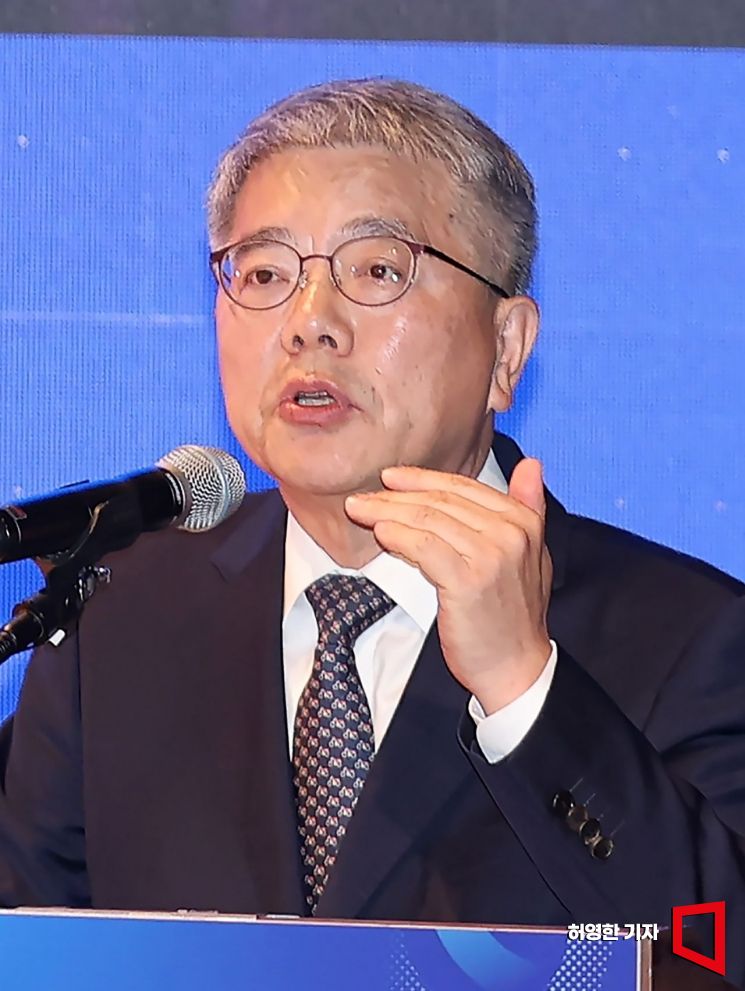 At the 5th National Pension Financial Calculation Public Hearing held at COEX on the 1st, Kim Yongha, Chairman of the Financial Calculation Committee, is making a presentation. Photo by Heo Younghan younghan@
The National Pension Fund Actuarial Committee has proposed 18 pension reform measures under the theme of "pay more and receive later." The proposals include raising the contribution rate up to 18% and starting pension payments at age 68. There was also a suggestion to increase the fund's investment return rate by 1 percentage point. If the most stringent measures are chosen, concerns about deficits disappear, and it was found that there would be no issues with National Pension payments for the next 23 years even after 2093.
The adjustment plan for the income replacement rate (the ratio of pension amount to average income) was excluded. This means there are no scenarios to increase or decrease the pension amount received by the public. In response, two members of the Actuarial Committee who had advocated for raising the income replacement rate resigned the day before. Amid criticism that the committee failed to present successful reform measures due to too many scenarios and lack of consensus, the government will announce its final plan next month.
On the 1st, the Actuarial Committee held a public hearing at COEX in Gangnam-gu, Seoul, to disclose these proposals. The committee forecasts the long-term finances of the National Pension and discusses system development and fund management improvements. The actuarial calculation is conducted every five years, and this year marks the fifth time.
Raising Contribution Rates and Delaying Pension Age... National Pension Financial Stability Scenarios
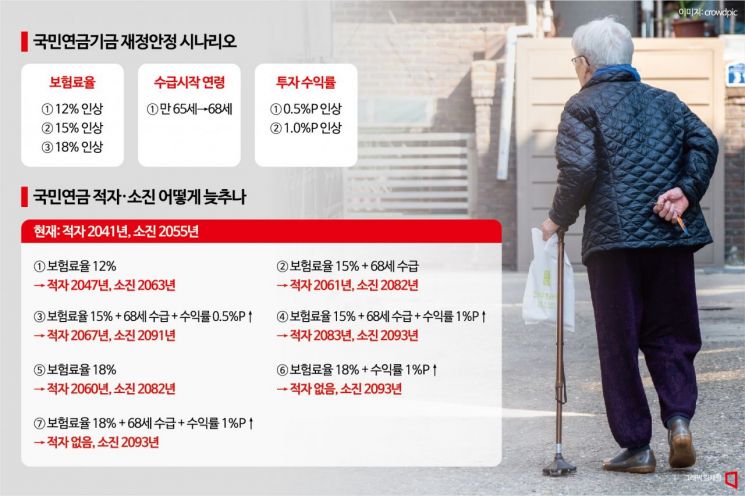
The goal of this actuarial calculation was decided as "to prevent depletion of the reserve fund during the calculation period." Currently, the contribution rate is 9%, the income replacement rate is 40%, and pensions are paid from age 65 starting in 2033. If this system is not revised, the National Pension will start running a deficit in 2041 and be depleted by 2055. The core objective is to ensure that the fund does not run out even 70 years later (in 2093), the projection period for the National Pension, and to clearly guarantee that current subscribers can safely receive benefits until they reach average life expectancy.
The proposals revealed by the Actuarial Committee consist of contribution rates, pension starting age, and fund return rates. Regarding contribution rates, three options were presented: increases to 12%, 15%, and 18%. These would be raised by 0.6 percentage points annually over 5, 10, and 15 years respectively. This could delay the deficit start to 2047, 2053, and 2060, and postpone depletion to 2063, 2071, and 2082.

However, even raising the contribution rate to 18% is still 11 years earlier than the target depletion prevention year of 2093. The solution proposed by the Actuarial Committee is to increase the pension starting age, meaning receiving pensions later. The committee suggested raising the pension age by one year every five years starting in 2033, reaching age 68 by 2048. However, this policy must be implemented alongside employment policies for the elderly.
Increasing the National Pension fund's investment return rate is also important. Raising the investment return rate of the fund can delay the depletion date accordingly. The committee argued that the return rate should be 0.5 to 1 percentage point higher than the forecast by the Financial Projection Committee throughout the entire period.
In summary, the Actuarial Committee's pension system improvement proposals are divided into 18 types. Among these, six policy combinations meet the committee's goal of preventing fund depletion by 2093. The 12% contribution rate increase option could not extend the depletion date beyond 2080 regardless of the combination chosen. For the 15% increase, the pension starting age must be raised to 68 and the return rate increased by 1 percentage point simultaneously. On the other hand, the 18% increase option achieved the goal by selecting any one of the additional measures. Especially when both age increase and return rate improvement are implemented together, the reserve ratio in 2093 is calculated to reach 23.6 times.
18 Pension Reform Options... Controversy Over Excluding Income Replacement Rate Increase
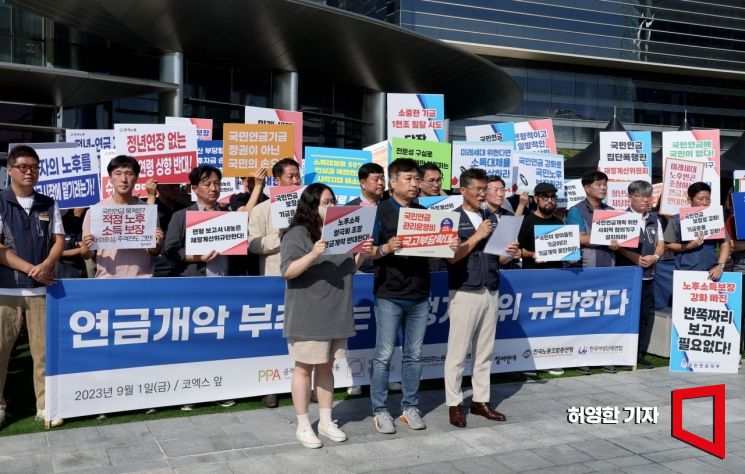 On the 1st, in front of COEX in Seoul where the National Pension Fund Actuarial Review Public Hearing was held, members of organizations such as the Korean Confederation of Trade Unions and People's Solidarity held a press conference condemning the pension reform and the National Pension Fund actuarial review. Photo by Younghan Heo younghan@
The problem lies in the discord caused by the income replacement rate. Professors Nam Chan-seop of Dong-A University’s Department of Social Welfare and Joo Eun-seon of Gyeonggi University’s Department of Social Welfare resigned from the committee a day before the public hearing in protest of the decision to include the income replacement rate proposal as a minority option. Both professors had advocated raising the income replacement rate from the current 40% to 50%. They criticized, "The committee was biased toward fiscal conservatives and during 21 meetings, it was inclined to treat the National Pension as if it were private insurance or a fund system."
The committee responded that the income replacement rate increase proposal was not absent. Kim Yong-ha, chair of the Actuarial Committee, said, "There are many diverse ways to secure retirement income, but it is regrettable that the income replacement rate increase option was missing. Although it was not shown in the report, related discussions and reviews were conducted within the committee." He added, "During the report writing process, disagreements over majority and minority opinions on the income replacement rate increase led to its exclusion."
There is also criticism that there are too many options. In the past, the Actuarial Committee narrowed improvement measures down to two or three. This time, there are 18 scenarios depending on policy combinations. While this has the advantage of disclosing various options and their effects to the public, it also raises criticism that the committee failed to narrow down solutions at a time when pension reform is imminent. Although the committee is not a body that creates pension reform plans, the lack of consensus makes it more difficult for the government to prepare a single plan later.
Legislative Pension Reform Discussions Stalled... Government Faces Complex Calculations
 Minister of Health and Welfare Cho Kyu-hong attending the Special Committee on Pension Reform at the National Assembly last March [Image source=Yonhap News]
Moreover, discussions in the National Assembly’s Special Committee on Pension Reform are also facing difficulties. The private advisory committee of the National Assembly’s Pension Special Committee was launched in November last year and was supposed to release a draft report in January. However, the Pension Special Committee failed to reach consensus on financial stability and retirement income security plans. The reform plan scheduled for April was postponed, and with the activity period ending in late October, there are only about 40 days left to submit the report.
Considering the current situation, the government’s task of deriving a pension reform plan has become more complicated. Lee Seuran, Director of the Pension Policy Bureau at the Ministry of Health and Welfare, said, "We will try to narrow down the options, but it is indeed a challenging situation for the government. Since the plan only mentions raising contribution rates while maintaining the replacement rate, it is questionable whether this will be acceptable to the public. Persuading the public is important for pension reform, so it is a concern." She also mentioned, "I think it is appropriate to mention the income replacement rate as well."
Meanwhile, the government plans to announce the pension reform plan next month, incorporating advisory proposals, public opinion collection, and discussions from the National Assembly’s Pension Special Committee.
© The Asia Business Daily(www.asiae.co.kr). All rights reserved.
![Clutching a Stolen Dior Bag, Saying "I Hate Being Poor but Real"... The Grotesque Con of a "Human Knockoff" [Slate]](https://cwcontent.asiae.co.kr/asiaresize/183/2026021902243444107_1771435474.jpg)


















