Civil and Criminal Litigation Complaints
Low-Risk Ballistics May Threaten Life
Reviewing Regulations on Use of Physical Force
As the government moves to expand the introduction of low-risk pistols to provide frontline police officers with 'one firearm per person,' voices from frontline officers warn that without supporting regulations on the use of force, the initiative will be ineffective. Since low-risk pistols are still classified as firearms under the current police suppression equipment categories, officers must bear the same burdens and responsibilities as with conventional pistols when using them at crime suppression scenes. However, the introduction was announced before related regulations were properly established.
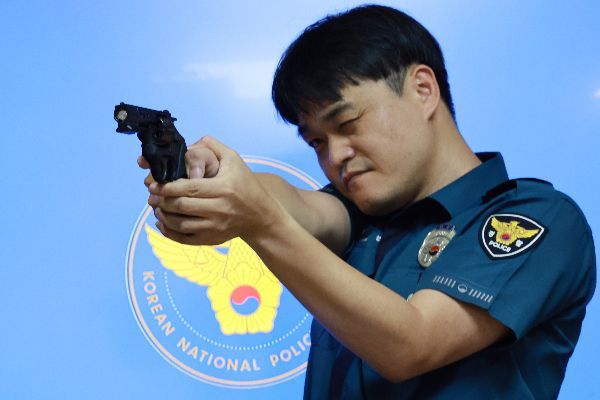
On the 1st, Corporal A, who works at a district police station in Seoul, said, “Honestly, very few officers on the scene have actually used a pistol. It’s practically impossible,” adding, “Low-risk pistols also require institutional improvements first, such as protections against civil and criminal lawsuits when used.” Another Corporal B said, “It’s true that the inability to actively use firearms delays the suppression of criminals,” and added, “Since low-risk pistols have reduced lethality, the burden of use may be lower than with regular pistols, but usage frequency will vary greatly depending on usage regulations and post-use responsibilities.”
Generally, police officers dispatched in pairs to the field currently carry one pistol and one electronic stun gun (Taser). According to the ‘Regulations on the Standards and Methods of Police Use of Physical Force,’ a Taser can be used when a subject assaults or attempts to harm a police officer. In ‘lethal attack’ situations where there is a high possibility of harm to officers or citizens with firearms or knives, police can use batons and shields to strike vital points of the suspect, as well as Tasers and live pistol rounds. However, pistols are to be used only as a last resort when other means are insufficient, and officers are instructed to aim below the thigh whenever possible.
Despite these physical force standards, frontline officers find it difficult to use pistols or Tasers. If any casualties occur, they may face internal investigations as well as civil and criminal lawsuits. In fact, in 2016, a court ruled that a police officer who fatally shot a man wielding a knife late at night after repeated warnings must pay 110 million won in damages. In 2019, a woman threatening officers with weapons in both hands was subdued with a Taser and handcuffed, but she lost consciousness and died five months later; the court ordered the state to pay 320 million won to her family.
Frontline officers worry that similar incidents could occur even if low-risk pistols are distributed. The plastic special bullets used in low-risk pistols have about one-tenth the lethality of live pistol rounds. They are designed to penetrate up to about 6 cm, not reaching the bone, based on the thigh as a target. However, even low-risk rounds can be life-threatening if they hit vital organs. Moreover, only the introduction of low-risk pistols has been announced; no basic regulations on when they can be used have been established yet. Sergeant D said, “If officers can’t even easily use Tasers in the field, I doubt they will be able to properly use low-risk pistols.” Lieutenant E also said, “If the regulations remain unchanged and only firearms are provided, the current situation where weapons are not used won’t change.”
Experts emphasize the need for institutional improvements to encourage active firearm use by police officers. Measures under consideration include strengthening support for lawsuits and lowering the standards for physical force use with low-risk pistols. Professor Lim Joon-tae of Dongguk University’s Department of Police Administration stated, "Although incidents involving weapons attacks are increasing, police officers face high risks in using firearms because suspects sometimes sue them personally. Police agencies at the National Police Agency or provincial levels should establish systems that fully support officers from lawyer appointment to lawsuit defense, including civil and criminal litigation,” he suggested. He added, “If low-risk pistols are set with even lower usage standards than Tasers, more active use will be possible.” Professor Lee Woong-hyuk of Konkuk University’s Department of Police Science also said, “It’s meaningless to just provide equipment without changing the rule that officers bear individual post-use responsibility. A system is needed where the Minister of the Interior and Safety or the Commissioner General of the National Police Agency is designated as responsible, so that institutions bear the responsibility for lawsuits.” A National Police Agency official said, “We are conducting risk assessments of low-risk pistols and gathering opinions from frontline officers,” adding, “We are reviewing related regulatory improvements during the introduction process.”
© The Asia Business Daily(www.asiae.co.kr). All rights reserved.

















