Final Round of Competition on the 31st... First Hosted by Economic Organizations
Participant Proposing Childbirth Support Measures for Those Over 40 Wins Top Prize
"Add 'Fertility' to Health Checkup Items for People in Their 20s for Better Management"
"From the early 20s, both men and women should be supported to manage fertility for safe childbirth. Please add 'fertility' to the health checkup items for people in their 20s to help them assess their fertility potential in advance."
On the 31st, Park Hyo-jin, a researcher at Daegu University's Infertility Research Institute and the winner of the 'MZ Generation (born early 1980s to early 2000s) Low Birthrate Overcoming Policy Paper Competition' held by the Korea International Trade Association (KITA) at COEX in Samseong-dong, Gangnam-gu, Seoul, argued that pregnancy after the 40s should be managed starting from the 20s. KITA is the first economic organization to hold a competition asking the MZ generation about low birthrate policies.
The event was attended by KITA Chairman Koo Ja-yeol, Vice Chairman Jung Man-ki, Director Lee In-sil of the Korean Peninsula Future Population Research Institute, among others. Vice Chairman Jung, Director Lee, 40 MZ generation citizens, and 8 journalists selected the grand prize, excellence award, and encouragement award from 10 papers that passed the preliminary round. Winners received a cash prize and the KITA Chairman's Award.
Researcher Park presented on support measures for childbirth after the 40s through freezing reproductive cells. She stated, "Human reproductive life is fertile until age 35, after which fertility sharply declines," and emphasized, "Both men and women should be supported to manage fertility from their early 20s." She also suggested including fertility in health checkup support and items for people in their 20s and promoting a health monitoring system linked with wearable devices.
Park added, "It is necessary to support healthy men and women in their 20s to early 30s to freeze their reproductive cells so they can complete their personal careers while young and then use the stored reproductive cells for childbirth after their 40s. This system can prevent situations where people give up childbirth due to infertility or aging."
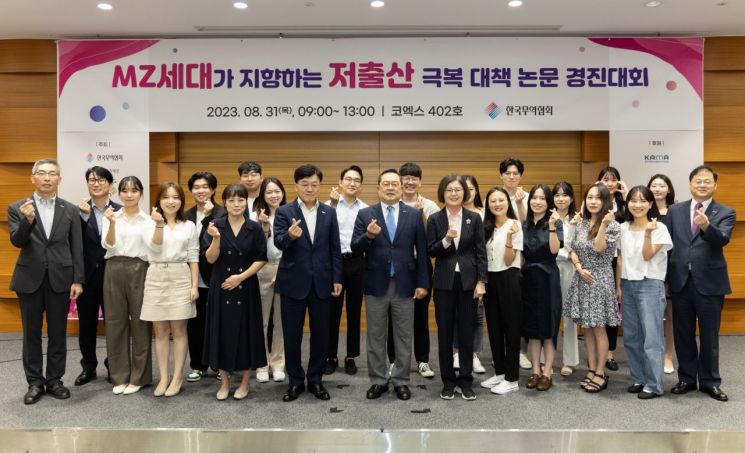 Participants of the low birthrate overcoming policy paper contest, aimed at the MZ generation (born early 1980s to early 2000s), are taking a group commemorative photo.
 From the fifth person on the left in the front row: Jeong Manki, Vice Chairman of the Korea International Trade Association; Koo Ja-yeol, Chairman of the Korea International Trade Association; Lee In-sil, Director of the Korean Peninsula Future Population Research Institute.
[Photo by Korea International Trade Association]
Song Seul-ran, the presenter from Sookmyung Women's University who won the excellence award, said that the low birthrate problem should be addressed mainly by supporting the birth of a second child. Song proposed, "A Korean-style 'Speed Premium' system should be introduced, which provides 150% of parental leave pay if the second child is born within 30 months after the first birth," and added, "It is necessary to mandate telecommuting and reduced working hours for parents with children under 13 years old and implement a male parental leave quota system."
The Starlight Wind team (including presenter Lee Sang-hoon from Soongsil University and two others), who won the encouragement award, suggested establishing a specialized childbirth promotion agency and building an integrated platform to provide childbirth counseling and other information. They also proposed introducing a babysitter system centered on the MZ generation to offer experiences related to marriage, childbirth, and childcare. The team estimated that implementing these measures would cost about 15 trillion won in budget, but "all of it could be recovered through taxes in about 18 years."
Other proposals included separate training for pediatric and adolescent doctors, establishing university courses on dating culture, and government-led support for safe meetings through dating applications.
Chairman Koo said, "Since the low birthrate issue could threaten the nation's existence, both companies and members of society must strive to positively change the future generation's perception of marriage and childbirth," and added, "KITA will also engage in various activities to create a childbirth- and childcare-friendly corporate culture, including policy recommendations related to low birthrate."
Vice Chairman Jung stated, "Given that the number of aborted children is estimated to be in the tens of thousands to hundreds of thousands, the most important thing to increase the birthrate is to create an environment where pregnant women with children can give birth." He emphasized that the state should support hospital and medical expenses during pregnancy if necessary and take responsibility for childcare through establishing infant schools after childbirth. He stressed that childbirth promotion policies should be implemented from the start of pregnancy, not after childbirth.
KITA will hold a 'Childbirth and Childcare-Friendly Model Export Company Contest' targeting its 70,000 member companies starting next month. A KITA official said, "We plan to continue various projects to spread a childcare-friendly culture throughout the trade industry."
© The Asia Business Daily(www.asiae.co.kr). All rights reserved.
![Clutching a Stolen Dior Bag, Saying "I Hate Being Poor but Real"... The Grotesque Con of a "Human Knockoff" [Slate]](https://cwcontent.asiae.co.kr/asiaresize/183/2026021902243444107_1771435474.jpg)
















