[Fuel Efficiency AtoZ]
Increase in Eco-friendly Vehicle Sales and Technological Advances
2.4% Improvement Compared to Previous Year
Increase in Convenience Features Raises Average Vehicle Weight
Fuel Efficiency Improvement Progressing Slowly
Use of Lightweight Materials Reduces Vehicle Weight
Advanced Battery Thermal Management Technology
Comprehensive Collaborative Technological Efforts
Car fuel efficiency must improve. This is not only to achieve the imperative goal of reducing energy consumption for the environment but also because there is growing demand in the market for vehicles with excellent fuel efficiency. As various environmental regulations are being strengthened under the pretext of addressing climate change, failing to meet a certain level of fuel efficiency in the future could result in significant penalties or even market exclusion. This is why major automakers and parts manufacturers are diving into eco-friendly vehicle development or focusing on fuel efficiency technologies.
Increased Vehicle Fuel Efficiency, Yet Still Insufficient
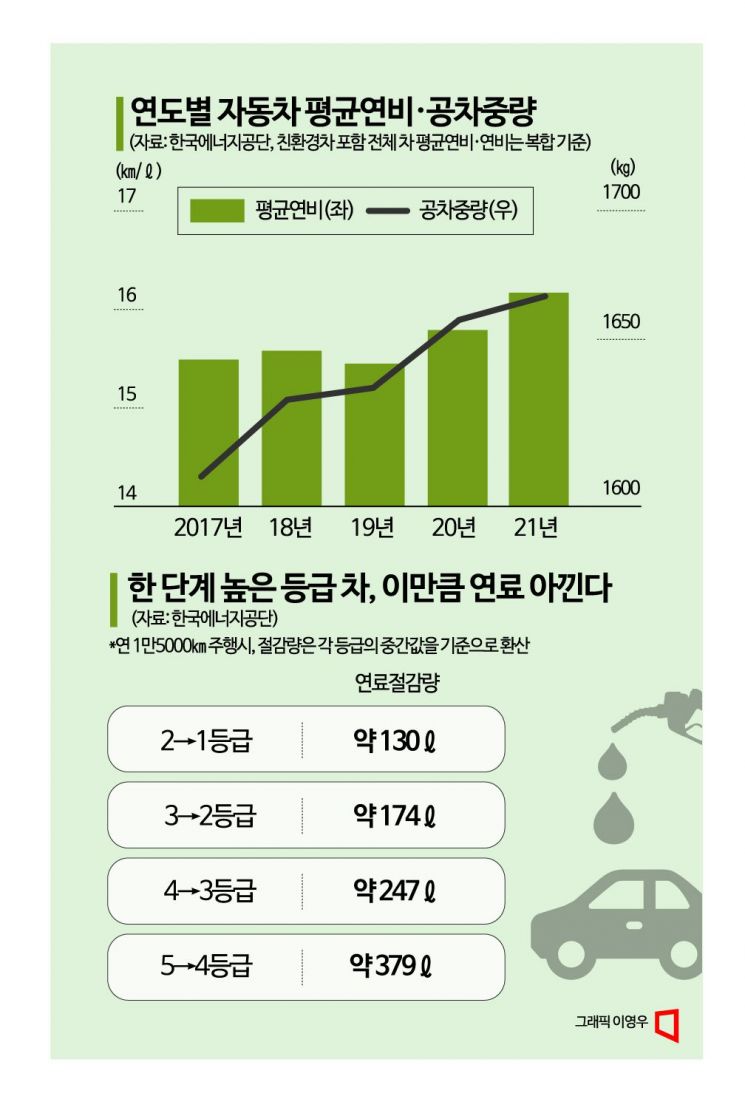
According to the Korea Energy Agency’s analysis of automobile energy consumption efficiency, the average fuel efficiency of all cars sold in South Korea in 2021 was 16.17 km per liter (combined standard). This represents an improvement of about 2.4% compared to the previous year. Since the early 2000s, when average fuel efficiency surveys began, there has been steady progress.
The increase in eco-friendly vehicle sales has also contributed. Although prices are somewhat higher, eco-friendly vehicles have better fuel efficiency and lower maintenance costs, so they are often purchased by those who drive beyond a certain distance. Last year, the number of eco-friendly vehicles sold domestically exceeded 400,000, marking an all-time high. The share of eco-friendly vehicles among all cars was about 27%, also a record high.
However, considering the active research and development for fuel efficiency improvement and the increased distribution of various eco-friendly vehicles, the growth rate is relatively moderate. The agency explained, "This is because the sales volume of larger vehicles has increased, and various convenience and safety devices, as well as after-treatment systems, have been added, resulting in an increase in average vehicle weight."
 At the 2021 Asia Economy Fuel Efficiency King Competition, Hankook Tire officials are servicing the participating vehicles. Photo by Dongju Yoon doso7@
To meet the average fuel efficiency standards set by our government, the level must be raised to 33.1 km per liter by 2030 (for passenger cars and vans with 10 or fewer seats). Considering the 2021 standard (24.3 km/l), this means an increase of more than 36% over ten years. Given the average fuel efficiency growth rate of vehicles sold domestically so far, this is a considerable challenge. Over the past ten years since 2011, the average fuel efficiency of cars sold domestically increased by about 23%. If the response continues at the same pace as before, meeting the standard will be difficult.
Average fuel efficiency is a system to reduce greenhouse gas emissions, where domestic and foreign manufacturers selling vehicles above a certain scale are evaluated comprehensively based on the types, weights, and fuel efficiencies of the vehicles they sell to determine compliance with standards. If a manufacturer exceeds the standard in either greenhouse gas emissions or fuel efficiency, they can carry over the surplus performance; if they fall short, they must pay fines or purchase surplus credits from other manufacturers. Similar environmental regulations are in place in most regions worldwide, including the United States and Europe.

Weight, Design, Thermal Management... Comprehensive Technological Collaboration
Research and development to create cars that can travel farther on less fuel are conducted from multiple angles. Methods such as traveling hundreds of kilometers per liter (internal combustion engines) or thousands of kilometers on a single charge (electric vehicles) have already been realized. Renault, a French automaker subject to strict environmental regulations, showcased a concept car in 2014 that could travel 100 km per liter.
Mercedes-Benz’s electric concept car unveiled last year traveled 1,008 km on a single charge. Although this record was achieved under extreme conditions as a concept car, it demonstrates the extent to which fuel efficiency technologies have been refined and are being applied to actual production vehicles.
Internal combustion engine vehicles inherently have low efficiency in converting fuel into power. Only about 10-30% of the energy from carbon-based fuels such as gasoline or diesel is actually used to move the vehicle. The rest is lost during combustion or transmission or used to operate other vehicle components. To improve fuel efficiency, efforts are made to increase engine efficiency itself, use lightweight materials to reduce vehicle weight, and refine designs to minimize air resistance during driving. Even seemingly minor technologies, such as opening and closing the front grille or eliminating side mirrors, are results of research aimed at improving fuel efficiency.
With the increase in electric vehicle adoption, thermal management technology has become important. Batteries play a critical role not only in driving performance but also in driving range. Batteries are sensitive to temperature, with efficiency dropping in cold conditions and fire risks increasing at high temperatures. While internal combustion vehicles have separate systems for cabin heating and engine cooling, electric vehicles integrate heating, cooling, motor, and battery thermal management systems. Systems are being advanced to avoid wasting excess heat and to use it efficiently where needed. Hydrogen fuel cell vehicles require even more cooling systems?4 to 5 times more than internal combustion engines?due to the large amount of heat generated by the stack.
© The Asia Business Daily(www.asiae.co.kr). All rights reserved.
![Clutching a Stolen Dior Bag, Saying "I Hate Being Poor but Real"... The Grotesque Con of a "Human Knockoff" [Slate]](https://cwcontent.asiae.co.kr/asiaresize/183/2026021902243444107_1771435474.jpg)


















