Concerns Over Biguiyuan Default Spread
Major Banks Strengthen Non-Performing Loan Management with Sufficient Capacity
Small and Medium-Sized Banks Expected to Face Relatively Greater Impact
As the default risk of Country Garden (Biguiyuan), China's largest private real estate developer, increases, the market is paying close attention to how far the repercussions will spread. Large banks, which have consistently managed their non-performing assets, have sufficient capacity to withstand the impact, but the consensus is that smaller banks may suffer damage to their asset quality.
According to major foreign media including Bloomberg on the 30th (local time), Country Garden's loss in the first half of this year reached a record high of 48.9 billion yuan (approximately 8.87 trillion won). During the same period, revenue increased by 39% year-on-year to 226 billion yuan. Country Garden stated, "The group's liquidity is under unprecedented pressure due to difficulties in sales and financing," adding, "If performance continues to deteriorate, we may fail to meet debt repayment obligations, which could result in default."
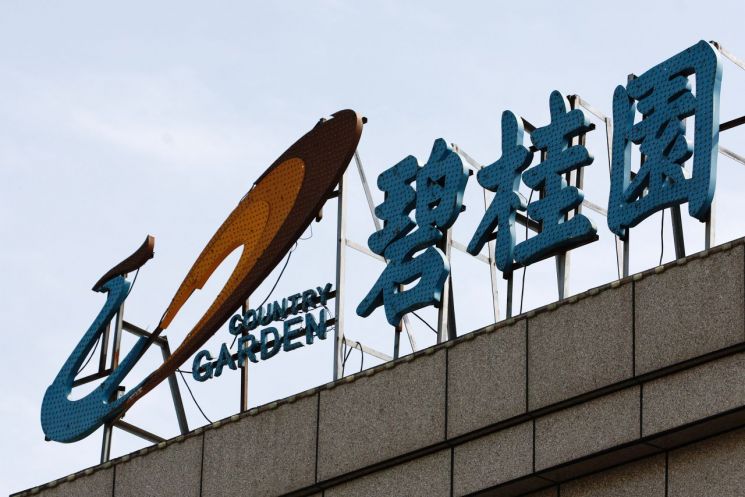
The company plans to request creditors to extend the grace period by 40 days for bonds worth 3.9 billion yuan maturing on the 2nd of next month. The total principal and interest of bonds that must be prevented from defaulting amount to 15.72 billion yuan, with maturities coming one after another from early next month starting with the 3.9 billion yuan bond. The grace period (30 days) for the unpaid interest on dollar bonds due on the 7th is also nearing its deadline.
As the likelihood of Country Garden's default increases, the market is concerned about further deterioration among private developers and the worsening asset quality in China's banking sector. Goldman Sachs forecasts that about 1.9 trillion yuan, or approximately 10% of real estate financing held by financial institutions, could become non-performing due to the deepening real estate crisis in China. Goldman Sachs believes that large banks have sufficient capital buffers and resilience, but small and medium-sized banks are expected to be hit. UBS estimates that the non-performing loan (NPL) ratio of medium-sized joint-stock commercial banks increased by 1.1 percentage points compared to the end of last year, nearly three times higher than the 0.4 percentage point increase in large state-owned commercial banks.
However, the prevailing view is that the recent situation is unlikely to escalate into a systemic crisis. In particular, the exposure of the four major local banks?Bank of China, Industrial and Commercial Bank of China, China Construction Bank, Agricultural Bank of China?and China Merchants Bank to Country Garden risk was between 30 billion and 48 billion yuan as of 2021, accounting for only 0.09% to 0.37% of their total assets. The proportion of total loans is also limited to 0.16% to 0.71%. China Merchants Bank, which counts Country Garden as its largest corporate client, has a somewhat higher exposure and loan ratio compared to other banks, but still does not exceed 1%. Additionally, local banks have expanded their provisions to about 15% of NPLs over the past few years in preparation for real estate sector defaults.
The Zhongrong Trust incident, where payments on trust products were suspended due to liquidity issues, has worsened as its major shareholder, Jingwei Textile Machinery, is pursuing voluntary delisting. However, the assets under management of trust funds in China stood at about 21.2 trillion yuan as of the first quarter, accounting for only 5.7% of the total assets in the banking system. Furthermore, most trust products are closed-end and redeemable only at maturity, which the market views as preventing a panic-driven sell-off that could induce fear.
© The Asia Business Daily(www.asiae.co.kr). All rights reserved.

















