Seminar Hosted by Housing Industry Research Institute on the 31st
The owners of 100,000 nationwide residential lodging facilities (Saengsuk) are under urgent pressure. This is because the grace period for changing the use of Saengsuk from officetels will end in about a month. The government plans to impose an annual fine of 10% of the publicly announced property price starting from the end of October on all Saengsuk that have not registered as lodging businesses and have not changed their use to officetels.
Experts oppose the retroactive application, saying, "It is excessive to apply the revised Enforcement Decree of the Building Act, amended in May 2021, to Saengsuk completed or permitted before that date."
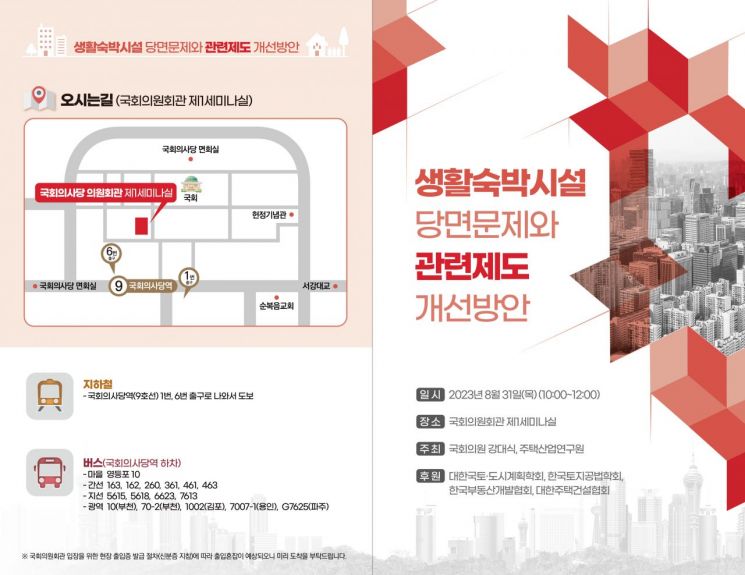
On the morning of the 31st, the Korea Research Institute for Human Settlements held a seminar titled 'Current Issues of Residential Lodging Facilities and Related Institutional Improvement Measures' at the National Assembly Members' Office Building in Yeouido, Seoul. Seo Jong-dae, the head of the institute, stated, "The regulation on Saengsuk was hastily pushed forward from the perspective of curbing speculation without fully considering legal issues and social ripple effects," adding, "It is necessary to thoroughly identify unreasonable parts of the system to prevent infringement on users' housing rights and property rights and promptly amend related laws."
The main topic of the seminar was the Enforcement Decree of the Building Act related to Saengsuk, revised in May 2021. At that time, the Moon Jae-in administration mandated the registration of Saengsuk as lodging businesses to curb real estate speculation spreading from apartments and officetels to Saengsuk. Until then, Saengsuk had few special regulations under the Building Act and were often used as residences rather than lodging facilities.
The problem is that the government decided to apply the amendment retroactively to Saengsuk that had already been sold or completed. Currently, about 80,000 Saengsuk units have been completed, and 20,000 are under construction. If they do not register as lodging businesses, they must pay an annual enforcement fine of 10% of the building's publicly announced price starting from the end of October.
After these issues were raised following the amendment of the Enforcement Decree, the Ministry of Land, Infrastructure and Transport announced a plan to change Saengsuk to officetels. However, so far, only 1,173 units, or 1.1% of the total, have been converted to officetels. A representative from the Korea Research Institute for Human Settlements explained, "It is practically impossible to change in cases where the complex is large, there is opposition from nearby residents, or it is difficult to expand infrastructure such as parking lots."
Experts have argued that the scope of application of the revised Building Act should be reduced to reflect reality. Professor Seok Ho-young of Myongji University’s Department of Legal and Administrative Studies and a member of the Korean Land Law Association said, "It is difficult to consider the retroactive application of Saengsuk regulations as so-called ‘improper retroactivity,’ so retroactive application should be excluded to uphold the constitutional principles of prohibition of disadvantageous changes and protection of trust," and suggested, "Regulatory application should be limited to cases where building permits were obtained after the enforcement date."
Professor Kim Ji-yeop of Sungkyunkwan University’s Department of Architecture and a member of the Korean Urban Planning Association stated, "There is a growing need to utilize Saengsuk as one of the hybrid ‘stay-type residential facilities’ that combine residential and lodging functions," and argued, "To revitalize this, Saengsuk should be recognized as quasi-housing under the Housing Act."
© The Asia Business Daily(www.asiae.co.kr). All rights reserved.

















