Manufacturing Purchasing Managers' Index at 49.2, Down Over 40% from Peak
Indicating Economic Contraction Phase
As the real estate-driven Chinese economic crisis spreads fears of deflation, aluminum prices have fallen more than 40% from their peak. This is a direct result of the global demand being hit hard by the economic downturn in China, the world's largest raw material consumer. Market forecasts on the direction of aluminum prices are divided.
On the 30th (local time), the London Metal Exchange (LME) aluminum futures (3-month contract) price stood at $2,170 per ton, down 43% from the peak of $3,840 in March last year. It has also dropped to about one-fifth of the high point reached in January this year. This month, a 'super contango' phenomenon occurred, marking the largest gap between spot and futures prices since the 2008 global financial crisis. While futures prices are generally higher than spot prices, when market demand sharply declines and inventories accumulate, spot prices plunge, causing a significant gap with futures prices; this is known as super contango.
The global demand slowdown has pushed aluminum prices down and widened the gap with futures prices. In particular, the real estate debt crisis in China has directly impacted demand from construction and manufacturing sectors. Foreign media analyzed that "China, the world's largest raw material consumer, is losing momentum in its recovery after reopening, and Europe's industrial activity has sharply slowed due to high-intensity tightening, leading to weak consumption, while aluminum inventories stored at the LME have not decreased."
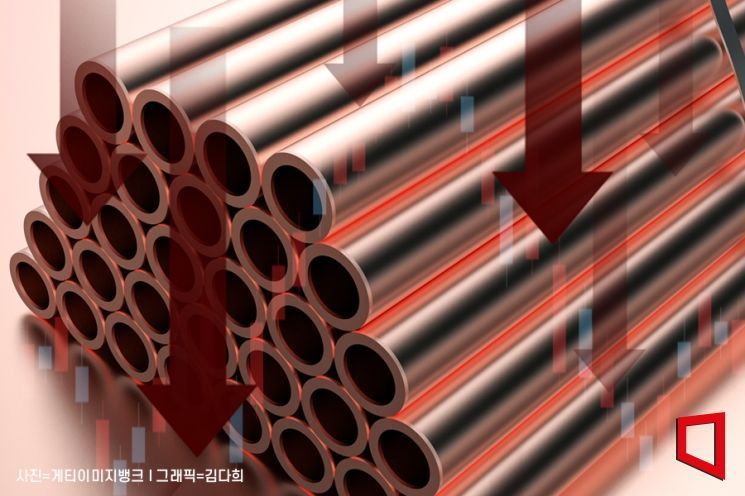
Aluminum price forecasts are mixed. China's largest aluminum-consuming industries, construction and manufacturing, are losing vitality. Starting with Evergrande, China's second-largest real estate developer two years ago, the industry leader Biguiyuan is now facing a default crisis. Subsequently, major real estate companies such as Wanda and Yuanyang are also facing domino default risks, showing signs of a bubble collapse. China's monthly Manufacturing Purchasing Managers' Index (PMI) fell to 49.2 in July, returning to pre-reopening levels. The PMI, based on surveys of purchasing managers, indicates economic trends in related sectors; a reading above 50 signals expansion, while below 50 indicates contraction.
Consulting firm CRU forecasted, "Aluminum demand outlook for this year and next has been lowered, and prices will decline further." Ross Strachan, CRU's aluminum analyst, pointed out, "There is a global oversupply of more than 800,000 tons, which burdens aluminum price rebounds," adding, "The global demand recovery is also delayed and falling short of expectations." Paul Kildemo, CFO of Norsk Hydro, the world's fourth-largest aluminum producer, predicted, "The timing of demand recovery is delayed compared to previous expectations and may only occur as early as the first quarter of next year."
On the other hand, some believe the bleak period has already passed. BMO Capital Markets projected that aluminum demand will strengthen in the medium term, based on the rapidly increasing demand for clean technologies such as electric vehicles and solar panels. Colin Hamilton, an analyst at BMO Capital Markets, said, "The aluminum price cycle is nearing its bottom," and predicted, "The bottom will be passed within this year."
© The Asia Business Daily(www.asiae.co.kr). All rights reserved.
!["The Woman Who Threw Herself into the Water Clutching a Stolen Dior Bag"...A Grotesque Success Story That Shakes the Korean Psyche [Slate]](https://cwcontent.asiae.co.kr/asiaresize/183/2026021902243444107_1771435474.jpg)
















