Patricia Florissi, Google Cloud Technical Director
Keynote Speech at the 'Global Digital Healthcare Symposium' via Video Conference
"Artificial Intelligence (AI) has begun to understand the meaning of new objects and generate new things based on this understanding. Once federated learning enables information sharing among medical institutions worldwide, we can achieve another significant change and advancement."
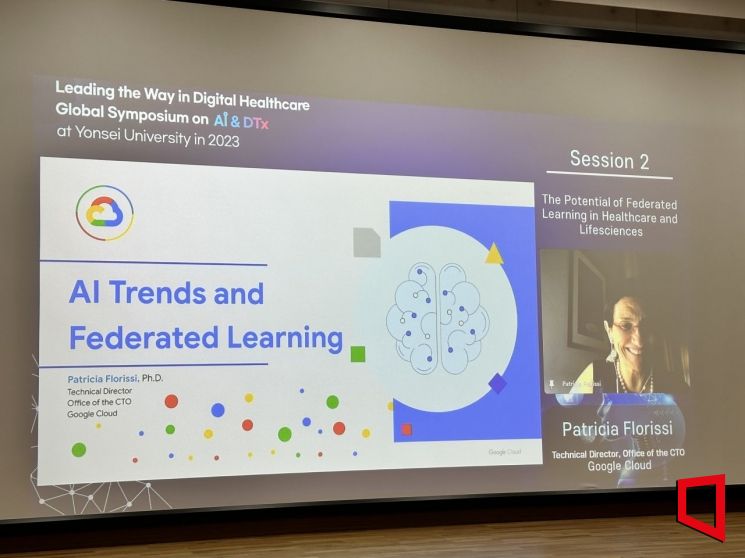 Patricia Florissi, Google Cloud Technical Director, is giving a virtual lecture at the '2023 Global Digital Healthcare Symposium' held on the 30th at Yonsei University in Seodaemun-gu, Seoul, co-hosted by Kakao Healthcare and Yonsei Medical Center.
 [Photo by Lee Chunhee]
Patricia Florissi, Google Cloud Technical Director, recently emphasized that a major AI revolution is underway, and if these changes spread to healthcare, it will bring about another large-scale innovation.
On the 30th, Florissi participated via video lecture in the '2023 Global Digital Healthcare Symposium' held at Yonsei University in Seodaemun-gu, Seoul, co-hosted by Kakao Healthcare and Yonsei Medical Center. She stressed, "Recently, AI intelligence has become highly advanced and evolved to understand language, which is a significant breakthrough." She explained, "Previously, AI could be shown a photo and asked whether it was a cat or a dog, but it could not answer what a cat or dog actually means. Now, AI has the feature of understanding the meaning of new objects and generating new things, such as requesting the creation of a new cat shape."
As a starting point of this change, Florissi pointed to a paper published by Google in 2013. The paper titled 'Efficient Estimation of Work Representation in Vector Space' aimed to explain the similarity of words. For example, banana and bandana are adjacent in the dictionary but have no semantic similarity. Rather, banana is similar to words like taste, edible, and calories. Humans naturally think of the latter, but computers are more likely to find similarity with bandana. However, if concepts like taste are quantified and assigned to banana, apple, and pineapple, and bandana is quantified with concepts related to accessories like bracelets and watches, the computer can continuously generate such tables and group similar words together.
This process, called 'embedding,' which converts natural language used by humans into mathematical vectors that machines can understand, enables AI to grasp the meaning of data and form data with different meanings. This has led to functions such as distinguishing different pronouns for translation and predicting the next word automatically when composing sentences. Through this, the current concept of generative AI has emerged, and large language model (LLM) services like 'ChatGPT' have appeared.

Florissi emphasized that such AI can be used extensively in healthcare research and development (R&D). She said, "This concept can be applied to genomics as well," adding, "Just as AI predicts the next word in a sentence, it can predict the next code in genomic sequences." She also explained that AI was used in the development of vaccines and treatments during the COVID-19 pandemic.
Florissi cited transparency, fairness, and security as key challenges for AI innovation, highlighting security as especially important. She emphasized that data should not be taken outside medical institutions for security reasons. She stated, "Because extensive data is scattered in many places, centralization is necessary," but also stressed, "It is important that data remains within a region."
Related to this, the concept of 'Federated Learning' has been advocated. Unlike traditional machine learning, which learns directly on a central server, learning takes place directly at each hospital. Florissi explained, "Learning is done regionally, and only the learned data is sent to the platform," adding, "Data never leaves the local hospital; only the trained data is transmitted to the platform."
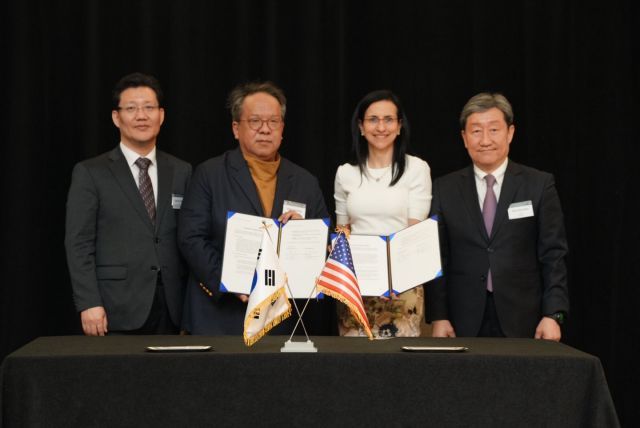 Last April in Boston, USA, Kakao Healthcare and Google Cloud signed a Memorandum of Understanding (MOU) and a Term Sheet for global business collaboration. Im In-taek, Director of Health and Medical Policy at the Ministry of Health and Welfare, Hwang Hee, CEO of Kakao Healthcare, Patricia Florissi, Technical Director of Google Cloud, and Cha Soon-do, President of the Korea Health Industry Development Institute (from left), posed for a commemorative photo.
 [Photo by Kakao Healthcare]
Recently, Google Cloud announced a collaboration with Kakao Healthcare. Florissi explained the significance, saying, "While thinking more about the concepts and meanings of language, it is essential to share information globally among medical institutions," and added, "Through cooperation with Kakao Healthcare, accessibility to the healthcare system can be improved, and we will soon witness an innovative direction."
© The Asia Business Daily(www.asiae.co.kr). All rights reserved.



















