Effects of US and EU Support Policies
There is a forecast that the global semiconductor supply chain will be fundamentally restructured between 2025 and 2030. This is because the effects of semiconductor support policies by the United States and the European Union (EU) are expected to emerge during that period, enabling the restructuring process.
The Korea International Trade Association's Institute for International Trade and Commerce released a report titled 'U.S. and EU Semiconductor Industry Development Strategies and Implications' on the 31st, containing these details.
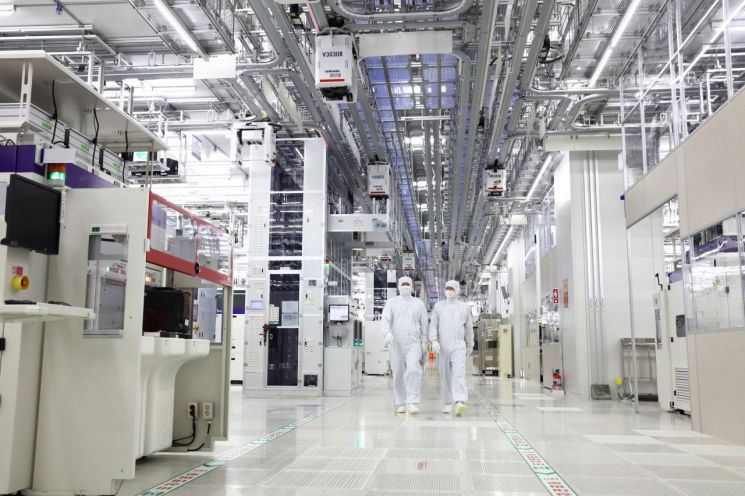
Recently, the U.S. and the EU have been strengthening their domestic semiconductor supply chains by positioning semiconductors as a core element of national security. They are providing massive subsidies to grow their domestic semiconductor industries and enhancing cooperation with third countries. This is because if semiconductor supply chain functions halt or if the supply chain becomes centered around China, which aims to grow its semiconductor industry, major countries could suffer significant damage.
While the U.S. is focusing on tightening sanctions against China, the EU is concentrating on strengthening monitoring and crisis response capabilities. For domestic companies seeking to enter the U.S. market, U.S. semiconductor subsidies could present an opportunity. However, stringent application requirements and pressure to participate in decoupling from China pose risks. The EU's support measures have the drawback of low demand for advanced semiconductor fabs (factories) locally and a weak semiconductor ecosystem foundation. However, demand is expected to increase in the future.
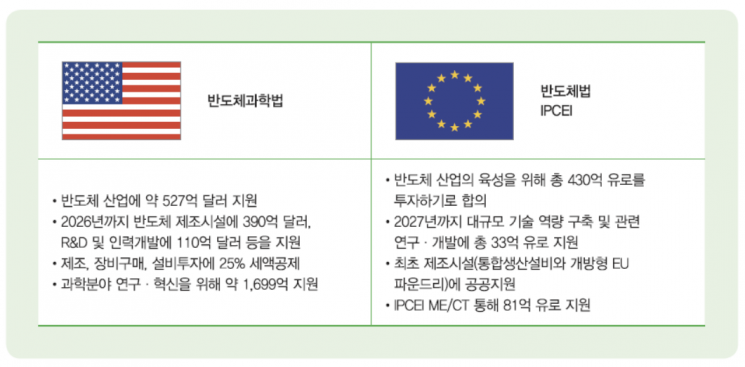 Comparison Table of Semiconductor Support Programs between the United States and the European Union (EU) / [Image Source=Korea International Trade Association International Trade and Commerce Research Institute, excerpted from the report "Strategies and Implications for Semiconductor Industry Development in the US and EU"]
Lee Jeong-ah, a senior researcher at the Korea International Trade Association, stated, "The global semiconductor supply chain will be newly restructured around 2025 to 2030, when the effects of the U.S. and EU semiconductor support policies become apparent," adding, "To secure a leading position in the global semiconductor supply chain, it is essential to strengthen support for related businesses and secure key talent."
She also emphasized, "In a situation where major countries are undertaking large-scale semiconductor facility expansions, securing key talent for companies and ensuring a stable workforce supply are important challenges," and "the government and the semiconductor industry must not spare investments in workforce development."
© The Asia Business Daily(www.asiae.co.kr). All rights reserved.


















