Aiming for Safe Incident Resolution through Dialogue and Communication, Not Force
Deployed for Hostage Situations, Self-Harm Incidents, etc.
Total of 1,618 Crisis Negotiators Nationwide
On the afternoon of the 26th at around 7:30 PM in a residential area of Eunpyeong-gu, Seoul, a man identified as A (37) armed with a weapon confronted the police. He threatened officers by brandishing the weapon and warned them not to approach, even pointing the weapon at himself in a state of agitation. The police chose 'crisis negotiation' over a forceful arrest. Since it was a self-harm disturbance incident without intent to harm others, the decision prioritized safety. Yoon Gi-seok, head of the Criminal Division at the Seoul Eunpyeong Police Station, took on the role of negotiator. Wearing clothing labeled "Crisis Negotiation," he approached A and began calming him through conversation. Yoon said, "It was a tense situation where you could see the weapon piercing into the perpetrator's flesh," adding, "I calmed him down by listening and persuaded him to put down the weapon to make it easier to subdue him." Yoon reassured A and guided his gaze, and around 10 PM, the police special forces on site subdued A, ending the situation without any casualties. Yoon stated, "We prioritize citizen safety and choose the safest method between forceful suppression and negotiation depending on the situation."
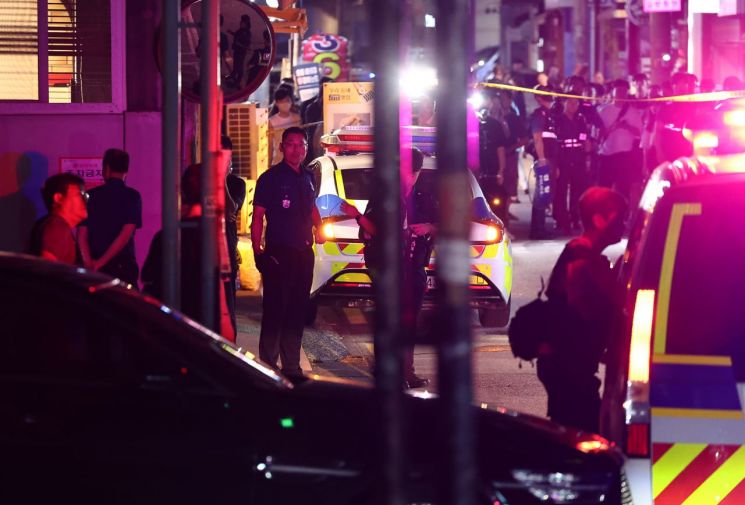 A residential area in Galhyeon-dong, Eunpyeong-gu, Seoul, the scene of an incident on the evening of the 26th where a man holding weapons in both hands was subdued after a standoff with the police, is being cordoned off.
 [Image source=Yonhap News]
The police crisis negotiation team is mainly deployed to scenes where there is concern for potential casualties, such as hostage situations, domestic violence, suicide attempts, and self-harm disturbances, resolving incidents through dialogue and communication.
The police crisis negotiation system was officially introduced in 2014. As of March this year, 1,618 crisis negotiators are active nationwide. Each metropolitan police agency and police station has one ad hoc team. Normally, these negotiators perform regular duties but form a team and deploy when a crisis negotiation is needed. A typical team consists of five members: one team leader, one chief negotiator, one assistant negotiator, one intelligence officer, and one support officer. The team leader oversees the situation, while the chief and assistant negotiators take turns negotiating. The intelligence officer gathers information necessary for persuasion, such as the subject’s hometown, family relations, and occupation. The support officer assists by providing items requested by the suspect, like water or cigarettes, under the negotiators’ instructions. Becoming a crisis negotiator does not require a separate certification but is designated through internal training. The Police Investigation Academy conducts four basic and two advanced crisis negotiation courses annually. The training covers negotiation theories and includes practical exercises with professional actors simulating real situations.
Since crisis negotiation approaches through dialogue rather than force, it has the advantage of minimizing casualties if successful. For example, in September 2021, a day laborer in his 50s confronted police on the rooftop of a building in Dobong-gu, Seoul, threatening to jump. His wife and daughter were also watching the situation. After negotiations by the crisis management team that lasted from dawn until morning, the man came down from the rooftop railing. Officer B, who participated in the negotiation, said, "The man attempting to jump said he was tired and struggling with life on the rooftop railing," adding, "After long hours of persuasion, I felt the worth of crisis negotiation when he returned safely to his family."
Not all crisis negotiations succeed. During a hostage situation in Hanam-si, Gyeonggi Province in 2014, police attempted negotiation, but the suspect demanded police withdrawal and persuasion failed, leading to forced suppression. Similarly, in a 2015 hostage incident in Ansan-si, Gyeonggi Province, police deployed both the special forces and crisis negotiation team and negotiated for five hours, but when dialogue broke down, they resorted to forced suppression. Professor Choi Sun-hwa of the Police Investigation Academy said, "Since the crisis negotiation system was introduced in 2014, it is not perfect yet," adding, "We are working to enhance expertise and increase success rates."
Experts foresee the importance of crisis negotiation growing further. Professor Lee Yun-ho, Chair of the Police Science Department at Korea Cyber University, said, "Depending on the situation, peacefully resolving without using force is one of the best methods," and "The need for crisis negotiation will increase." Professor Lee Woong-hyuk of Konkuk University’s Police Science Department also stated, "With the rise in people dissatisfied with society, the need for crisis negotiation will continue to grow," adding, "In response, education and training for crisis negotiation teams should be strengthened and personnel expanded."
© The Asia Business Daily(www.asiae.co.kr). All rights reserved.

















