RDA Develops 'Radio Wave Short-Term Aging Technology for Beef'
The Rural Development Administration announced on the 30th that it has developed a 'radio wave beef short-term aging technology' that can achieve effects similar to dry aging for more than three weeks in just 48 hours.
Last year, the annual per capita consumption of livestock products in South Korea was 58.4 kg and has been steadily increasing, with growing consumer interest in aged meat. In response, the Rural Development Administration developed the radio wave beef short-term aging technology to establish a foundation for the industrialization and popularization of dry-aged beef.
Traditional dry aging tenderizes the meat and enhances its flavor, but in the livestock industry, there is a need to improve aging efficiency due to inventory burdens during the long aging period of over three weeks and the issue that only 60-70% of the meat is edible compared to fresh meat after aging.
Beef aging occurs as various enzymes in the meat break down proteins into amino acids. Based on previous research showing that aging beef above 15 degrees Celsius accelerates enzyme reactions despite concerns about microbial contamination, the radio wave beef short-term aging technology was developed.
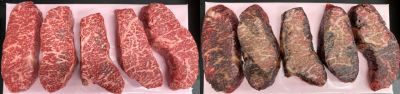 Beef before aging (left) and beef treated with the 'Radio Wave-Based Short-Term Aging Technology' developed by the Rural Development Administration.
This technology heats the beef with radio waves while simultaneously blowing subzero cold air to prevent microbial growth on the meat surface. Unlike microwaves, which have short wavelengths absorbed by the meat surface, radio waves with longer wavelengths heat the interior of the meat while cooling the surface.
Lee Seung-don, Director of the National Institute of Agricultural Sciences at the Rural Development Administration, explained, "As a result of applying this technology, the meat texture became 25% more tender in just 48 hours, and the flavor-enhancing factors increased by 1.5 times compared to the weight before drying. This effect is greater than that achieved by applying the traditional dry aging method for three weeks."
According to the Rural Development Administration, when meat is aged using the traditional dry aging method, the yield is about 60-70% due to weight loss from drying and the removal of spoiled parts and hardened surfaces. However, with this technology, only weight loss from drying occurs, resulting in a higher yield of about 85%. Additionally, applying specific lactic acid bacteria or yeast to the meat surface during the process can create various flavored aged beef tailored to individual preferences, such as fermented or bakery aromas.
The Rural Development Administration has developed an aging device in the form of a display case (showcase) and is continuously improving it to increase processing capacity and reduce device costs. Currently, the device can age about 20 kg of meat per batch. The technology has also been transferred to three industrial companies, which are leading commercialization efforts.
Director Lee stated, "We expect to supply aged low-fat cuts such as front leg, round, and sirloin?produced three times more than traditional grilling cuts like tenderloin and sirloin and priced lower?to consumers as grilling meat. This will also significantly help increase farmers' income by adding value to low-fat cuts."
© The Asia Business Daily(www.asiae.co.kr). All rights reserved.
![Clutching a Stolen Dior Bag, Saying "I Hate Being Poor but Real"... The Grotesque Con of a "Human Knockoff" [Slate]](https://cwcontent.asiae.co.kr/asiaresize/183/2026021902243444107_1771435474.jpg)
















