Hana Financial Management Research Institute Analysis Report on the Jalpase Generation
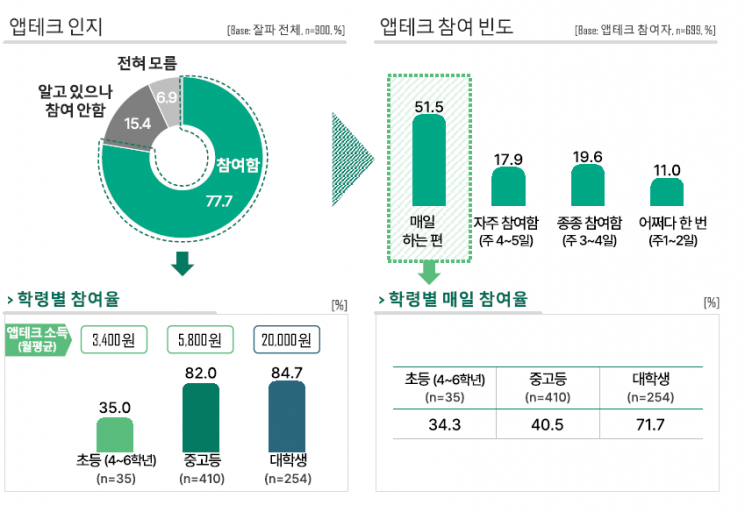
77.7% Use App Tech... More Than Half Use It Daily
Monthly Allowance Increased by About 6% Through Additional Income
Stock Investment Is the Top Financial Interest Starting from Middle School Students
Preference for Internet Banks Decreases with Age
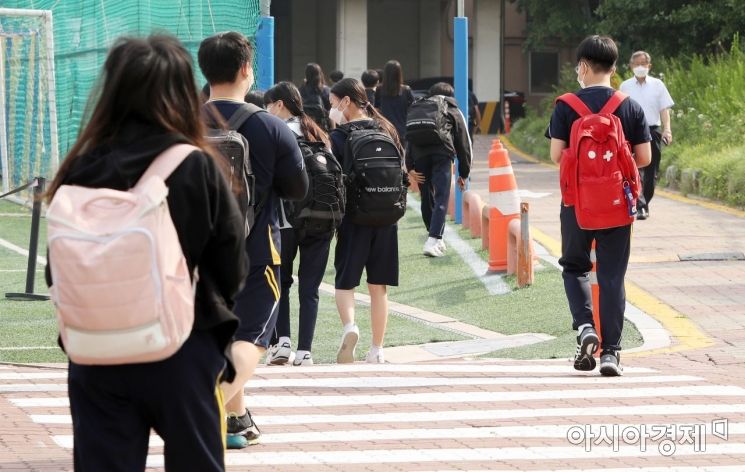 As the school density standard was raised from one-third to two-thirds, the attendance of middle school students in the metropolitan area has expanded, and vocational high school students can now attend school every day. On the 14th, students are attending school at Jangpyeong Middle School in Dongdaemun-gu, Seoul. 2021.06.14 Photo by Joint Press Corps
It has been found that the Z+Alpha generation, known as the Jalpa generation, in their teens and twenties earn pocket money daily through app-tech (application + finance) and show interest in stock investment from middle school. Since their behavior varies by elementary, middle/high school, and university students who actively use mobile banking and fintech apps, it is analyzed that banks need to approach and target them more delicately.
On the 30th, Hana Financial Management Research Institute published the "Jalpa Generation Financial Awareness and Transaction Status Report" containing these findings. The institute surveyed 1,200 people including upper-grade elementary school students, middle/high school students, university students, and parents of upper-grade elementary students in Seoul, Gyeonggi Province, and six major metropolitan cities. The results showed that 77.7% of the Jalpa generation engaged in app-tech. Among them, 51.5% used app-tech daily, exceeding half. By age, university students had the highest rate at 71.7%, followed by middle/high school students at 40.5%, and elementary students (grades 4-6) at 34.3%. They earned about 6% more of their average monthly allowance through app-tech.
All Jalpa generation members saved money with goals such as hobbies and cultural activities, purchasing electronic devices, and travel expenses. They mainly used check cards for consumption. The Alpha generation, born after the smartphone era began in 2010, primarily used children’s wealth cards issued by commercial banks such as Hana Bank’s Ibuja Card and KB Kookmin Bank’s Soyoung Check Card. Meanwhile, middle/high school students overwhelmingly favored Kakao Bank’s Niniseu Card (60.9%, multiple responses allowed) and Toss’s Youth Card (34.6%). University students also frequently used internet-only banks. KB Kookmin Card had the highest usage rate at 48.0%, but Kakao Bank Card and Toss Bank Card ranked high as well at 39.3% and 37.3%, respectively.
The Jalpa generation showed a significant increase in financial interest starting from middle school. The proportion of those using mobile banking and fintech apps for financial transactions was only 19.0% and 20.0%, respectively, among elementary students (grades 4-6), but surged to 74.0% and 60.5% from middle school onward. When asked about financial products of interest in the future, elementary students answered card issuance (26.0%) and small savings products (21.0%), whereas middle/high school students showed the greatest interest in stock investment (25.6%). University students also most frequently answered stock investment at 22.7%, followed by installment savings (18.3%) and deposit/withdrawal accounts (15.0%).
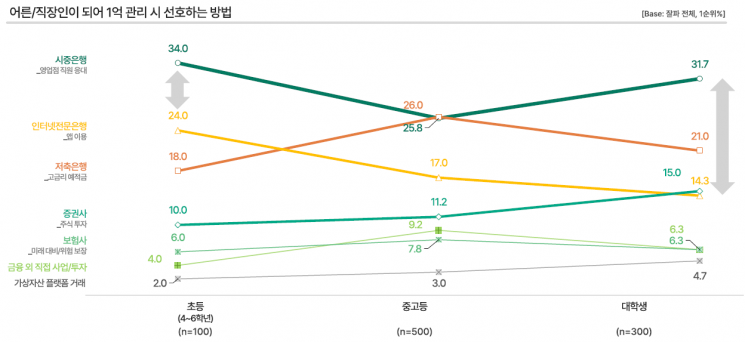
There were notable generational differences when asked about preferred banks for future transactions. When managing 100 million KRW as adults and workers, elementary students most frequently chose commercial banks at 34.0%, citing the need for in-branch staff assistance. Only 24.0% chose internet-only banks. Middle/high school students preferred savings banks (26.0%) and commercial banks (25.8%), with only 17.0% selecting internet-only banks. University students ranked commercial banks (31.7%) and savings banks (21.0%) highest, with internet-only banks dropping further to 14.23%.
The percentage of those who had experience changing their main bank was higher among university students at 40.8% compared to 27.5% for middle/high school students. This is interpreted as a result of increased decision-making by themselves rather than their parents and more regular saving habits. Seonkyung Hwang, senior researcher at Hana Financial Management Research Institute, stated, "Although generational interest is shifting from the MZ (Millennial + Z) generation to the Jalpa generation, interpreting Alpha and Z as a single homogeneous group may reduce precision due to rapidly changing environments. From the perspective of future banks’ core customers, it is necessary to approach the Jalpa generation starting from Alpha and manage changes over time to build continuous relationships."
© The Asia Business Daily(www.asiae.co.kr). All rights reserved.



















