SNS Spread of 'Japanese Boycott Movement'
Growing Concerns Over Sharp Cooling of China-Japan Relations
There is growing backlash within China over Japan's commencement of releasing contaminated water from the Fukushima Daiichi Nuclear Power Plant into the ocean. Chinese citizens have expressed their protests by throwing stones and eggs at Japanese schools, while the "No Japan" (boycott of Japanese products) movement appears to be spreading online.
According to earlier reports from Japanese media, on the first day of the release, the 24th, an incident occurred where a Chinese person threw stones at a Japanese school in Qingdao, Shandong Province, China. On the 25th, several eggs were thrown at a Japanese school in Suzhou, Jiangsu Province. In Shanghai, Japanese schools received phone calls protesting the contaminated water release.
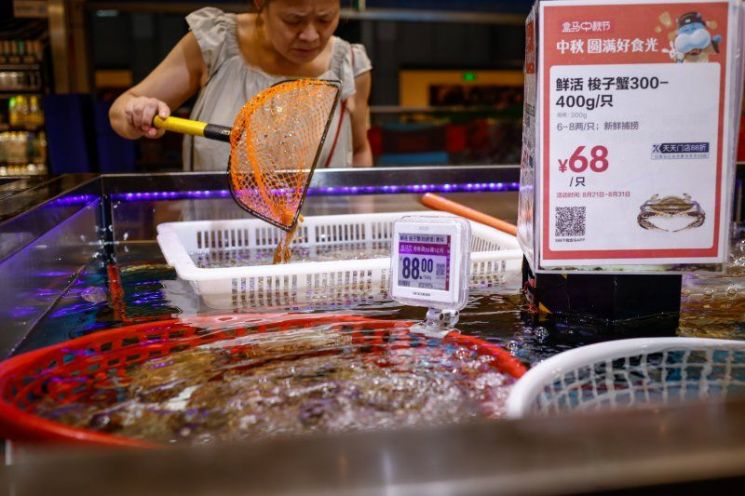 On the 24th, a citizen is examining crabs at a seafood market in Beijing, China. Photo by EPA·Yonhap News
The "No Japan" movement is also growing on Chinese social networking services (SNS). Videos showing people randomly calling the Japanese parliament or embassies to protest the contaminated water release are spreading in the form of a "challenge," and lists of Japanese cosmetic companies are being shared with calls to boycott Japanese cosmetics.
Japanese ministers have expressed regret over the spread of anti-Japanese sentiment. According to Kyodo News, on the 29th, Economy, Trade and Industry Minister Nishimura Yasutoshi held a press conference and said regarding the flood of protest calls, presumed to be from China, across Japan since the start of the contaminated water ocean release, "It is very regrettable and concerning," and urged the Chinese government to "discuss and consider this based on scientific evidence."
He also mentioned China's complete ban on imports of Japanese seafood following the contaminated water release, noting that the tritium concentration in fish caught around the Fukushima nuclear plant is very low, and "strongly demanded immediate repeal."
However, the Chinese government emphasizes that the cause of this situation is Japan's contaminated water release. At a regular briefing on the 28th, Wang Wenbin, spokesperson for the Chinese Ministry of Foreign Affairs, said regarding measures related to the stone-throwing incidents at Japanese schools, "What I want to emphasize is that China protects the safety and legal rights of foreigners residing in China according to the law," but also added, "I want to emphasize that neighboring countries and the international community are criticizing Japan's behavior of ignoring international opposition and starting the contaminated water release."
Kang Jun-young, professor at the Graduate School of International and Area Studies at Hankuk University of Foreign Studies, explained on YTN News Rider on the 29th, "From China's perspective, Japan is the first case to discharge contaminated water from an accident nuclear plant into the ocean without consulting the international community, and this is not normal nuclear plant water, so it is absolutely unacceptable," adding, "In that sense, the collective protests by Chinese people are somewhat tolerated."
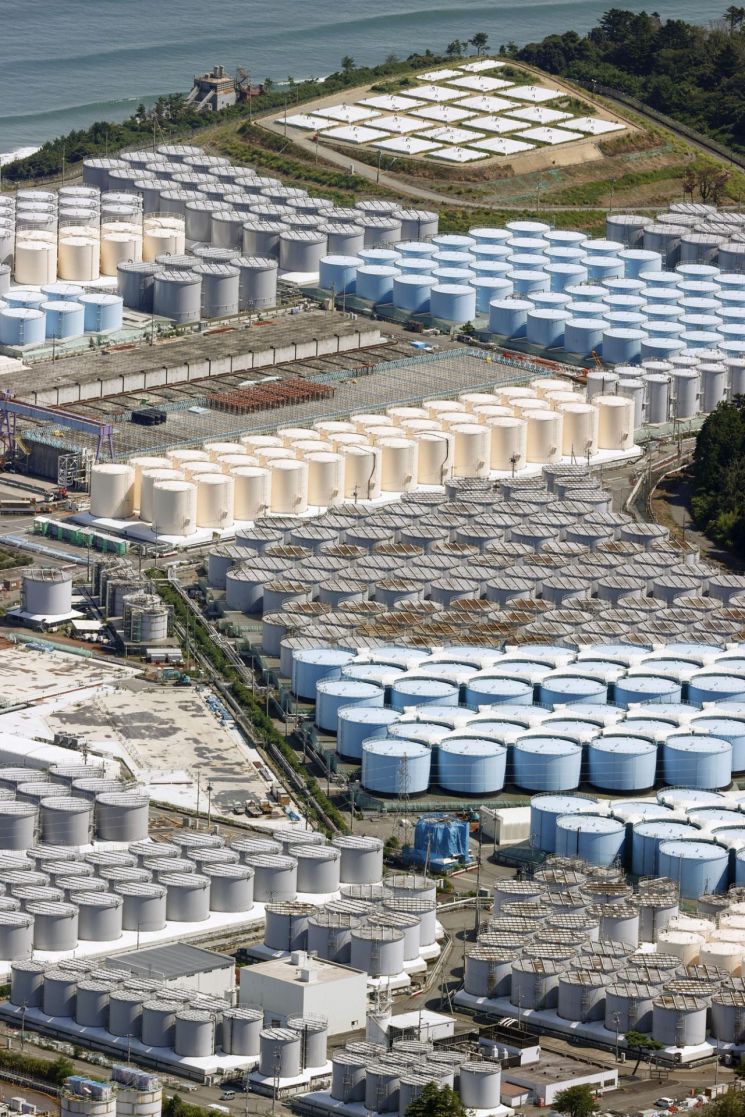 Japanese Prime Minister Fumio Kishida, who has expressed his determination not to delay the ocean discharge of contaminated water from the Fukushima Daiichi Nuclear Power Plant (referred to as "treated water" by the Japanese government), is reported by Kyodo News to meet with leaders of fishermen's associations on the afternoon of the 21st. Photo by Yonhap News
He continued, "From China's standpoint, the state must clearly show a message that it will step in to protect the health and safety of its people," and assessed, "If there is an extreme reaction like this from Japan, Japanese fishermen will be very flustered, and with Japan facing a House of Representatives election, it is difficult for anyone to suddenly back down."
However, he predicted that the two countries would maintain a conflict relationship within reasonable limits. He said, "If they wanted to escalate to a catastrophe, there could have been stronger measures related to semiconductors or automobiles."
Professor Kang added, "But it is burdensome for the conflict to spread further. There is the G20 summit in New Delhi in September and the Asia-Pacific Economic Cooperation (APEC) meeting in San Francisco in November, so until then, tensions will likely be raised while seeking a breakthrough through a Xi Jinping-Kishida summit."
© The Asia Business Daily(www.asiae.co.kr). All rights reserved.
![Clutching a Stolen Dior Bag, Saying "I Hate Being Poor but Real"... The Grotesque Con of a "Human Knockoff" [Slate]](https://cwcontent.asiae.co.kr/asiaresize/183/2026021902243444107_1771435474.jpg)

















