Increase in Stablecoin Circulation Raises Crypto Prices
Insensitive to Jackson Hole Meeting Good News
The total circulation of stablecoins has been steadily decreasing. Stablecoins are primarily used as a means of virtual asset transactions, and the reduction in total circulation appears to be limiting the rise in coin prices.
According to virtual asset data firm CryptoQuant, as of the 28th, the total circulation of stablecoins was recorded at 66.79186 billion units. This figure represents the supply actually circulating in the market, excluding amounts held in issuer wallets and other reserves from the total stablecoin supply. At the beginning of this year, the total circulation of stablecoins was 78.06433 billion units. This means it has decreased by 14.44% to date.
Stablecoins are virtual assets designed to be pegged (fixed) to fiat currencies and are mainly used as trading tools. Overseas virtual asset exchanges sometimes issue stablecoins directly for trading purposes.
Ultimately, for virtual asset trading to be active, the circulation of stablecoins in the market is crucial. Since February last year, the total circulation of stablecoins has shown a downward trend, and the 'crypto winter' fully arrived thereafter. This year as well, the total circulation of stablecoins and coin price fluctuations have shown similar patterns. On March 5th, the total supply of stablecoins increased by about 1 billion units compared to the beginning of the year, and after a few days' lag, the price of the representative virtual asset Bitcoin also showed an upward trend. Bitcoin's price, which had fallen to the $20,000 range on March 10th, subsequently rose and surged to the $30,000 range in April.
Furthermore, on June 10th, the total circulation of stablecoins was recorded at 68.4 billion units, showing an increasing trend, and it rose to 71 billion units by June 20th. At that time, Bitcoin's price also began to rise. The price, which was around $25,100 on June 16th, showed strength and reached the $31,000 range by July 14th.
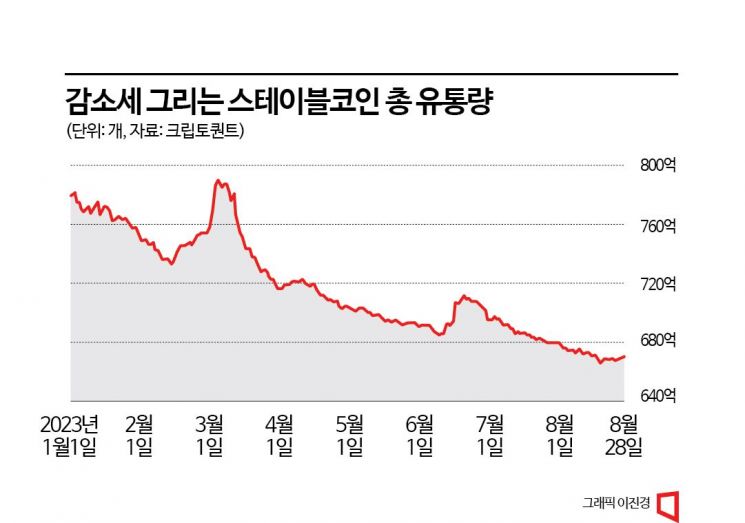
However, as the total circulation growth slowed and the decline continued, virtual asset prices also fell. From the 16th of this month, Bitcoin's price dropped from the $29,000 range to the $26,000 range due to tightening concerns. At that time, the total circulation of stablecoins decreased after reaching 71 billion units, and this trend has continued to the present.
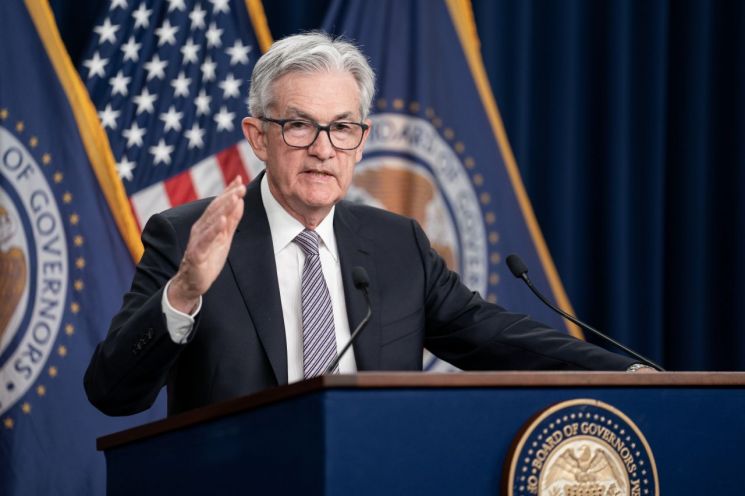
Despite Jerome Powell, Chairman of the U.S. Federal Reserve (Fed), delivering a speech at the recent Jackson Hole meeting that was largely unchanged from previous remarks, virtual asset prices have remained sideways, which analysts attribute to the failure of stablecoin total circulation to rebound. On the 25th (local time), Powell stated in his Jackson Hole speech that inflation remains at a high level and that the Fed is prepared for additional interest rate hikes. He assessed that to sustainably lower inflation to the 2% target, economic growth below trend and easing of labor market overheating are necessary.
Nevertheless, as these remarks were analyzed to be not significantly different from before, the U.S. stock market turned upward. In contrast, Bitcoin's price broke below the $26,000 level after Powell's remarks but then recovered and has been trading sideways since.
© The Asia Business Daily(www.asiae.co.kr). All rights reserved.


















