At the Press Conference on the 28th, Indicated 'Considering Expansion into Europe'
If the 'Global Top 3 Battery' Market Enters Europe,
Production Facilities for Cathode Materials Will Be Established in North America, Europe, and China
Posco Future M, a battery cathode material company, announced that it is considering entering the European market.
On the 28th, Yoon Young-joo, Head of Secondary Battery Material Strategy at Posco Future M, said at a press conference held at the Posco Center in Daechi-dong, Gangnam-gu, Seoul, "European battery and automobile companies are continuously inquiring about (joint venture establishment, etc.) with our company," adding, "We want to enter once the regulatory and support details for the market become clear, similar to the U.S. Inflation Reduction Act (IRA)." Key executives including CEO Kim Jun-hyung, CFO Yoon Deok-il, Head of Secondary Battery Material Strategy Yoon Young-joo, Purchasing Manager Koo Ja-hyun, and Marketing Manager Kwak Min-su attended the conference.
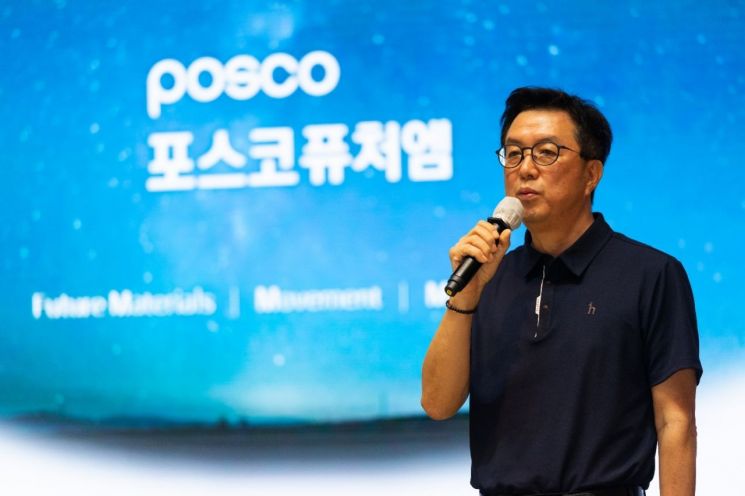 On the 28th, POSCO Future M held "Vision Empathy 2023: The Value POSCO Future M Will Add to the World" at the POSCO Center in Daechi-dong, where it announced its new vision and management plan. Kim Jun-hyung, CEO of POSCO Future M, personally presented the mid- to long-term business goals and management plans to the employees. Photo by POSCO Future M
Entering All Three Major Battery Markets: North America, Europe, and China
Europe is considered one of the three major battery markets along with North America and China due to high demand for electric vehicles and ESS (Energy Storage Systems). If Posco Future M establishes a factory in Europe, it will become the first company to have cathode material production facilities in all three major markets. Currently, Posco Future M has a total cathode material production capacity of 105,000 tons, including the Gwangyang plant with an annual capacity of 90,000 tons, the Gumi plant with 10,000 tons, and the Zhejiang Pohua plant in Zhejiang Province, China, with 5,000 tons. Additionally, it is constructing a 30,000-ton capacity cathode material production plant (Phase 1) in Becancour, Quebec, Canada, to be completed by next year. When Phase 2 is completed in 2026, North American production capacity will increase to 63,000 tons.
Yoon said, "There are many emerging battery companies in Europe, and these companies tend to be less competitive compared to Korean and Chinese finished cell companies, so they rely more heavily on material suppliers," adding, "We held several meetings with European companies in May this year, and discussions are ongoing."
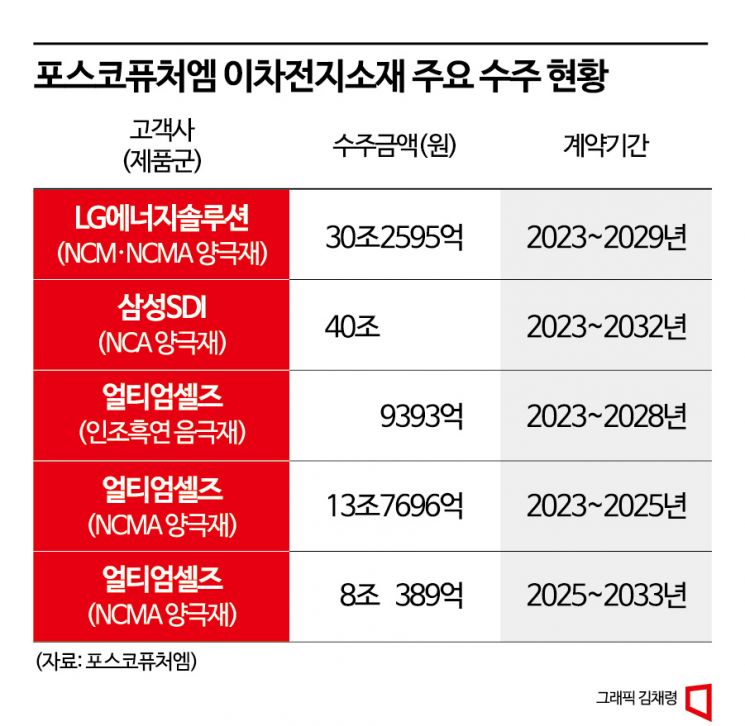
CEO Kim Jun-hyung also revealed ambitions to achieve KRW 43 trillion in sales and KRW 3.4 trillion in operating profit by 2030 during a vision presentation held before the press conference. To achieve this goal, cathode material production capacity will be expanded from 215,000 tons in 2024 to 1 million tons by 2030. Posco Future M’s current cathode material production capacity is about 105,000 tons, ranking second after EcoPro BM (about 180,000 tons). Competitor EcoPro BM has set a target of 710,000 tons by 2027, while LG Chem plans to secure a production capacity of 470,000 tons by 2028. CEO Kim said, "Of the 1 million tons of cathode material, 695,000 tons will be produced domestically, 240,000 tons in North America and Europe, and 65,000 tons in China and Indonesia," adding, "We will base ourselves domestically but expand overseas bases through cooperation with customers."
LFP Cathode Material Development Nearing Completion with Price Competitiveness... 'LFP Joint Venture' Considered if Necessary
Posco Future M is also preparing LFP (Lithium Iron Phosphate) cathode materials, which have recently become a hot topic in the battery industry due to price competitiveness. CEO Kim said about the development status of LFP battery cathode material technology, "Customer sample production is almost complete," adding, "We are encouraging the research institute to achieve visible results by the end of this year. If mass production is needed sooner, we are also considering joint ventures with companies that possess LFP cathode material technology."
He continued, "If we develop good products, customers will request supply contracts," adding, "Currently, many companies want to collaborate with Posco Future M on LFP battery cathode materials. We plan to build production facilities and supply products according to order volumes." This means they will start constructing production facilities after securing orders from customers.
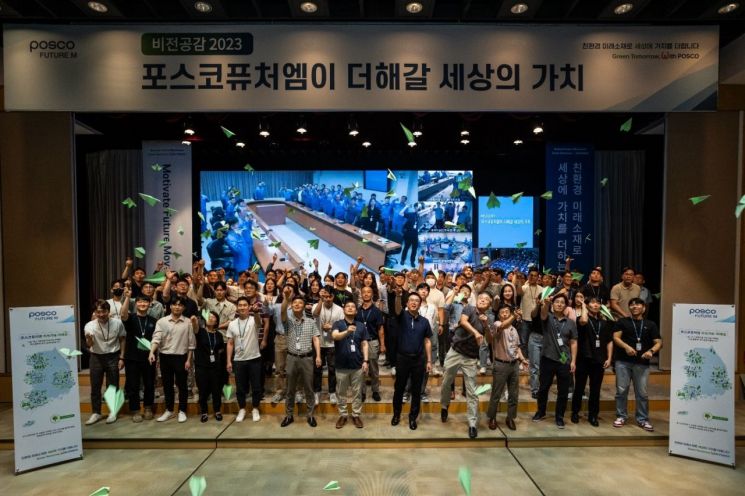 Employees of POSCO Future M are performing a paper airplane flight performance with the company's and their individual visions written on the planes, wishing for the achievement of a new vision after completing "Vision Sympathy 2023: The Value POSCO Future M Will Add to the World," held at the POSCO Center in Daechi-dong on the 28th. Photo by POSCO Future M
Posco Future M plans to increase the production capacity of another key battery material it produces, anode materials, from the current 93,000 tons to 370,000 tons. CEO Kim said about the anode material business, "We will gradually expand the production of silicon-based anode materials, which are expected to grow rapidly in the future." Anode materials store and release lithium ions to allow current flow, and silicon theoretically has more than 10 times the lithium storage capacity compared to conventional graphite, enabling higher battery capacity.
Posco Future M is the only anode material producer excluding Chinese companies. Yoon said, "Depending on how the Foreign Entity of Concern (FEOC) guidelines under the IRA are issued, Chinese-made anode materials might be unable to enter the North American market," adding, "If we secure competitiveness across the entire anode material value chain, we believe it is possible for us to capture the North American market in the future."
© The Asia Business Daily(www.asiae.co.kr). All rights reserved.



















