Mandatory Paternity Leave... Promotion for Having a Third Child
"Let's Raise the Birth Rate" Companies Introducing Bold Policies
"South Korea is completely ruined; I have never heard of such a low fertility rate (Joan Williams, Professor Emerita at California State University)."
The reaction of foreign scholars upon learning that South Korea's total fertility rate (the average number of children a woman is expected to have in her lifetime) is 0.78 became a hot topic. There are even talks that the country will disappear if this continues. From a business perspective, companies cannot find workers to run factories, nor consumers to buy products. To shed the dishonorable title of 'the country with the lowest fertility rate,' companies are waging a war on fertility rates.
S, a manager at POSCO, wakes up at 6 a.m. to change diapers and feed milk to his six-month-old twins with his wife. After sending his six-year-old first child to kindergarten and having a quick breakfast, it is 7:50 a.m. From then on, he turns on his laptop and starts work. Since January this year, S has been balancing work and childcare through the 'parental leave telecommuting system.' S said, "I was going to take parental leave, but I was worried about the financial impact," adding, "Fortunately, the company has a system that allows telecommuting, so I applied for it, and I really like being able to focus on work comfortably."
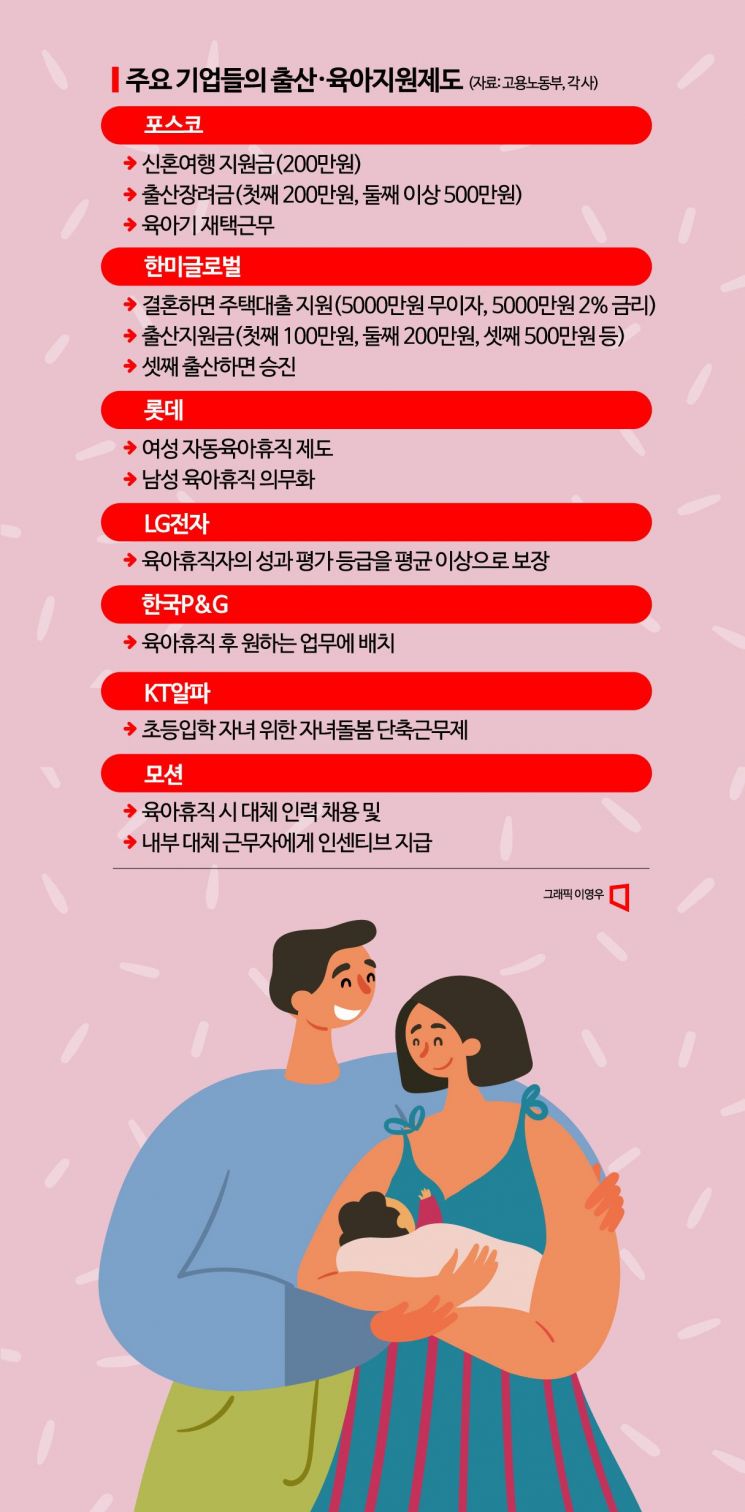
POSCO is a male-dominated company, with men accounting for 95% of the workforce due to the nature of the steel industry. The main users of childbirth and childcare support systems are also male employees. At first glance, one might think the company culture is far from family-friendly, but that is not the case. Since 2017, POSCO has revamped its systems to align with the life cycle of marriage, pregnancy, childbirth, childcare, and education, providing full support for infertility treatment, childbirth, and childcare.
The most highly rated system is the 'parental leave telecommuting system.' It was the first such system introduced by a domestic company in July 2020. Any employee with a child under eight years old or in the second grade of elementary school or below can choose this option. Depending on the employee's situation, they can select full-day (8 hours) or reduced (4 or 6 hours) telecommuting. If reduced telecommuting is chosen, employees can select their working hours in connection with the 'convertible time selection system.' They can choose from 8 a.m. to 12 p.m., 10 a.m. to 3 p.m., or 1 p.m. to 5 p.m., allowing them to adapt working hours to their childcare environment. Basic wages, benefits, and promotions are applied equally even when using the parental leave telecommuting system. This compromise reduces the burden of career interruption and income reduction, gaining strong support from employees.
In addition, there are various family-friendly systems that follow employees' life cycles. Employees who get married receive a congratulatory gift of 1 million KRW and 2 million KRW as a 'honeymoon support fund.' For infertility treatment, which is often the first hurdle to childbirth, employees can take up to 10 days of infertility treatment leave. Treatment costs of 1 million KRW per session are supported up to 10 times for the employee or their spouse who undergoes treatment. After childbirth, employees can take parental leave for up to two years. To prevent career interruption, the parental leave period is included in continuous service. Thanks to this, the return-to-work rate after parental leave reaches 93.1%.
Lotte Group is also serious about parental leave. In 2012, Lotte became the first large company to introduce an automatic parental leave system. This system allows employees to take parental leave without a separate application process or supervisor approval. Since 2017, the parental leave period has been extended to a maximum of two years. Male parental leave has also been made mandatory. When a spouse gives birth, the employee must take at least one month of parental leave. Up to one month of parental leave is paid at full regular wages. This means employees receive not only their base salary but also all allowances. In 2016, only 180 male employees took parental leave, but in the first year of the system's introduction in 2017, the number increased sixfold to 1,100. By 2022, a cumulative total of 6,508 male employees had taken parental leave.
HanmiGlobal has introduced a bold system that promotes employees who have a third child. Regardless of promotion eligibility or performance evaluations, employees who have a third child are promoted to the next higher rank. This system applies regardless of rank. Employees who take parental leave are supported so they do not suffer disadvantages in promotions. The parental leave period, up to two years, is recognized as continuous service, allowing employees to be evaluated for promotion even during leave. Additionally, job applicants with children receive extra points in document screening during open recruitment for new employees.
There is also significant effort to help employees returning from parental leave adapt to work. To this end, LG Electronics guarantees that employees returning from parental leave will not be disadvantaged in promotions by ensuring their evaluation rating for the leave year is at least average. There is also a 'smart working' system to support balancing work and childcare. Using the flexible working hours system, employees can set their working hours except for core time. The motto is to work efficiently and rest sufficiently. Korea P&G assigns employees returning from parental leave to the jobs they want. Thanks to this, the return rate of employees from parental leave was 100% last year, with a three-year average of 95%.
KT Alpha operates a 'childcare reduced working hours system' to help employees smoothly continue childcare after returning from parental leave. This system considers that children entering elementary school need more parental care to adapt to their new life. Employees choosing this system can reduce their working hours by one hour per day to send their children to school and start work after 10 a.m. or leave at 5 p.m. to care for their children. The system can be used from March 1, when the school term begins, until February 28 of the following year, with no wage reduction. If both parents in the company have a first-grade elementary school child, both can apply.
Even with such systems, if the culture makes employees feel self-conscious about using them, they are useless. This is why Motion, a software development company affiliated with Hyundai Motor Company, is working to remove obstacles to using childbirth and childcare support systems. Motion encourages employees to take at least six months of childbirth and childcare leave. This is to hire replacement personnel to cover the work of employees on parental leave. If replacement personnel cannot be hired, the department head has the discretion to distribute the work among internal team members and provide incentives.
© The Asia Business Daily(www.asiae.co.kr). All rights reserved.
![Clutching a Stolen Dior Bag, Saying "I Hate Being Poor but Real"... The Grotesque Con of a "Human Knockoff" [Slate]](https://cwcontent.asiae.co.kr/asiaresize/183/2026021902243444107_1771435474.jpg)
















