"Positive View on Marriage" 57% 10 Years Ago
Dropped Sharply to 36% Last Year
Main Reason: "Lack of Marriage Funds"
Younger generations are increasingly showing a tendency not to be bound by 'marriage.' While the proportion of young people who view marriage positively has decreased to one in three, the number of unmarried couples cohabiting has actually increased.
 As marriage and birth rates have emerged as social issues, an increasing number of young people are notably less bound by the concept of 'marriage.' The photo is not related to the specific content of the article. Photo by Yonhap News
According to the 'Changes in Youth Awareness Examined through Social Surveys' released by Statistics Korea on the 28th, the proportion of young people who think positively about marriage was 36.4% as of May last year. This marks a 20.1 percentage point (p) decrease compared to 56.5% in 2012, ten years ago.
This figure is 13.6%P lower than the 50.0% positive rate for marriage among the overall population. Among young people, the positive attitude toward marriage was 28.0% for women and 43.8% for men, both down by 18.9%P and 22.3%P respectively compared to ten years ago.
By age group, the positive responses were 34.0% for ages 19?24, 36.1% for ages 25?29, and 39.2% for ages 30?34. Even among those in their early 30s, typically considered the prime marriage age, the majority did not respond positively toward marriage.
Top Reason for Not Marrying: 'Lack of Marriage Funds'
 The recently concluded reality entertainment program '2 Eok 9 Cheon' is a show that captures the intense competition among ten couples striving to win the prize money of 290 million KRW, which is the average marriage cost in South Korea.
 [Photo by tvN]
Why are young people more negative about marriage compared to the past?
Young people most frequently cited 'lack of marriage funds' (33.7%) as the main reason why people do not marry. This was followed by feeling no need for marriage (17.3%), burdens of childbirth and child-rearing (11.0%), unstable employment status (10.2%), and not meeting a suitable partner (9.7%).
The proportion citing lack of marriage funds was higher among men (40.9%) than women (26.4%). The percentage of young people who believe that men and women can live together without marrying rose by 19.1%P over the past ten years to 80.9%.
More than half of young people thought that even if they marry, they do not have to have children. This rate has been steadily increasing: 46.4% in 2018, 50.5% in 2020, and 53.5% last year.
Young people who reported satisfaction with their relationship with their parents and overall family relationships had higher proportions (57.6% and 57.1%, respectively) who responded that 'children should be born after marriage' compared to the overall youth group (46.5%).
The proportion of young people who think it is better to divorce if there is a reason increased by 11%P over ten years to 24.1%. The proportion agreeing with non-marital childbirth rose by 9.8%P over ten years to 39.6% last year.
The proportion of young people willing to adopt was 31.5%, down 20.5%P from ten years ago. Reasons for not wanting to adopt included 'not feeling the necessity of adoption' (43.1%) and 'concerns about whether they can raise the child like their biological child' (37.6%).
Regarding international marriage, 83.3% of young people responded positively, an increase of 9.5%P compared to ten years ago.
Most Important Factor When Choosing a Job: 'Income'
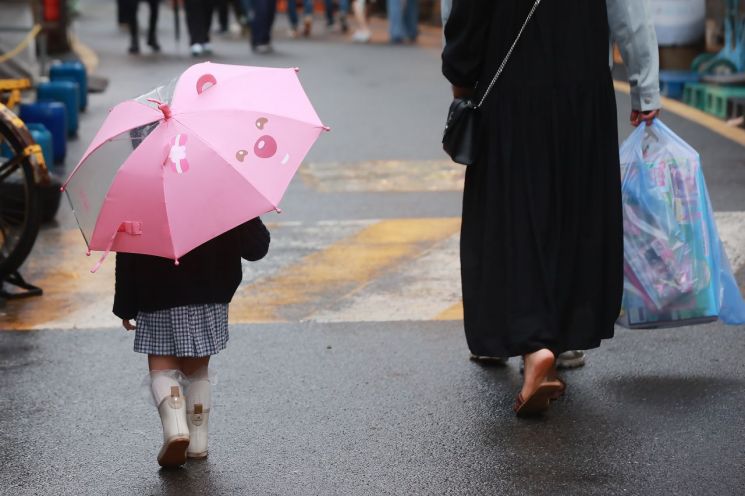 More than half of young people thought that even if they got married, they did not have to have children. This proportion has been steadily increasing, with 46.4% in 2018, 50.5% in 2020, and 53.5% last year. The photo is not related to the specific content of the article. Photo by Yonhap News.
The most important factors young people consider when choosing a job (based on 2021 data) were income (35.8%), stability (22.1%), aptitude and interest (19.1%), and working environment (9.8%), in that order.
However, young people aged 19?24 valued aptitude and interest (24.2%) more than stability (19.9%), unlike those aged 25?34.
Preferred workplaces changed from 2011, when national institutions (27.7%), large corporations (19.6%), and public enterprises (19.3%) were favored, to 2021, when public enterprises (23.2%), national institutions (20.8%), and large corporations (20.2%) took the lead. Public enterprises became more popular than government jobs.
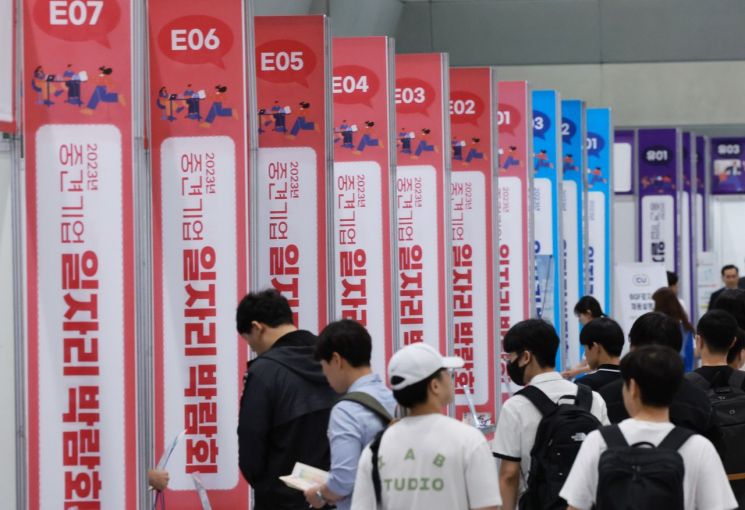 The most important factors young people consider when choosing a job (based on 2021 data) were income (35.8%), stability (22.1%), aptitude and interest (19.1%), and working environment (9.8%) in that order.
 [Photo by Yonhap News]
Both male and female young people regarded childcare burdens (46.3%) as the biggest obstacle to women's employment. This was followed by social prejudice (18.5%) and unequal working conditions (13.8%).
The proportion of young people who want women to maintain employment regardless of childbirth and child growth increased by 20.8%P over ten years to 74.0%.
More than half of young people (54.8%) reported feeling anxious about losing their job or having to change jobs in the near future. However, this rate decreased by 8.0%P compared to ten years ago.
Meanwhile, the perception that children are not obligated to support their parents has also strengthened. The response that family should be responsible for parents' old age was 20.6%, down 12.6%P from ten years ago. A majority of 60.7% believed that family, society, and government should jointly take responsibility for parents' old age, while 15% thought parents should solve it themselves.
© The Asia Business Daily(www.asiae.co.kr). All rights reserved.
![Clutching a Stolen Dior Bag, Saying "I Hate Being Poor but Real"... The Grotesque Con of a "Human Knockoff" [Slate]](https://cwcontent.asiae.co.kr/asiaresize/183/2026021902243444107_1771435474.jpg)


















