6th Trade Issues Press Briefing on the 28th
Vice Chairman Jeong Manki: "Exchange Rate and IT More Problematic than China
Semiconductors to Recover in Q4, IT in Early Next Year"
There is a forecast that South Korea's export slump will recover in the first half of next year. It is analyzed that the global semiconductor market will recover in the fourth quarter, and the ICT (Information and Communication Technology) market will recover in the first half of next year, leading to an increase in South Korean exports. This differs from the previous Korea International Trade Association (KITA) analysis, which attributed the export decline mainly to intermediate goods exports to China due to decreased IT market demand.
On the 28th, Chung Manki, Vice Chairman of KITA, made this forecast at the '6th Trade Issues Press Briefing' held at the Trade Tower in Samseong-dong, Gangnam-gu, Seoul. As soon as he began the briefing, Vice Chairman Chung said, "Until now, the causes of export sluggishness were seen as a complex interplay of exchange rates, China, and semiconductors, but we have confirmed that the biggest cause was the ICT market downturn."
From the beginning of this year until the 20th, South Korea's trade balance was a deficit of $28.4 billion (approximately 37.6 trillion KRW). Exports amounted to $385.3 billion (approximately 510.06 trillion KRW), down 13.2%, and imports were $413.7 billion (approximately 547.66 trillion KRW), down 12%.
KITA diagnosed that the reason for South Korea's export slump is the global ICT product market downturn. The decline rate of ICT imports to South Korea from the United States, the European Union (EU), and China was higher than that of non-ICT imports. Compared to the same period last year, the U.S. ICT import decline rate to South Korea was -44.8%, while non-ICT was 13.3%. The EU's ICT imports decreased by 17.5%, and non-ICT imports increased by 16.7%. China's ICT imports decreased by 29.7%, and non-ICT imports decreased by 18.2%.
South Korea's semiconductor export performance also worsened. From January to July this year, semiconductor exports to China amounted to $19.7 billion (approximately 26.08 trillion KRW), a decrease of $13.4 billion (approximately 17.74 trillion KRW, 40.4%) compared to the same period last year. This accounted for 93% of the total $14.4 billion (approximately 19.06 trillion KRW) decrease in exports to China during the same period.
KITA explained that a detailed analysis of the performance with China shows that the ICT downturn had an absolute impact on the export decline.
From January to July this year, South Korea's top 10 export items to China decreased by $18 billion (approximately 23.83 trillion KRW) compared to the same period last year. Among them, ICT items such as semiconductors ($9.3 billion, approximately 12.31 trillion KRW), flat panel displays and sensors ($1.6 billion, approximately 2.12 trillion KRW), and wireless communication devices ($600 million, approximately 790 billion KRW) totaled $11.5 billion (approximately 15.22 trillion KRW). These three ICT items accounted for 63.9% of the total trade deficit with China.
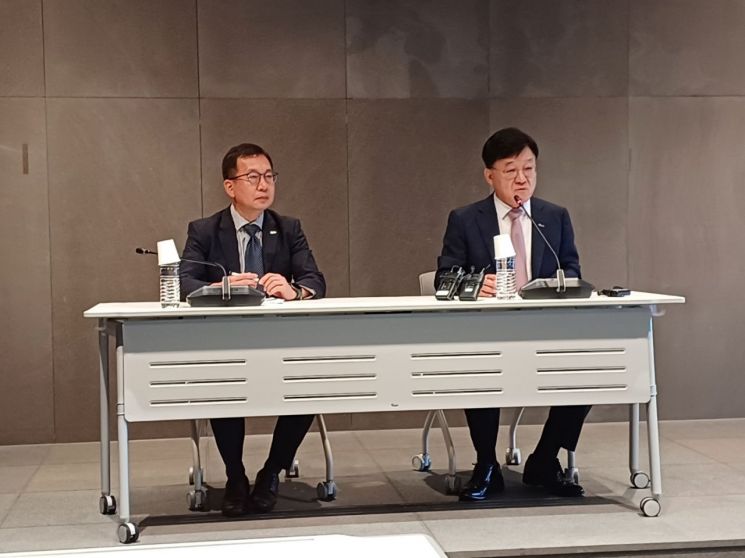 Jung Manki, Vice Chairman of the Korea International Trade Association (right), speaks at the August Korea Export Media Briefing held on the 28th at the Trade Tower in Samseong-dong, Gangnam-gu, Seoul.
 [Photo by Moon Chaeseok]
Vice Chairman Chung forecasted that semiconductor exports will recover in the fourth quarter of this year, and the overall ICT market will recover in the first half of next year. According to a survey by the Korea Semiconductor Industry Association, South Korea's semiconductor exports are expected to reach $9.5 billion (approximately 12.58 trillion KRW) in October, a 3% increase compared to the same period last year. Memory semiconductors are projected to increase by 26.9% to $5.7 billion (approximately 7.55 trillion KRW).
According to market research firm Gartner, global IT device demand was $766.3 billion (approximately 1014.58 trillion KRW, down 6.3% year-on-year) last year, is forecasted at $700 billion (approximately 926.66 trillion KRW, down 8.6%) this year, and is expected to recover to $748.2 billion (approximately 990.62 trillion KRW, up 6.9%) next year.
When KITA changed its analysis to state that South Korean exports will increase if the IT market recovers, rather than due to China's domestic economy or the Japanese yen situation, many questions arose.
Vice Chairman Chung said, "I had spoken vaguely about the status of exports to China, but after a detailed review this time, I realized that predicting demand for IT devices such as PCs, mobile phones, and servers is necessary to assess semiconductor demand and South Korean exports."
In response to the question, "Did China's improved technological capabilities replacing Korean IT devices affect exports?" he said, "There is some impact, but in the short term, the cause of export performance can be seen as the global IT device downturn in the U.S., EU, China, and others."
© The Asia Business Daily(www.asiae.co.kr). All rights reserved.

















