Color Changes According to the Amount of Light
Not Related to Wastewater Discharge Issues
On the 24th, regarding the photos circulating on the internet showing a change in the color of the Fukushima sea area after Japan's release of contaminated water, the government stated that "the color can change depending on the amount of light" and emphasized that "this is not an issue related to the release of contaminated water."
Park Gu-yeon, First Deputy Director of the Office for Government Policy Coordination, announced on the 28th during a daily briefing on contaminated water that this was confirmed after inquiring with Tokyo Electric Power Company (TEPCO).
Park first conveyed TEPCO's position that "the photo was taken around 13:05, but the actual time when contaminated water began flowing into the sea was 13:13. The claim that the phenomenon in the photo occurred due to the release is not consistent with the timeline."
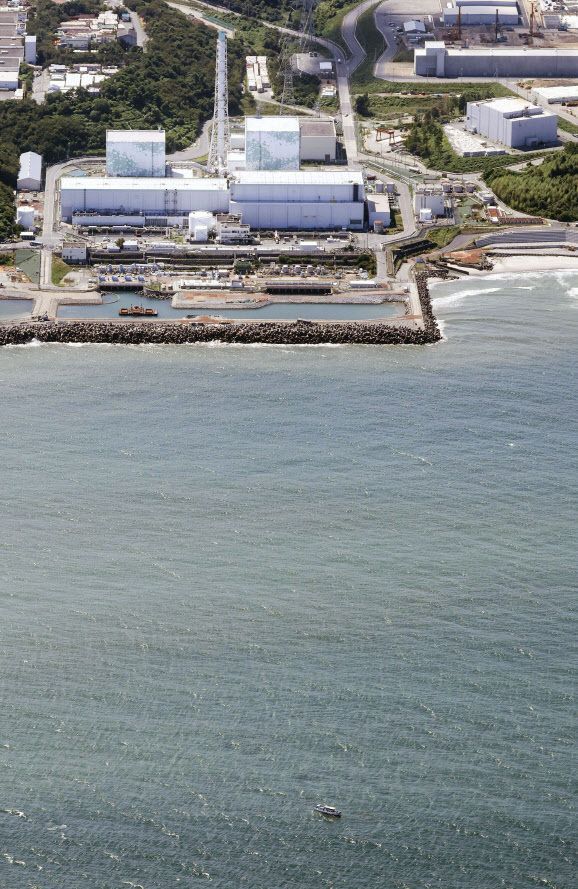 The Fukushima Daiichi Nuclear Power Plant, which began releasing contaminated water into the ocean on the afternoon of the 24th. (Photo by Yonhap News)
The part of the sea appearing black in the photo corresponds to the location of the reef zone, and it was explained that the color can change depending on the amount of light. The yellowish appearance of the sea surface is due to strong tidal currents, which is a common phenomenon in the sea area in front of Fukushima. Park stated, "The phenomenon in the photo is a very natural occurrence and is not related to the release of contaminated water."
During the briefing, Park also mentioned that the data provided by TEPCO after the release meets safety standards. He said, "The 'total notified concentration ratio,' which sums the ratios of actual measured values against the emission standards for each radionuclide, must not exceed 1; if it does, the water must undergo ALPS (Advanced Liquid Processing System) purification again. The 'total notified concentration ratio' of the contaminated water currently being released, disclosed on June 22, is 0.28, which meets the standards."
Park added, "The main focus of inspection is whether the tritium concentration in the seawater pipeline header is below the discharge target of 1,500 Bq (becquerels) per liter." He stated, "Since the start of the release, the concentration has been confirmed to be below the standard, recording a minimum of 142 Bq and a maximum of 200 Bq per liter (ℓ)."
© The Asia Business Daily(www.asiae.co.kr). All rights reserved.

















