MSCI Emerging Markets Index Falls 7.3% This Month
Largest Drop in Nearly a Year
Currency Values of Won, Yuan, Peso Also Decline
The 'high interest rate new normal' in the United States and the economic crisis in China have caused emerging market asset markets in Asia, South America, Africa, and other regions, including South Korea, to suffer from a double burden.
According to the Wall Street Journal (WSJ) on the 27th (local time), the Morgan Stanley Capital International (MSCI) Emerging Markets Index fell 7.3% from the 1st to the 25th of this month. This is the largest drop in a year. The Korean KOSPI (weight 13%) included in the MSCI Emerging Markets Index fell 4.3% this month. The Taiwan Weighted Index fell 3.9% during the same period, while Brazil's Bovespa Index and India's Sensex Index dropped 5% and 2.5%, respectively. The Shanghai Composite Index in China (29.4%) plunged 6.9%.
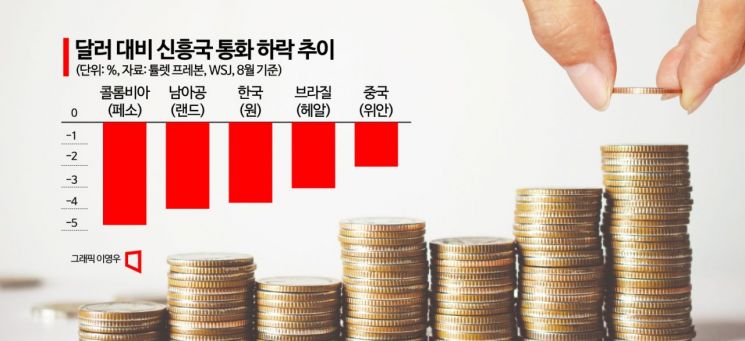
The value of emerging market currencies also fell significantly. The Colombian Peso depreciated 4.7% against the dollar this month, and the South African Rand fell 4%. The Korean Won dropped 3.8% during the same period, while the Brazilian Real and Chinese Yuan fell 3% and 2%, respectively.
The biggest cause of the slump in emerging market asset markets is the prolonged outlook for high interest rates in the United States. Due to an unexpected boom driven by strong consumption and employment in the U.S. economy, expectations for a soft landing have spread, causing market scenarios such as an economic recession in the second half of this year and the Fed's rate cuts within the year to lose their appeal.
Jerome Powell, Chairman of the U.S. Federal Reserve (Fed), left open the possibility of further rate hikes at the Jackson Hole meeting held from the 24th to the 26th. He stated, "It is a welcome development that inflation has come down from its peak, but it is still too high," and added, "We are prepared to raise rates further if appropriate."
With expectations that the Fed will maintain its tightening stance for the time being, the yield on the U.S. 10-year Treasury bond rose to the 4.3% range on the 17th, the highest in 16 years. As U.S. bond yields rose, Allianz Global Investors estimated that the additional yield offered by emerging market bonds compared to U.S. bonds fell to the lowest level since 2007. This means that the attractiveness of emerging market bonds compared to the safe-haven U.S. Treasury bonds has significantly declined. Typically, in such cases, there are repercussions such as sell-offs of emerging market bonds and increased borrowing costs. Sergei Lanau, Global Emerging Markets Strategist at Oxford Economics, pointed out, "The greater the interest rate differential, the more people avoid investing in emerging markets."
The U.S. high interest rate stance also limits the ability of emerging markets to implement accommodative monetary policies. Kieran Curtis, Head of Emerging Market Currency and Bonds at Aberdeen Asset Management in the UK, predicted, "The market's reassessment of the Fed is likely to limit the number of rate cuts that emerging market central banks can implement."
Economic instability in China is also a negative factor for emerging markets. As China's consumption and employment shrink and defaults by real estate companies spread, major global banks such as Citigroup, JP Morgan, and Barclays have lowered their annual growth forecasts for this year to the 4% range. As China's commodity demand, known as the 'commodity black hole,' decreases, the export economies of emerging markets that produce and sell oil, metals, and minerals to China are also likely to slow down. South Korea, which has a high dependence on intermediate goods exports to China, is unlikely to escape the impact of the Chinese economic shock.
The WSJ diagnosed, "The International Monetary Fund (IMF) has lowered its average annual growth forecast for this century from the previous 5.2% to 3.9% in the medium term," adding, "As China faces difficulties and the era of easy money ends, many emerging markets may find it difficult to achieve the surprisingly high growth rates of the past."
© The Asia Business Daily(www.asiae.co.kr). All rights reserved.
![Clutching a Stolen Dior Bag, Saying "I Hate Being Poor but Real"... The Grotesque Con of a "Human Knockoff" [Slate]](https://cwcontent.asiae.co.kr/asiaresize/183/2026021902243444107_1771435474.jpg)












