Bank of Korea, Evaluation Report on Private Consumption Recovery Momentum
Domestic Consumption from April to July Decreased by About 0.5% Compared to Q1
Excluding Weather-Influenced Items, Increased by About 0.2%
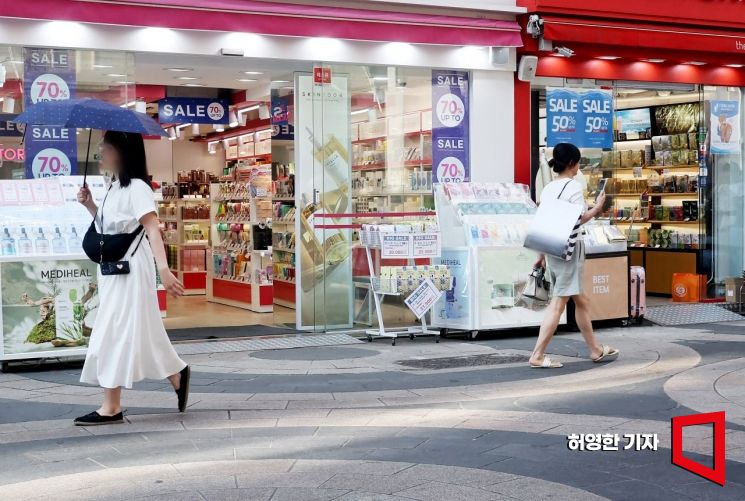
In the second quarter of this year, private consumption decreased by 0.1% compared to the first quarter due to the slowdown of pent-up demand (consumption resumption delayed by COVID-19), abnormal weather, and heavy rain, and it was also recorded to have declined in July. Going forward, private consumption is expected to show a recovery trend as temporary factors such as weather disappear and consumer sentiment improves. However, the burden of principal and interest repayment on household loans is increasing due to high interest rates, and uncertainties in external conditions such as risks originating from China are growing, which may constrain household consumption.
On the 28th, the Bank of Korea stated in its report titled "Assessment of the Momentum of Private Consumption Recovery" that based on a rough estimate using high-frequency data such as the retail sales index, service production index, and July credit card data, domestic consumption from April to July decreased by about 0.5% monthly on average compared to January to March. However, excluding items particularly affected by weather, consumption increased by about 0.2%.
Consumption of Goods and Services Declined Sharply Compared to the First Quarter
By consumption type, consumption of goods and services closely related to face-to-face activities in the second quarter and July decreased sharply compared to the first quarter, while other consumption generally showed a moderate increase. Goods consumption (based on retail sales) saw a significant decrease in expenditures on semi-durable goods such as clothing and footwear, but durable goods like passenger cars and non-durable goods such as food and beverages increased. Service consumption (based on service industry production) saw declines in food and accommodation and land passenger transport, but increases in health and welfare.
The sluggish consumption related to face-to-face activities in the second quarter and July was due to the slowdown of pent-up demand and the significant impact of temporary factors such as weather. The Bank of Korea explained, "The average temperature in the first quarter of this year was higher than usual, leading to increased early medical purchases in spring, which resulted in decreased consumption of semi-durable goods such as clothing." It added, "Since May, especially in July, rainfall exceeding the normal level appears to have contracted consumption of goods and services centered on outdoor activity-related items such as clothing, food and accommodation, leisure, and travel." Analysis using microdata from credit cards also measured a significant decrease in expenditures on leisure, accommodation, and restaurants when rainfall increased.
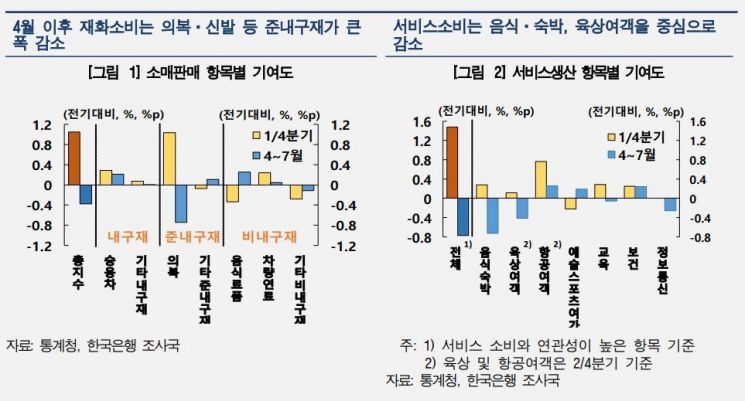
The Bank of Korea expects private consumption to resume its recovery trend as temporary factors such as weather disappear, but other consumption conditions such as consumption capacity, consumption propensity, and housing prices will act as variables affecting the degree of recovery.
First, consumption capacity is expected to be supported by gradually improving real purchasing power of households due to favorable employment conditions and a slowdown in inflation, along with accumulated excess household savings. However, the increased burden of principal and interest repayment on household loans due to high interest rates is expected to constrain consumption capacity.
Housing Market Improvement, Increased Household Principal and Interest Repayment Burden... Positive Effects Offset
Also, while recent improvements in consumer sentiment are positive for consumption recovery, the high uncertainty of external conditions such as the slowdown in the Chinese economy is analyzed to potentially constrain household consumption. The improvement in the housing market is also accompanied by an increase in household loans, which may limit its positive contribution to consumption recovery. The Bank of Korea stated, "Generally, rising housing prices act as a factor increasing consumption through wealth effects, but given the current high interest rate environment, the rebound in housing prices accompanied by housing loans increases the burden of principal and interest repayment on households, offsetting the positive effects." It added that prospective homebuyers may reduce consumption to save for housing purchase funds.
On the other hand, the resumption of group tours by Chinese tourists is expected to have a positive impact on improving household income conditions through increased business income of self-employed individuals. The Bank of Korea said, "Going forward, private consumption will continue its recovery trend supported by favorable employment conditions and accumulated excess savings. However, with high household debt levels and sustained high interest rates increasing the burden of principal and interest repayment, along with high uncertainty in external conditions, the recovery momentum is expected to be moderate."
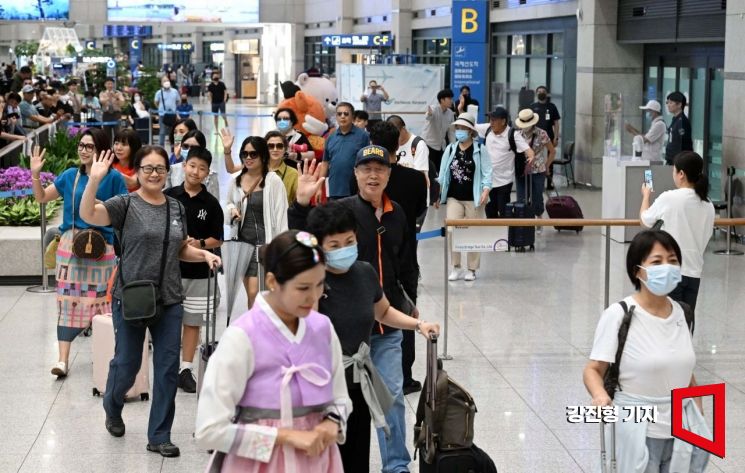 On the 24th, Chinese group tourists are arriving at Incheon International Airport Terminal 1. On this day, to commemorate the 31st anniversary of Korea-China diplomatic relations, the Korea Tourism Organization held a welcoming event for Chinese group tourists. Photo by Jinhyung Kang aymsdream@
© The Asia Business Daily(www.asiae.co.kr). All rights reserved.
![Clutching a Stolen Dior Bag, Saying "I Hate Being Poor but Real"... The Grotesque Con of a "Human Knockoff" [Slate]](https://cwcontent.asiae.co.kr/asiaresize/183/2026021902243444107_1771435474.jpg)













