Climate Anomalies and Black Sea Grain Deal Suspension... Food Prices Unstable
BOK "Impact on Inflation Expectations, Will Delay Price Deceleration"
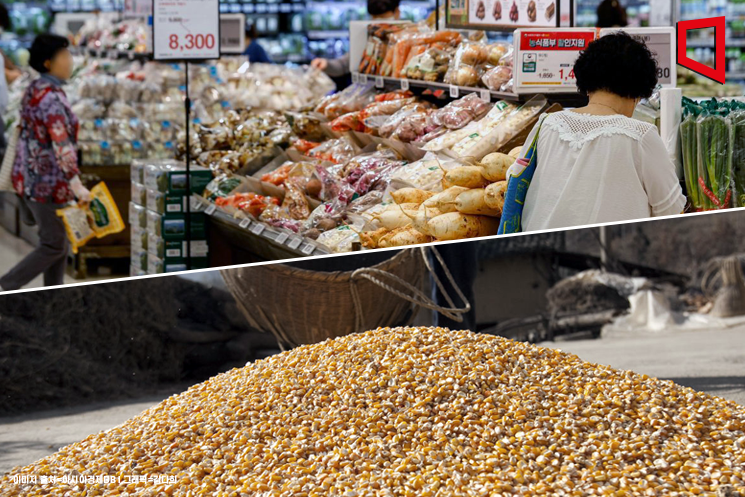
The Bank of Korea recently forecasted that instability in international grain prices could persist for a considerable period due to the suspension of the Black Sea Grain Initiative, El Ni?o, typhoons, and other abnormal climate impacts. Since South Korea has a very high external dependence on grains except for rice, concerns are rising that upward pressure on food-related inflation could intensify with future increases in international grain prices.
On the 28th, the Bank of Korea explained in its report titled 'Assessment of Domestic and International Food Price Trends and Risk Factors' that "recently, due to deteriorating weather conditions such as heavy rains, heatwaves, and typhoons in South Korea, prices of agricultural products like vegetables and fruits have rapidly increased compared to the previous month. Additionally, overlapping factors such as abnormal weather, the suspension of the Black Sea Grain Initiative, and food export restrictions by some countries have heightened concerns about food price inflation."
High External Dependence on Grains... Concerns Over Food Price Inflation
In fact, although the rate of increase in food prices in South Korea has slightly slowed, it still exceeds the overall consumer price inflation rate. The cumulative price increases since the COVID-19 pandemic have also significantly outpaced consumer price inflation. Last month, domestic producer prices rose by 0.3% compared to the previous month, marking a rebound after four months, largely influenced by a sharp surge in agricultural product prices (10.6%).
The Bank of Korea explained that the recent strong rise in domestic and international food prices is largely due to global factors. These include supply bottlenecks following the pandemic, disruptions in grain and fertilizer supplies caused by the Russia-Ukraine war, food export restrictions by various countries, and abnormal climate conditions acting in combination. Using data from 50 countries, the Bank of Korea analyzed factors driving food price increases and found that global common factors accounted for a larger share than country-specific factors.
In particular, South Korea is highly sensitive to fluctuations in international food prices due to its very high external dependence on grains except for rice. As of 2021, South Korea's grain self-sufficiency rate was 20.9%, relying mostly on imports. According to the Bank of Korea, international food prices affect domestic processed food prices and dining-out prices with a time lag, with processed food prices peaking after 11 months and dining-out prices after 8 months.
The Bank of Korea expects that the slowdown in the rise of domestic and international food prices may proceed slowly. Concerns over food security due to the suspension of the Black Sea Grain Initiative and India's rice export halt could increase upward pressure, and in the medium to long term, El Ni?o and abnormal climate conditions may raise international food prices.
This Year’s Strong El Ni?o: "Food Prices Rise 5% per 1℃ Increase"
Above all, with a strong El Ni?o expected this year, concerns are growing about abnormal weather in major grain-producing regions and disruptions in agricultural product supply. Past cases show that international food prices tend to rise following El Ni?o periods. It has been analyzed that when sea surface temperatures rise by 1℃ above average, international food prices increase by 5-7% on average with a lag of 1 to 2 years.
El Ni?o refers to a phenomenon where Pacific Ocean sea surface temperatures remain at least 0.5℃ above the average for several months. Since May, sea surface temperatures have already exceeded 0.5℃ above average, and a strong El Ni?o with temperatures rising more than 1.5℃ is expected to occur in the second half of this year and continue until the second half of next year.
Major countries such as the United States, the United Kingdom, and the Eurozone have also seen food price inflation rates significantly exceeding overall consumer price inflation rates since last year, raising concerns about food-driven inflation instability.
The Bank of Korea pointed out, "Food prices for processed foods and dining out tend to be downwardly rigid and persistent, and they are closely linked to perceived inflation, thus having a significant impact on inflation expectations. This could act as a factor slowing the future domestic inflation deceleration."
It added, "Household burdens may increase and real purchasing power may shrink, especially among low-income groups with a high proportion of food expenditure. Therefore, it is necessary to closely monitor the trends and impacts of food price inflation going forward."
© The Asia Business Daily(www.asiae.co.kr). All rights reserved.
![Clutching a Stolen Dior Bag, Saying "I Hate Being Poor but Real"... The Grotesque Con of a "Human Knockoff" [Slate]](https://cwcontent.asiae.co.kr/asiaresize/183/2026021902243444107_1771435474.jpg)











