Bank of Korea Governor: "Consider if you can manage before investing in real estate"
Opens possibility of base rate hike
Consider switching to fixed 4% loans
Refinancing long-term products can reduce monthly payments
 View of the Noryangjin redevelopment site in Seoul from the 63 Building observatory. Photo by Hyunmin Kim kimhyun81@
"The likelihood of financial costs (interest rates) dropping to 1-2% per annum as they did over the past decade is low. Real estate investments should be made considering whether one can bear the costs," said Lee Chang-yong, Governor of the Bank of Korea, on the 24th.
The Bank of Korea held the base interest rate steady at 3.5% on the 24th. Regarding the final interest rate level during this rate hike cycle, Governor Lee stated, "All six Monetary Policy Committee members have expressed opinions that the possibility of raising it to 3.75% for the time being should be kept open."
The biggest influence on this atmosphere has been the tightening stance of the U.S. Federal Reserve (Fed). The U.S. 10-year Treasury yield surged to its highest level in 15 years, pushing up Korean bond yields. As the financial bond yields, which are a means of raising loan funds, increased, banks immediately reflected this in their loan interest rates.
Rapidly Rising Mortgage Loan Interest Rates
The mortgage loan interest rates at commercial banks have already risen close to 7% per annum, the highest level since December last year. On the 24th, the variable rates at the five major banks (Kookmin, Shinhan, Hana, Woori, NongHyup) ranged from 4.05% to 6.94%. Fixed rates ranged from 3.90% to 6.31%.
Even internet banks no longer offer loans in the 3% range. Along with the rise in bond yields, some voices suggest that recent financial authorities' identification of internet bank mortgage loans as one cause of household debt increase led internet banks to adjust rates that had been maintained in the 3% range.
As of the 24th, KakaoBank's mortgage loan variable rates ranged from 4.07% to 6.94%, and fixed rates ranged from 4.17% to 6.77%. K Bank showed similar figures: variable rates from 4.13% to 5.98%, fixed rates from 4.22% to 5.25%. For K Bank, mortgage refinancing rates were somewhat lower, ranging from 3.69% to 5.68%.
From the consumer's perspective, choosing between fixed and variable interest rates is the biggest concern. A commercial bank official advised, "Borrowers currently paying variable mortgage rates above 5% should switch to fixed rates in the 4% range. If variable rates drop later, they can switch back."
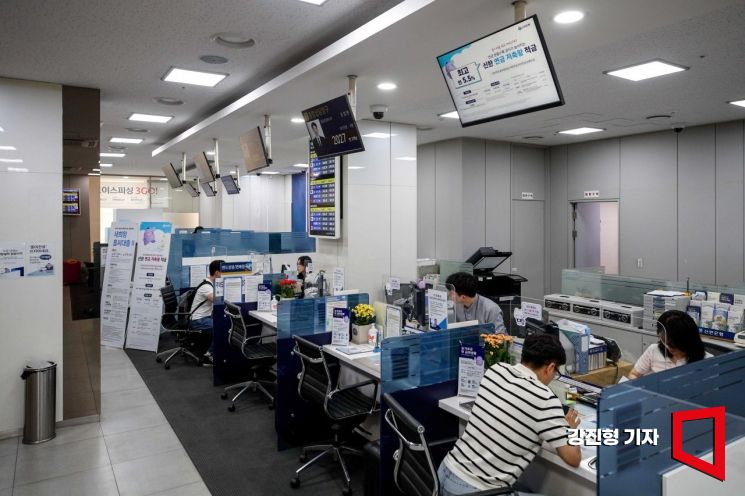 A customer is receiving consultation at the bank loan consultation desk. Photo by Jinhyung Kang aymsdream@
Refinance with Fixed Rates or Repay if You Have Extra Funds
As interest rates began rising again, 50-year term mortgage loans briefly gained popularity in the banking sector. Existing borrowers can reduce principal and interest payments by switching to longer-term products. A commercial bank official explained, "Extending the loan term delays principal repayment, reducing monthly payments, so there is considerable demand from existing borrowers to switch to 50-year mortgages to lower fixed monthly costs."
For example, a borrower who took out a 300 million KRW mortgage loan with a 3.73% variable rate for 30 years in February last year, paying 1.39 million KRW monthly, would see monthly payments drop to about 1.12 million KRW if switching to a 50-year mortgage in August this year (assuming a blended rate of 4%). This creates a strong incentive for borrowers to choose 50-year mortgages.
However, due to financial authorities' concerns that 50-year mortgages may fuel household debt growth, commercial banks have stopped selling or imposed age restrictions on these products. Gyeongnam Bank announced it will sell the product only until the 25th, NongHyup Bank until the end of this month, and KakaoBank has set an age limit of 34 years or younger starting from the 25th.
There is also a somewhat noticeable trend of borrowers repaying before further rate hikes. Another commercial bank official said, "Earlier this year, we predicted mortgage rates would fall, but recently, influenced by the U.S., the consensus has shifted to rates rising. Financial consumers with extra funds are repaying before rates increase further."
Although it is necessary to observe until the end of this month, household loan growth appears to be slowing. As of the 21st, the outstanding household loans at the five major banks totaled 678.6399 trillion KRW, down 581 billion KRW from the end of July (679.2209 trillion KRW). Notably, mortgage loans decreased by 70.8 billion KRW (from 512.8875 trillion KRW to 512.8167 trillion KRW).
© The Asia Business Daily(www.asiae.co.kr). All rights reserved.


















