- Among 4.555 million single-person employment households, about 24% are in their 30s... Urban-type 'Co-living Houses' near workplaces are popular
- 'Gasan Digital Complex Station' has the highest number of passengers getting off during rush hours... High demand for workplace-proximate housing
As the number of single-person households among the MZ generation increases, a type of shared housing called ‘Co-living House’ is gaining attention.
According to Statistics Korea, the recent population of single-person working households is 4,555,000 households, with those in their 30s accounting for the largest portion at 1,071,000 households. In particular, single-person working households aged 30 to 39 prefer locations with good accessibility to workplaces and residences, and there is high demand for ‘Co-living Houses’ supplied within urban areas.
◇ Popularity of Co-living House Brands Equipped with Shared Spaces and Communities
‘Co-living House’ refers to a residential type where both private and shared spaces are enhanced compared to the conventional concept of shared housing known as ‘Share House.’ In February this year, the Ministry of Land, Infrastructure and Transport revised related building laws to introduce the ‘rental dormitory’ use category, enabling large-scale supply that reduces construction costs through economies of scale and offers various services at affordable prices, thereby expanding the market for this new housing type.
Especially compared to small-scale studios or officetels, Co-living Houses are safer in terms of security management and free from concerns such as lease fraud. In addition to residential functions, they offer professional operation programs that enhance quality of life, attracting significant interest from young office workers as comprehensive lifestyle centers.
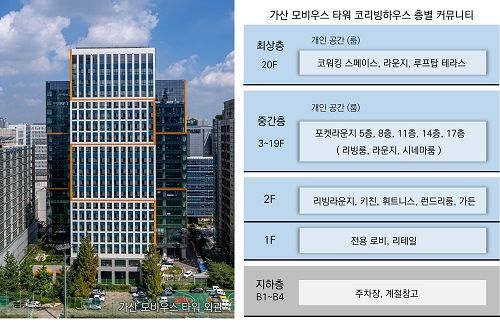 [Exterior of Gasan Mobius Tower and Floor-by-Floor Community Layout of the Coliving House / Fides Development]
Co-living Houses are noted for their abundant shared spaces that can be conveniently used whenever needed and meticulous community management tailored to residents’ needs. Particularly, large complexes with over 300 units have higher operational efficiency and are advantageous in terms of management costs.
According to a Co-living trend report based on an online survey of 462 Co-living residents across five countries?Korea, Japan, Australia, Spain, and the Philippines?conducted by SK D&D, the greatest advantage of Co-living was identified as shared spaces (lounges, kitchens, fitness centers, etc.) at 68.6%. Notably, Korean respondents rated ‘shared spaces’ as an advantage at 77.7%, the highest among the five countries. The majority of residents, 86.6%, trusted Co-living facilities operated by companies.
Reflecting diverse consumer needs, existing Co-living operators such as Share House Universe’s ‘Cellip,’ SK D&D’s ‘Episode,’ MGRV’s ‘Mangrove,’ and Homes Company’s ‘Homes Studio,’ as well as specialized Co-living House brands like ‘Heyy,’ jointly established by Yanolja Cloud and KT Estate, are steadily expanding.
◇ ‘Time is Money!’... Focus on the Work-Residence Proximity Type ‘Gasan Mobius Tower’
Analysis of Seoul subway line, station, and time-specific boarding and alighting data (January to July 2023 total) from the Seoul Open Data Plaza shows that the station with the highest number of alighting passengers during the morning rush hour (6 AM to 9 AM) is ‘Gasan Digital Complex Station.’ During the morning rush, approximately 5.3 million passengers alighted at Gasan Digital Complex Station, surpassing major Seoul central business districts such as Yeouido Station (5.07 million), City Hall Station (4.11 million), Samseong Station (3.65 million), Gangnam Station (3.5 million), and Jamsil Station (2.9 million). In 2022, Gasan Digital Complex Station also recorded the highest annual alighting number during rush hours at about 8.6 million, and commuting is expected to increase further following the lifting of pandemic social distancing measures this year.
‘Gasan Digital Complex Station’ connects to the ‘Seoul Digital Industrial Complex (G-Valley),’ the largest national industrial complex in Seoul, housing about 12,000 companies in information and communications, computers, electronics, and employing 140,000 workers. Particularly, IT software companies are concentrated in G-Valley’s 3rd district, where Gasan Digital Complex Station stops, resulting in high demand for work-residence proximity housing among young MZ generation office workers.
If workers at G-Valley secure housing near ‘Gasan Digital Complex Station,’ they can commute leisurely on foot or by electric scooter instead of navigating complex subway routes. It is also convenient for workers who board subway lines 1 and 7 at Gasan Digital Complex Station in the opposite direction of their alighting flow during the morning commute.
Meanwhile, the ‘Gasan Mobius Tower Co-living House,’ located an 8 to 10-minute walk from the busiest ‘Gasan Digital Complex Station’ during rush hours, will begin full occupancy this month. It is situated in a station area where lines 1 and 7 intersect, with the Seoul Digital Stadium to the south providing an open atmosphere, and the Anyangcheon walking trail just one minute away.
The Gasan Mobius Tower Co-living House is a 20-story building comprising a total of 386 private rooms and various community spaces. It has devised a ‘urban lifestyle center-type Co-living House’ with three key solutions: ‘compact private rooms, abundant community facilities, and services by professional operators,’ synthesizing global Co-living House cases and domestic trends. It also reflects the ‘WE DO, All in Vill, All in Room’ trends from the ‘7 Major Space Trends’ announced by Fides Development, highlighting practical space planning.
Notably, the initial planning phase benchmarked the Old Oak concept. ‘Old Oak’ is the world’s largest shared housing brand located in London, UK. Private spaces consist of small rooms of about 12m² (3.3 pyeong) with a bedroom and bathroom; rooms with mini kitchens are more expensive. Shared spaces include living rooms, kitchen dining areas, communal laundry rooms, libraries, fitness centers, game rooms, and gardens, all used collectively by residents.
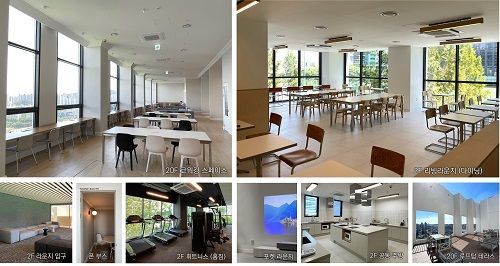
◇ ‘All in Room’ Private Spaces and ‘All in Vill’ Community Facilities ‘We Do’ Together
Private spaces vary from 10.6 to 28.33㎡. Most private spaces have ceilings expanded to over 3 meters (3.7 to 3.1 m), designed to enhance creativity. Lofts are applied in duplexes, and combined with service balcony areas, the usable space can be about 1.5 to 2 times the exclusive area.
The full-furnished system is also noteworthy. Built-in wardrobes and storage, kitchens equipped with sinks, system air conditioners, refrigerators, washing machines, and portable induction cooktops are provided as standard. Additional daily necessities can be accessed through various services offered by professional operators according to residents’ needs.
Community activity spaces are located on comfortable and scenic above-ground floors, which is a major advantage. They are diversely and three-dimensionally arranged across several floors by purpose, providing differentiated facilities and professional operational management services.
The top floor, the 20th floor, features a sky lounge and co-working space where residents can use seats for remote work, meetings, reading, ranging from single-person seats to 2-3 person seats and large conference rooms according to their needs. The outdoor rooftop terrace offers views of Anyangcheon for gatherings or relaxation.
The 2nd floor houses active community spaces. A spacious kitchen equipped with premium appliances and various sizes of dining tables provides a comfortable dining area. The laundry room is equipped with large washers and dryers, making it easy to handle bulky laundry. The fitness room (home gym) boasting city views and an outdoor garden perfect for fresh air are community facilities that enhance lifestyle.
From the 5th to the 17th floors, pocket lounges are installed every three floors in five locations, allowing residents on nearby floors easy access. These include reception rooms and lounges that can be used like living rooms to invite friends, as well as home cinemas with large screens for immersive experiences.
The basement floor includes parking and seasonal storage available for residents’ use. Residents can conveniently and affordably use all community spaces within the building without stepping outside their private rooms. To this end, Share House Universe Co., Ltd., which has extensive know-how in shared housing, manages the entire community operation as the ‘Cellipgardi’ branch.
© The Asia Business Daily(www.asiae.co.kr). All rights reserved.


















