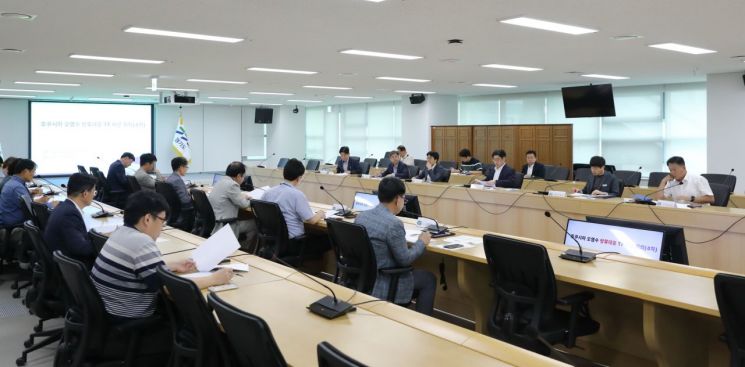
 Gyeonggi Province is holding an emergency response task force meeting on the 24th, the day the discharge of contaminated water from Fukushima was decided.
Gyeonggi Province will increase the frequency of radiation inspections on seafood produced and distributed within the province by 1.5 times in response to the imminent discharge of contaminated water from Fukushima, Japan. The province also plans to propose to the government an expansion of support for affected industries such as fishermen and small business owners.
On the 24th, Gyeonggi Province held an emergency countermeasure meeting chaired by Oh Byung-kwon, the first deputy governor of the province, to discuss measures to respond to the Fukushima contaminated water discharge.
Gyeonggi Province set the response direction to the Fukushima contaminated water discharge as prioritizing the safety and health of residents through seafood safety management and establishing a thorough response system to minimize damage. The response measures will be divided into three areas: radiation inspection, origin control, and support for affected industries, and will be prepared and implemented accordingly.
Starting from the 24th, Gyeonggi Province will operate a Fukushima contaminated water discharge response situation room led by Park Jong-min, Director of the Gyeonggi Province Agriculture, Fisheries, and Life Sciences Bureau. The situation room will be responsible for radiation inspections, origin control, public information disclosure, and support for the fisheries, distribution sectors, and small businesses such as sashimi restaurants.
Gyeonggi Province will significantly increase radiation inspections on seafood produced at Hwaseong Gungpyeong Port, Ansan Tando Port, and aquaculture farms from twice a month to once a week, raising the number of inspections from 271 to 400.
Radiation inspections on distributed seafood at wholesale markets, large logistics centers, department stores, G-Mark certified products, and school meals will also be expanded from 1-2 times a month with 1,500 inspections to once a week with 2,300 inspections.
Radiation inspection results will be promptly provided to residents through the Gyeonggi Province website, 102 outdoor air environment electronic display boards, and about 8,500 bus stop electronic display boards. A communication channel will be established to address residents’ questions related to Fukushima contaminated water.
Gyeonggi Province has also prepared measures to strengthen origin control, focusing on cracking down on false labeling such as origin box switching, with penalties including imprisonment of up to seven years or fines of up to 100 million KRW upon detection.
Additionally, a joint public-private honorary monitor system for origin labeling will be operated, expanding the inspection targets from about 3,700 to 4,000 locations. The inspection targets include restaurants and retail stores with a history of importing seafood from Japan.
To support the fisheries industry, which is expected to suffer the greatest damage from the contaminated water discharge, Gyeonggi Province plans to propose national funding for compensation due to consumption decline and health management costs related to radiation exposure.
To minimize the decline in seafood consumption, promotional events will be promoted, and for high-consumption seafood such as gim (seaweed) and solar salt, which are expected to see price drops due to the discharge, the province plans to propose government stockpiling measures.
Furthermore, loans and damage support for small businesses such as sashimi restaurants, support funds for industry conversion, and sales credit insurance premium support to prevent the chain bankruptcy of seafood processing companies will also be considered.
Sales credit insurance is a system that compensates a portion of losses if a company that has insured itself fails to collect payment after selling goods or services on credit.
A Gyeonggi Province official stated, "Since the news of the Fukushima contaminated water discharge became known in April, under the direction of Governor Kim Dong-yeon, we formed a dedicated team to prepare countermeasures and held four meetings to establish discharge measures. We will proceed with measures as quickly as possible to secure safe food for 14 million residents and minimize damage especially to fishermen and small business owners."
Meanwhile, on the 23rd, Governor Kim Dong-yeon of Gyeonggi Province strongly urged in a statement, "The Japanese government must immediately withdraw its plan to discharge radioactive contaminated water, which violates conscience and morality, and the government of the Republic of Korea must demand the immediate withdrawal from the Japanese government."
© The Asia Business Daily(www.asiae.co.kr). All rights reserved.

















