President Gilda Barabino and President Oh Yongjun of Hanbat National University Dialogue
Olin College of Engineering, Established in 2002... Approximately 350 Students
Project-Based Classes Without Department Divisions
Students Set Their Own Learning Process... 'Autonomous Being' as the Highest Value
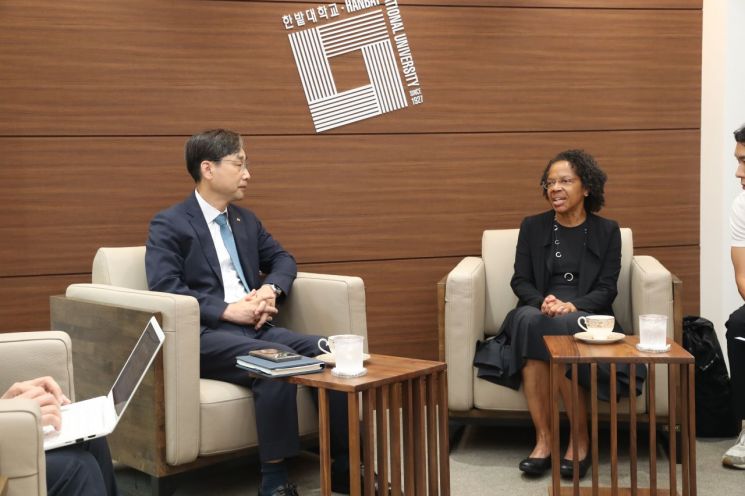 Oh Yong-jun, President of Hanbat National University (left), is having a discussion about university innovation with Gilda A. Barabino, President of Olin College of Engineering. Provided by Hanbat National University
Franklin W. Olin College of Engineering (hereinafter Olin College) is regarded as one of the most innovative universities in the world. Just four years after its founding, in 2006, it was selected by Newsweek as one of the 25 prestigious universities in the United States, becoming part of the so-called "New Ivies" group.
The university attracted attention by consecutively appearing on lists such as "Best Colleges in the U.S. (2018)" by the college information site College Factual, "Best Colleges in the Northeastern U.S. (2018)" by Princeton Review, and "20 Most Valuable Colleges (2019)" by CNBC. This is considered the result of continuous innovation that breaks away from the traditional framework of education and universities.
Gilda A. Barabino, president of Olin College, who visited Korea, held a dialogue on "Educational Innovation at Olin College" on the 22nd at the president's office of Hanbat National University in Daejeon with Oh Yong-jun, president of Hanbat National University. The format was President Oh asking about Olin College’s innovations and President Barabino responding. Asia Economy attended this dialogue to convey the opinions exchanged by the two on university educational innovation to readers.
- (President Oh’s question) How has Olin College been operated since its establishment?
▲ (President Barabino’s answer) Our university is a four-year undergraduate engineering college established in 2002 by the Franklin W. Olin Foundation. The total student body is around 350, with a faculty of 40. The student-to-faculty ratio of just 9 to 1 enables deep, student-centered education. Each year, we admit 80 to 90 freshmen. Students applying to our university have the capability to enter Harvard University or Massachusetts Institute of Technology (MIT), and we pride ourselves on having faculty of the highest caliber. Although majors are divided into mechanical engineering, electrical and computer engineering, and general engineering, there are no departmental boundaries, allowing for interdisciplinary education. Additionally, areas difficult to cover within an engineering college such as humanities, natural sciences, social sciences, and arts are supplemented through exchanges (interdisciplinary education) with nearby institutions like Babson College and Wellesley College.
 Gilda A. Barabino, President, is introducing the College of Engineering's university innovation process. Provided by Hanbat National University
- Why is Olin College considered a representative success case of university innovation?
▲ Our university departs from the traditional engineering education model that starts with theory and instead implements hands-on, experiment-focused field education from the beginning. Since its founding, we have provided students with full financial support and an education that pursues "experimentation and innovation." Through this, both students and the university have grown together. As a result, despite its short history, Olin College has become a successful model of university innovation that institutions worldwide, including Hanbat National University, seek to benchmark. Moving forward, our university will continue to attempt entirely new educational methods differentiated from other universities and strive to share these globally.
- Please introduce Olin College’s "project-based curriculum," which has become a major benchmarking target.
▲ Our university has no "departments," and professors and students freely conduct classes centered on projects. This is where interdisciplinary teaching and learning opportunities begin. The culture of learning across multiple fields forms the foundation for students and professors to create new types of project classes together. Students typically undertake one to two team projects per semester. Projects are student-led, with professors acting only as coaches. In the process where students define problems and find solutions themselves, professors serve as facilitators.
- How are students evaluated during projects?
▲ Students and professors first design the new curriculum projects and conduct pilot classes without grades. During the course, they suggest ideas to improve the class and jointly consider whether to continue or modify the project, concretizing these plans. This can be seen as a form of peer teaching that enhances class quality. Student evaluation is based on the entire process leading to the project outcome. For example, how well students absorb feedback from professors and others, and whether improvement and growth occur, are included in the evaluation criteria. Conversely, exams for evaluation are minimal, held only in one or two subjects per semester.
- How is faculty evaluation conducted within the university?
▲ First, there are no tenured professors at Olin College. Even the president is a contract employee, with reappointment decided every five years through evaluation. For evaluation, professors submit an annual report to the review committee describing the academic and social impact of their teaching and research. The committee then evaluates the professor based on this report. The professor’s role is assessed from perspectives such as "students (educational competence)," "institution (organizational contribution)," and "society (broad evaluation)," examining how faithfully each role was fulfilled. Professors are reappointed every five years and must submit a very detailed report explaining their achievements along with a new application at reappointment.
 Oh Yong-jun, President of Hanbat National University (left), is having a discussion about university innovation with Gilda A. Barabino, President of Olin College of Engineering. Photo by Hanbat National University
- What educational values does Olin College pursue?
▲ We place the highest value on students becoming "autonomous beings" who set their own learning processes and grow through the joy of learning. We see the university’s core role as helping students design classes in ways they desire and build their own portfolios. In this process, Olin College professors prepare several times more than students to conduct classes tailored to students’ diverse interests.
- Are there plans for future exchanges with Hanbat National University?
▲ As president of Olin College, my goal is to expand our university’s innovation model to the global stage through active international cooperation. To this end, our university strives to approach social stakeholders and overseas institutions directly. In particular, through continuous exchanges with Hanbat National University, we aim to transplant the strengths of the Olin College model and become a relationship that spreads it throughout the Asian region.
▲ Born in Alaska, USA
▲ Bachelor’s degree in Chemistry from Xavier University
▲ Ph.D. in Chemical Engineering from Rice University
▲ Professor at Georgia Tech
▲ Professor at Northeastern University
▲ Current President of Olin College
▲ Current President of the American Association for the Advancement of Science (AAAS)
© The Asia Business Daily(www.asiae.co.kr). All rights reserved.



















