"Dining at 5-Star Luxury Hotels Is 'Hip'"
Domestic Tourism Trend Seeking 'Korean-Style' Experiences
Growing Demand from Domestic Staycationers for Unique Experiences
"Selling Tteokbokki at a 5-star hotel?"
What used to be a puzzling question just a few years ago has now become a new trend in the hotel industry. Unique menus that truly capture the essence of Korean cuisine?such as tteokbokki, pork ssambap, and golbaengi?are appearing one after another in hotel in-room dining (room service), which was previously dominated by Western dishes like pasta and risotto. While the majority of orders come from foreign tourists who are highly interested in Korean culture and want to experience the "most Korean" dishes, recently, domestic customers enjoying "luxury hotel vacations" have also increasingly ordered Korean room service as a unique experience.
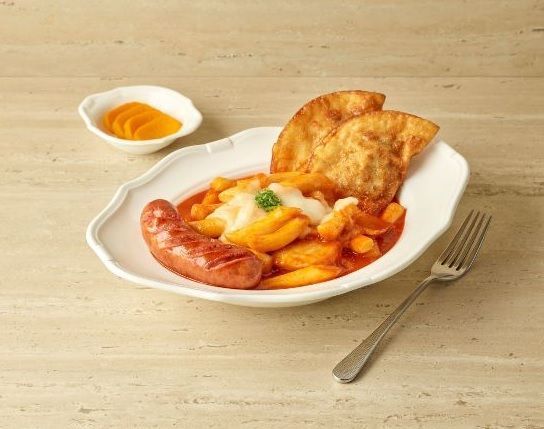 'Palace Tteokbokki,' a room service menu item at Chosun Palace
 [Photo by Shinsegae Chosun Hotel & Resort]
According to Shinsegae Chosun Hotel & Resort on the 24th, Chosun Palace, classified as a luxury brand, recently added six Korean dishes including "Palace Tteokbokki," "Our Pork Ssambap Set," and "King’s Surasang." Although they had previously offered simple Korean dishes like "Sirloin Jjapagetti," the proportion of Korean dishes on the room service menu was increased due to the rising number of foreign tourists and growing demand to taste Korean food.
The most popular newly added Korean dish is pork ssambap. Chosun Palace developed this menu after noticing that many foreign tourists visiting the hotel recently asked the concierge for "the best pork restaurants." About a month after its launch, the on-site response has been positive. More than one-third of foreign guests order Korean dishes, and inquiries and requests for explanations about the menu at the front desk have noticeably increased.
A representative from Chosun Palace said, "While maintaining the basic Western-style room service lineup such as salads, burgers, and pasta, we developed premium Korean dishes to meet customer demand for experiencing diverse K-foods. Initially, the order ratio was high among foreign tourists, but now there is also considerable demand from domestic customers."
Westin Chosun Seoul and Four Points by Sheraton Chosun Seoul Myeongdong are also offering promotions centered on Korean cuisine. Westin Chosun Seoul operates events such as "Chimaek Day," "Makgeolli & Dubu Kimchi Day," and "Bokbunja Day" every month at the Westin Club on the top floor, targeting foreign guests. Four Points by Sheraton Myeongdong leverages its location in Euljiro to offer unique menu items like "Chicken & Golbaengi Fried" at its Lounge & Bar.
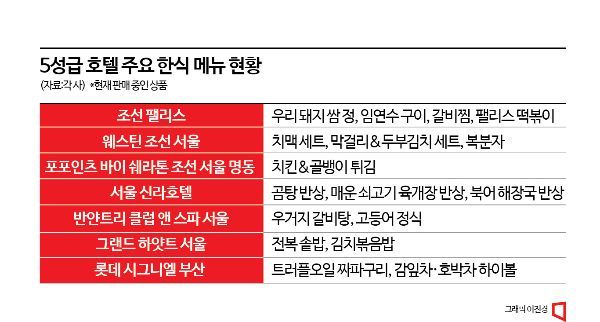
Additionally, major 5-star hotels such as The Shilla Seoul, Banyan Tree Club & Spa, Grand Hyatt Seoul, and Lotte Signiel Busan are presenting representative Korean dishes with their own luxurious twists, including "Ugeoji Galbitang," "Abalone Sotbap," and "Truffle Oil Jjapaguri."
The reason these unique Korean dishes are popular among both domestic and international customers is attributed to changing domestic travel trends and the "flex" craze among the domestic MZ generation (Millennials + Gen Z). Unlike before, when foreign tourists mainly enjoyed standardized trips centered around major tourist spots, the development of social networking services (SNS) has increased demand for unique places and Korean dishes, from street food stalls to regional specialties, that are less well known. Moreover, among domestic hotel vacationers, enjoying tteokbokki and kimchi fried rice at a 5-star hotel is now recognized as a new unique experience, which has helped these dishes quickly gain popularity among younger generations through word of mouth.
Dr. Sujin Lee from Seoul National University’s Department of Consumer Studies explained, "Among foreign tourists, 'traveling like a true Korean' is becoming a new travel trend, and as a result, the proportion of orders for unique Korean dishes like jjapaguri, which they couldn’t eat during their trip, is high in room service. For domestic customers, enjoying very everyday dishes like kimchi fried rice in the luxurious space of a hotel is perceived as a new unique experience. It seems that young people are enjoying their own culture."
© The Asia Business Daily(www.asiae.co.kr). All rights reserved.
![Clutching a Stolen Dior Bag, Saying "I Hate Being Poor but Real"... The Grotesque Con of a "Human Knockoff" [Slate]](https://cwcontent.asiae.co.kr/asiaresize/183/2026021902243444107_1771435474.jpg)

















