Imsil-gun, Jeonbuk announced on the 23rd that it has added 10 more Recycling Neighborhood Yards (Clean Houses) to improve proper waste separation and increase the collection rate of recyclables, and has started full-scale operation from this month.
The county currently operates 82 household waste separation facilities (18 key discharge facilities, 13 Recycling Neighborhood Yards, and 51 joint collection centers).
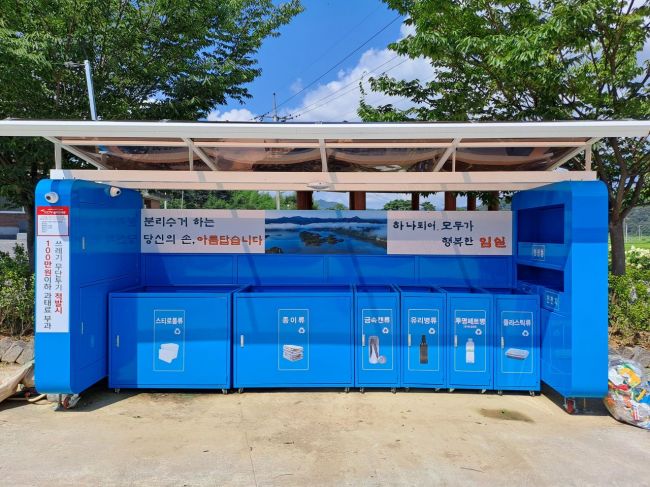
The Recycling Neighborhood Yard is a key collection facility where a house-shaped simple building is installed at household waste discharge points, allowing residents to separately dispose of recyclable resources such as plastics used and discarded at home, as well as paper, vinyl, bottles, cans, and clear PET bottles.
Since December last year, the county conducted a status and demand survey targeting 12 towns and townships in the area for additional installation of Recycling Neighborhood Yards, and after on-site inspections of candidate sites, completed the additional installations.
The facility is available for residents to use at any time without time restrictions, and local residents are hired as Green Keepers to continuously manage the Clean Houses by keeping them clean and guiding residents on proper waste separation.
The county is continuously promoting a recycling exchange project throughout the year to raise environmental awareness through environmental pollution prevention and recycling environmental practice movements by exchanging recyclables discarded after use at home for toilet paper and new batteries.
The exchange criteria are as follows according to the quantity submitted per item: ▲ 5 paper packs of 1,000ml, 10 packs of 500ml, 20 packs of 200ml ▲ 5 used batteries ▲ 5 ice packs ▲ 2 plaques can be exchanged for 1 roll of toilet paper or 1 new battery.
Paper packs include milk packs, juice packs, and soy milk packs. After emptying the contents, rinse with water, unfold, and dry them. Ice packs should be washed, dried, and then brought to the nearest town or township office.
Milk, juice, and soy milk paper packs are excellent resources made using premium natural pulp, which is mostly imported, and can be reborn as high-quality toilet paper and beauty tissues. However, since they are mixed with waste paper when disposed of, only a portion of the amount discharged is recycled.
Also, used batteries contain many chemicals such as mercury, nickel, and cadmium. If discarded in the soil, they corrode and pollute the soil and water quality. However, recycling them recovers valuable metal resources such as iron, zinc, and nickel.
County Governor Sim Min said, “We will create a cleaner street environment through efficient collection and processing of recyclable resources,” and added, “We ask residents to actively cooperate in practicing proper waste separation.”
Imsil = Asia Economy Honam Reporting Headquarters, Reporter Park Nosik baekok@asiae.co.kr
© The Asia Business Daily(www.asiae.co.kr). All rights reserved.

















