Operation of Joint Emergency Situation Rooms for Provinces, Cities, and Counties, etc.
Gyeongsangnam-do will operate a joint emergency situation room with the provincial, city, and county governments starting from the 23rd to alleviate residents' anxiety caused by the discharge of contaminated water from the Japanese nuclear power plant into the ocean.
On the 22nd, the Japanese government announced that it would begin discharging contaminated water from the Fukushima Daiichi Nuclear Power Plant into the ocean as early as the 24th.
In response, Gyeongnam Province announced on the 23rd that it has established post-discharge measures focusing on ▲strengthening residents' reassurance ▲enhancing support for the fisheries industry ▲promoting and expanding the consumption and sales of seafood products, and will implement these measures.
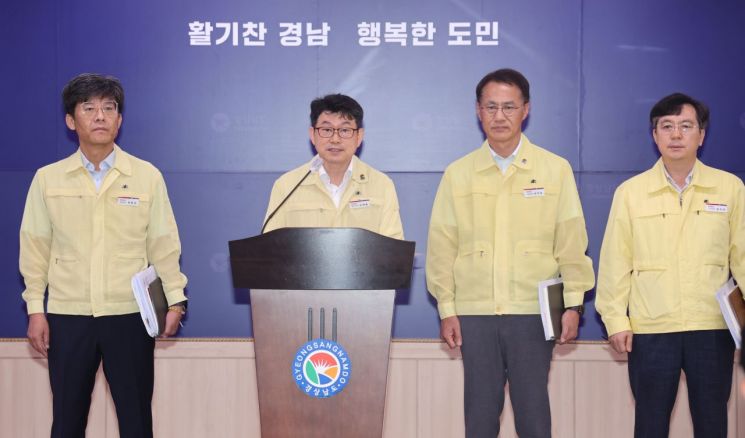 Kim Je-hong, Director of the Marine and Fisheries Bureau of Gyeongnam Province, is announcing future measures in response to the discharge of contaminated water from the Japanese nuclear power plant into the ocean.
 [Photo by Gyeongnam Provincial Government]
First, a ‘Joint Emergency Situation Room of Province, City, and County’ consisting of 15 members in 3 teams will be established at the Provincial Fisheries Safety Technology Institute.
The number of radiation tests on seafood at the production stage will be increased from 20 to 40 per week, and origin inspections of imported Japanese seafood will be conducted daily.
Resident-observed radiation tests will increase from once a month to once a week, and the process will be broadcast live through the official YouTube channel ‘Gyeongnam TV’.
Sixty honorary monitors will be selected, and from September to the end of the year, origin inspections of imported seafood, including Japanese products, will be conducted in all cities and counties.
Results of seafood radiation tests will be communicated to residents via electronic billboards in all cities and counties within the province, and radiation safety information for seafood will be continuously disseminated using social networking services (SNS) and text messages.
QR codes will be inserted into promotional materials such as posters, leaflets, and signboards related to seafood safety and origin labeling to allow immediate access to radiation safety information posted on the provincial website.
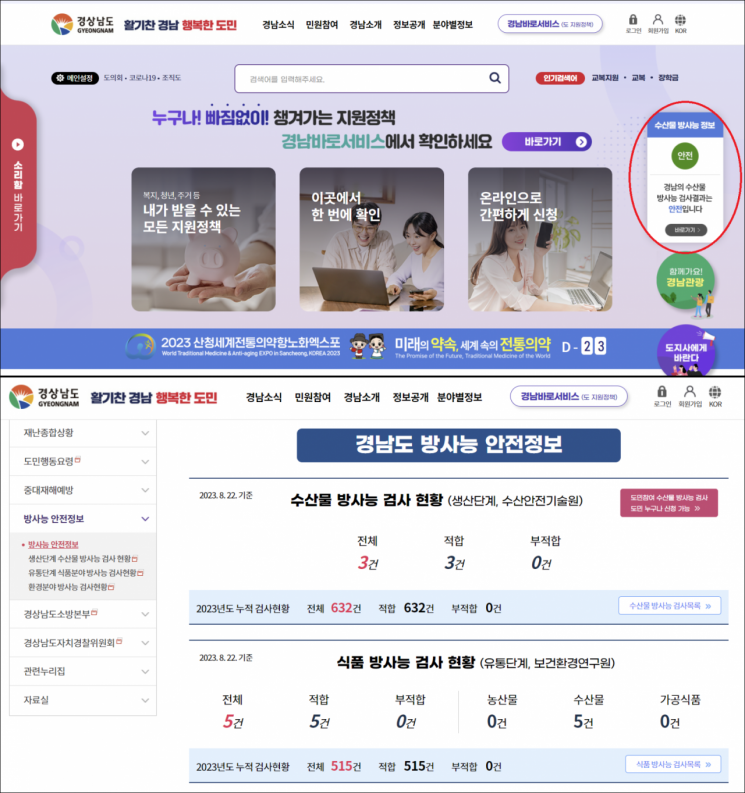 Status of radioactive contamination information on seafood on the Gyeongsangnam-do official website. [Image source: Captured from the Gyeongsangnam-do official website]
To prepare for the contraction of the fisheries industry within the province, designation as an industrial crisis preemptive response area will be pursued.
In order to establish support grounds for primary industries such as fisheries, which are not covered by current laws including the Special Act on Regional Industrial Crisis Response and Regional Economic Recovery, proposals will be submitted to government ministries such as the Ministry of Trade, Industry and Energy by September this year to revise enforcement ordinances and notifications.
The province anticipates an inevitable sharp decline in seafood consumption due to the discharge of contaminated water from the nuclear power plant and, as the first local government, has secured 1.6 billion KRW in reserve funds to be invested in revitalizing local seafood consumption from September to December.
Measures include ▲promoting discount sales of local seafood through online and offline distributors ▲signing agreements with the Korea Chain Store Association, Gyeongnam Merchants Association, followed by agreements with Coupang and Market Kurly ▲supporting the price difference between delivery price and market price when supplying seafood to corporate cafeterias of large companies in shipbuilding, defense, and nuclear power sectors within the province.
Seafood consumption promotion events linked to local festivals and other events, as well as large-scale discount sales events organized by the province, will also be held.
Previously held seminars inviting experts in radiation and fisheries in Changwon and Tongyeong will continue to be held in the future.
Kim Je-hong, Director of the Marine and Fisheries Bureau, said, “We will conduct more thorough inspections and vigilant monitoring to ensure that residents can consume seafood with peace of mind.”
© The Asia Business Daily(www.asiae.co.kr). All rights reserved.
![Clutching a Stolen Dior Bag, Saying "I Hate Being Poor but Real"... The Grotesque Con of a "Human Knockoff" [Slate]](https://cwcontent.asiae.co.kr/asiaresize/183/2026021902243444107_1771435474.jpg)

















