First Integrated Analysis After the Enforcement of the Urban Agriculture Act
Spread of New Trends Such as Companion Plants, Plant Caretakers, and Planterior
An analysis has revealed that the value of urban agriculture, which involves growing crops such as lettuce, trees, and flowers in city gardens and engaging in related experiential and leisure activities, amounts to 5 trillion won.
On the 23rd, the Rural Development Administration announced that the total value of urban agriculture, based on an analysis of its economic, social, and environmental values, was found to be 5.2367 trillion won.
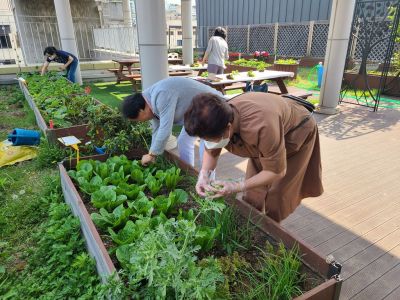
Urban agriculture has rapidly grown since the enactment of the Urban Agriculture Act in 2011 (implemented in 2012) and through the first and second five-year urban agriculture promotion plans. As of last year, the number of urban farmers exceeded 2 million, and the area of urban gardens reached 1,052 hectares. While the area of urban gardens in South Korea had been steadily expanding, the growth slowed due to gathering restrictions caused by the COVID-19 pandemic, whereas interest in indoor urban agriculture increased. The spread of new trends such as companion plants, plant caretakers, and plant interior design (planterior) has also led to increased interest in various services and products.
Accordingly, the Rural Development Administration conducted a value analysis together with professors specializing in the Korean Agricultural Economics Association to objectively evaluate the value of urban agriculture and establish directions for industry development.
The value analysis was calculated based on classifications derived from public institution statistical data collections, prior research, and urban agriculture-related laws. Economic value was analyzed through direct and indirect effect assessments, while social and environmental values were analyzed using surveys on citizen participation, awareness, willingness to pay, future participation intentions, and policies.
According to the analysis, the economic effects of urban agriculture include ▲an increase in agricultural product consumption due to experiential activities amounting to 57.3 billion won ▲industrial ripple effects such as agricultural materials and job creation totaling 3.0517 trillion won, summing up to a total of 3.109 trillion won. This is because hands-on cultivation and management experiences increase agricultural product purchases and consumption, which in turn boosts farmers’ incomes.
The social value of urban agriculture was analyzed as totaling 1.3416 trillion won, including ▲health promotion through physical activity and psychological and emotional stability valued at 421.1 billion won ▲community restoration through improved family relationships and increased neighborly exchanges at 145.5 billion won ▲cultural value through activation of leisure and hobby activities at 306.2 billion won ▲and educational enhancement effects provided to future generations at 468.8 billion won.
The environmental value was found to be 786.1 billion won in total, including ▲ecological value from biodiversity enhancement at 181 billion won ▲environmental purification value from air-purifying plants, carbon reduction, and mitigation of urban heat island effects at 185.4 billion won ▲and 178.9 billion won from rooftop greening and urban greening.
Kim Myung-soo, Director of the National Institute of Horticultural and Herbal Science at the Rural Development Administration, stated, "This analysis is significant as it is the first comprehensive study integrating the technological performance and industry field cases regarding the economic, social, and environmental values of domestic urban agriculture." He added, "The Rural Development Administration plans to provide this data as policy material to the Ministry of Agriculture, Food and Rural Affairs to be used as a basis for establishing urban agriculture policies that support the joint development of urban and rural areas."
© The Asia Business Daily(www.asiae.co.kr). All rights reserved.
![Clutching a Stolen Dior Bag, Saying "I Hate Being Poor but Real"... The Grotesque Con of a "Human Knockoff" [Slate]](https://cwcontent.asiae.co.kr/asiaresize/183/2026021902243444107_1771435474.jpg)
















