The government announced on the 22nd that it has determined there are "no scientific or technical issues with the plan" regarding Japan's scheduled release of radioactive contaminated water from Fukushima into the ocean on the 24th. However, the government stated that if the discharge proceeds even slightly differently from the plan, it will immediately request a halt to the release.
Park Gu-yeon, the First Deputy Minister of the Office for Government Policy Coordination, said at a daily briefing on Fukushima contaminated water held at the Seoul Government Complex in the afternoon, "We were informed in advance about the decision to start the discharge at the Japanese Cabinet meeting," and made the statement.
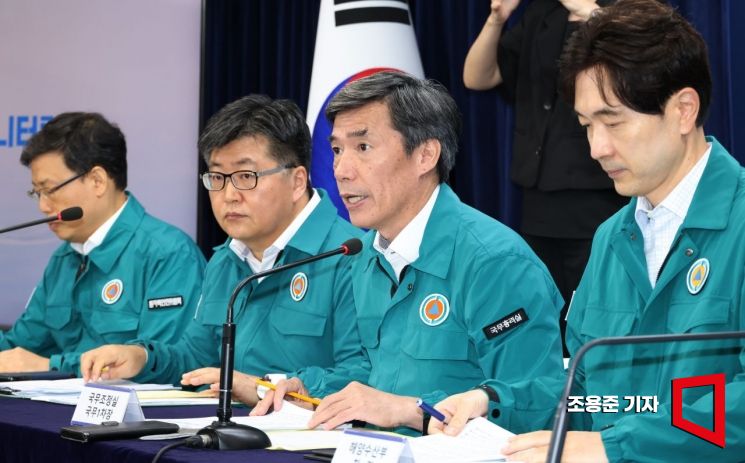 On the 22nd, Park Gu-yeon, the First Deputy Director of the Office for Government Policy Coordination, attended a daily briefing related to the discharge of contaminated water from the Fukushima nuclear power plant held at the Government Seoul Office in Jongno-gu, Seoul. He explained the government's position on Japan's discharge of contaminated water, following the Japanese government's announcement to release the contaminated water starting from the 24th. Photo by Jo Yong-jun jun21@
Immediate Halt Requested if Japan’s Discharge Plan Deviates
He added, "Today’s judgment by our government targets Japan’s discharge plan, and if the actual discharge proceeds even slightly differently from the plan, it will be judged as threatening the safety and health of our people, and we will immediately request Japan to stop the discharge."
Regarding one of the three demands President Yoon Suk-yeol made at the Korea-Japan summit on the 12th of last month?the dispatch of Korean experts?Park said, "Following the International Atomic Energy Agency (IAEA) proposal, our side will regularly visit the Fukushima nuclear power plant field office."
The government announced that it has agreed for Korean experts to participate at the Fukushima nuclear power plant field office. Park stated, "To enhance the transparency and reliability of contaminated water disposal, we have completed consultations with the IAEA and Japan on having our experts participate in the Fukushima nuclear power plant field office operated by the IAEA."
Regarding real-time monitoring information provision of the contaminated water discharge, Park explained, "Japan plans to post related data on its website every hour in cooperation with the IAEA and provide the information in Korean as well."
Additionally, Park said that among the four recommendations from Korea’s Nuclear Safety and Security Commission and Korea Institute of Nuclear Safety (KINS), regarding △ re-executing radiation impact assessments when changing the crew port and △ evaluating resident exposure doses based on actual radionuclide emissions, appropriate measures will be prepared under IAEA review.
For the remaining △ shortening the inspection cycle of the ALPS filter (cross-flow filter) and △ adding five radionuclides to the annual ALPS inlet/outlet concentration measurements, Japan will discuss the appropriateness of the cross-flow filter inspection cycle based on the results of the upgraded ALPS facility improvements, and both sides will continue technical consultations.
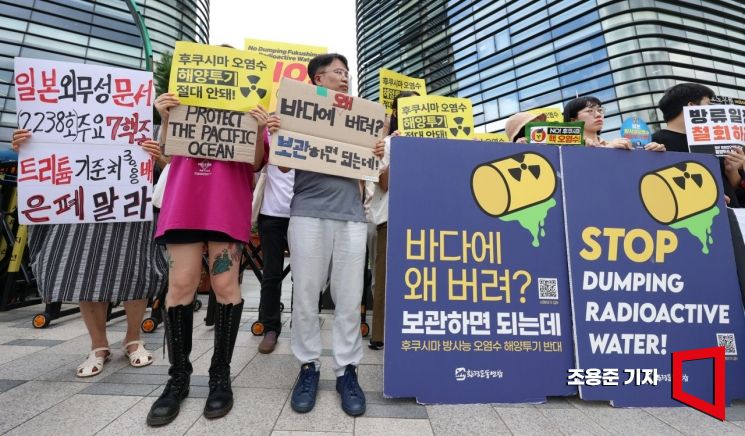 On the afternoon of the 22nd, when the Japanese government decided to begin the ocean discharge of contaminated water from the Fukushima nuclear power plant as early as the 24th, members of the Joint Action to Stop the Ocean Dumping of Radioactive Wastewater held a press conference in front of the Japanese Embassy in Jongno-gu, Seoul, demanding the withdrawal of the ocean dumping schedule. Photo by Jo Yongjun jun21@
Expansion of Radiation Monitoring Scope
The scope of marine radiation monitoring will also be expanded. Park added, "We plan to significantly extend beyond our waters to proactively investigate the impact of contaminated water on the ocean at the early stage of discharge and actively verify and check whether Japan complies with the discharge plan."
The additional investigation areas include △ waters near Pacific island countries and △ the open waters of the northwest Pacific near Japan. Initially, in the waters near Pacific island countries, investigations will begin next year at 10 fixed points where the radiation concentration of the North Equatorial Current connected to the Kuroshio Current, which flows directly into our waters, can be checked.
As part of marine radiation monitoring, joint marine radiation research will be promoted, including building research infrastructure with Pacific island countries by 2025. Park said, "The open waters survey near Japan will be conducted at eight fixed points in two areas about 500 to 1600 km from the Fukushima Daiichi Nuclear Power Plant, considering ocean current flows. The open waters survey has been conducted monthly since June following a pilot survey in April, and will continue except during the winter months (November to March) when sailing is difficult due to weather conditions."
Park concluded, "Our government has established double and triple verification and inspection procedures to ensure that the contaminated water discharge does not affect the safety and health of our people, and when the discharge actually occurs, we will maintain vigilance so that these procedures operate flawlessly without any gaps."
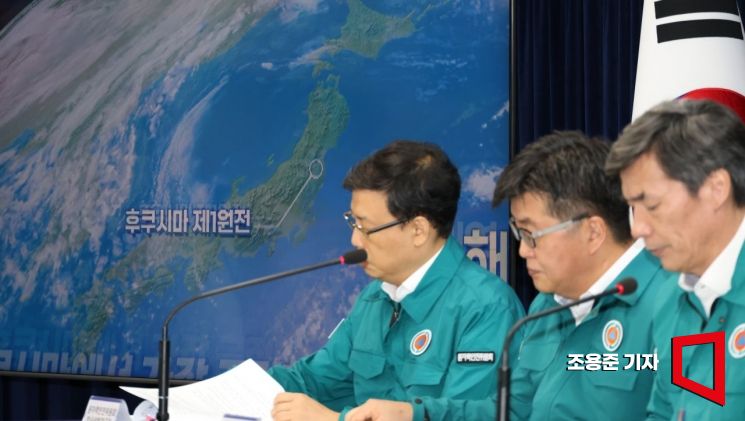 On the afternoon of the 22nd, Park Gu-yeon, First Deputy Director of the Office for Government Policy Coordination, attended a daily briefing related to the discharge of contaminated water from the Fukushima nuclear power plant at the Government Seoul Office in Jongno-gu, Seoul, explaining the government's position on Japan's discharge of contaminated water, following the Japanese government's announcement to release the contaminated water starting from the 24th. Photo by Jo Yong-jun jun21@
© The Asia Business Daily(www.asiae.co.kr). All rights reserved.



















