"If Weather and Sea Conditions Are Favorable, Release on the 24th"
Conclusion Reached 12 Years After the 2011 Great East Japan Earthquake
Struggling to Prepare Measures to Regulate Domestic Fishermen and Overseas Imports
The Japanese government has decided to discharge contaminated water from the Fukushima Daiichi Nuclear Power Plant into the ocean on the 24th. This marks the confirmation of ocean discharge 12 years after the Great East Japan Earthquake in 2011. While the Japanese government emphasizes the International Atomic Energy Agency (IAEA)'s approval of the safety of the discharge and is rushing to proceed with the discharge as soon as possible, strong opposition from neighboring countries and fierce backlash from fishermen within Japan are expected, indicating that there will be difficulties during the discharge process.
Kishida: "Discharge is an unavoidable task... Complies with IAEA safety standards"
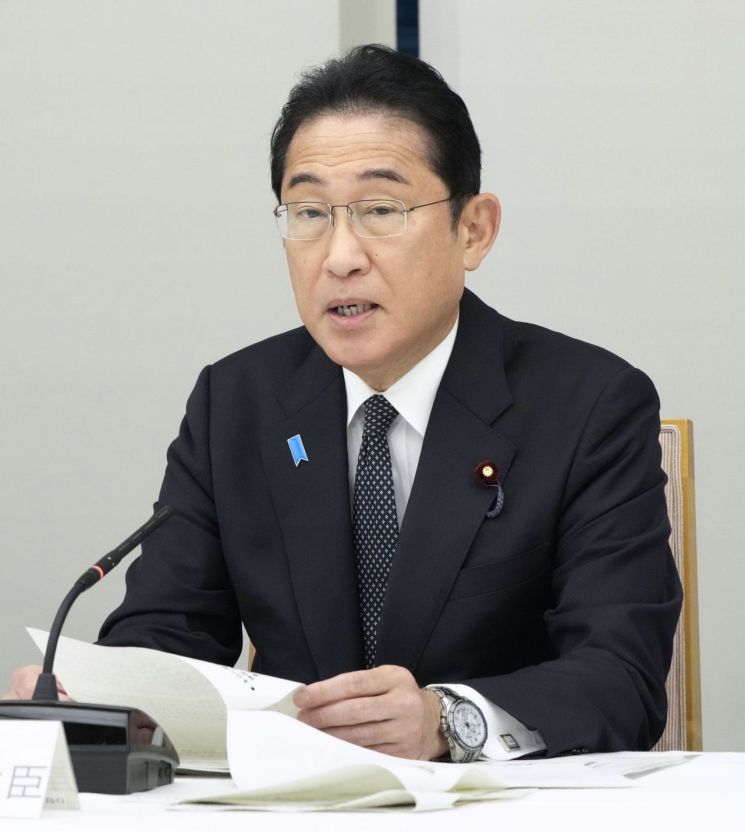 Japanese Prime Minister Fumio Kishida stated on the 22nd regarding the start of the release of contaminated water from the Fukushima Daiichi Nuclear Power Plant into the ocean, "If there are no weather or other disruptions, we expect to begin the release on the 24th."
 [Image source=Yonhap News]
Japanese Prime Minister Fumio Kishida held a meeting with relevant ministers at 10 a.m. on the 22nd and announced that the schedule for discharging contaminated water from the Fukushima Daiichi Nuclear Power Plant is set for the 24th. Prime Minister Kishida stated, "The specific date is expected to be the 24th if there are no disruptions due to weather or sea conditions," and emphasized, "The disposal of water treated by the Advanced Liquid Processing System (ALPS) is an unavoidable task to realize the reconstruction of Fukushima. The decision on disposal was made based on expert reviews conducted over more than six years."
He also highlighted the report by the International Atomic Energy Agency (IAEA), which legitimized Japan's contaminated water discharge. Kishida said, "Last month, the IAEA released a report concluding that the response to ocean discharge and related activities comply with international safety standards," and reiterated, "The IAEA will continuously review safety during the discharge process, and the Japanese government will respond firmly."
Prime Minister Kishida further mentioned that understanding of the contaminated water discharge is spreading in the international community. He added, "We are responding based on scientific evidence, and broad understanding and support have been expressed from other regions and countries," and "I believe accurate understanding in the international community is expanding."
12 years since the Great East Japan Earthquake in 2011... Discharge planned for the next 30 years
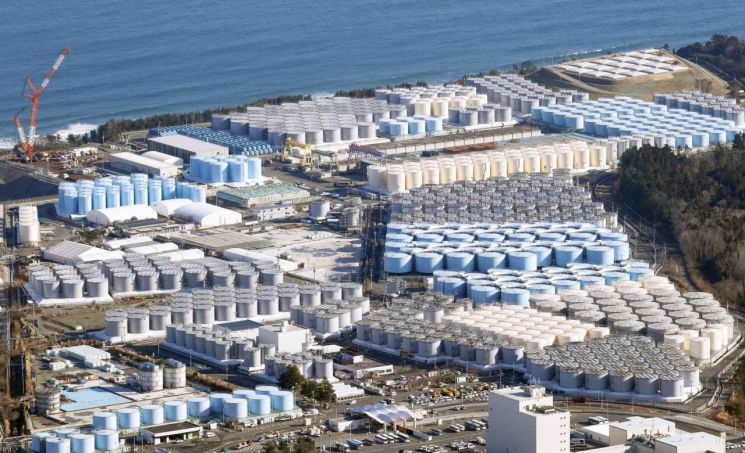
This discharge decision was made 12 years after the Fukushima nuclear accident caused by the Great East Japan Earthquake on March 11, 2011. During the Great East Japan Earthquake, a tsunami damaged all reactors 1 to 4 at the Fukushima nuclear power plant, leading to reactor meltdowns and ultimately hydrogen explosions, resulting in a major accident with massive radioactive material leakage.
Immediately after the accident, Tokyo Electric Power Company (TEPCO) circulated water to cool the reactors generating heat. This cooling water came into contact with nuclear fuel, producing a large amount of contaminated water. While circulating contaminated water within the reactors would not be problematic, rainwater and groundwater entering the reactor buildings caused additional contaminated water to be generated. The daily contaminated water generation, which was 493 cubic meters (㎥) in 2016, has gradually decreased to about 140 ㎥ per day currently.
There are currently about 1,000 tanks storing this contaminated water, containing 1.32 million ㎥ of contaminated water. The total tank capacity is 1.37 million ㎥, and 96% of it is filled. The Japanese government has expressed concerns that the tanks will be full by this summer or fall and argues that discharging this contaminated water is inevitable for decommissioning.
Accordingly, in March 2013, the Japanese government introduced the Advanced Liquid Processing System (ALPS) to purify the contaminated water continuously generated during the decommissioning process. In September of the same year, Nuclear Regulation Authority Chairman Junichi Tanaka first officially mentioned the plan to discharge contaminated water, sparking global controversy. The idea was to use ALPS and then dilute the remaining substances that could not be filtered to levels considered safe before discharging them. This led to criticism questioning whether ocean discharge was the best option despite alternatives like atmospheric release.
Moreover, news reports revealed that since 2013, TEPCO had been secretly discharging contaminated water generated in Fukushima into the ocean, intensifying the controversy. In response, in 2014, TEPCO sought understanding from local fishermen in Fukushima Prefecture and nearby areas and discharged purified groundwater pumped before it flowed into the reactor buildings. This meant unofficial discharge procedures existed even before the official contaminated water ocean discharge.
In August 2015, the Japanese government, TEPCO, the Fukushima Fisheries Cooperative Association Federation, and the National Federation of Fisheries Cooperative Associations exchanged promises not to dispose of contaminated water without the understanding of related parties. Since this promise was documented, if the Japanese government discharges contaminated water without persuading fishermen, it would effectively break this agreement.
Therefore, persuading fishermen was considered the final hurdle for the Japanese government before discharging contaminated water. Prime Minister Fumio Kishida personally met with fishermen representatives, and Minister of Economy, Trade and Industry Yasutoshi Nishimura visited Fukushima and Sendai almost every weekend for this reason. In September of the same year, TEPCO discharged contaminated water purified by ALPS around the reactor buildings with the consent of fishermen.
Subsequently, the Japanese government judged that ocean discharge of contaminated water was the most appropriate method and began preparing supporting evidence. In June 2016, an expert panel under the Ministry of Economy, Trade and Industry expressed the opinion that ocean discharge was "the quickest and cheapest method."
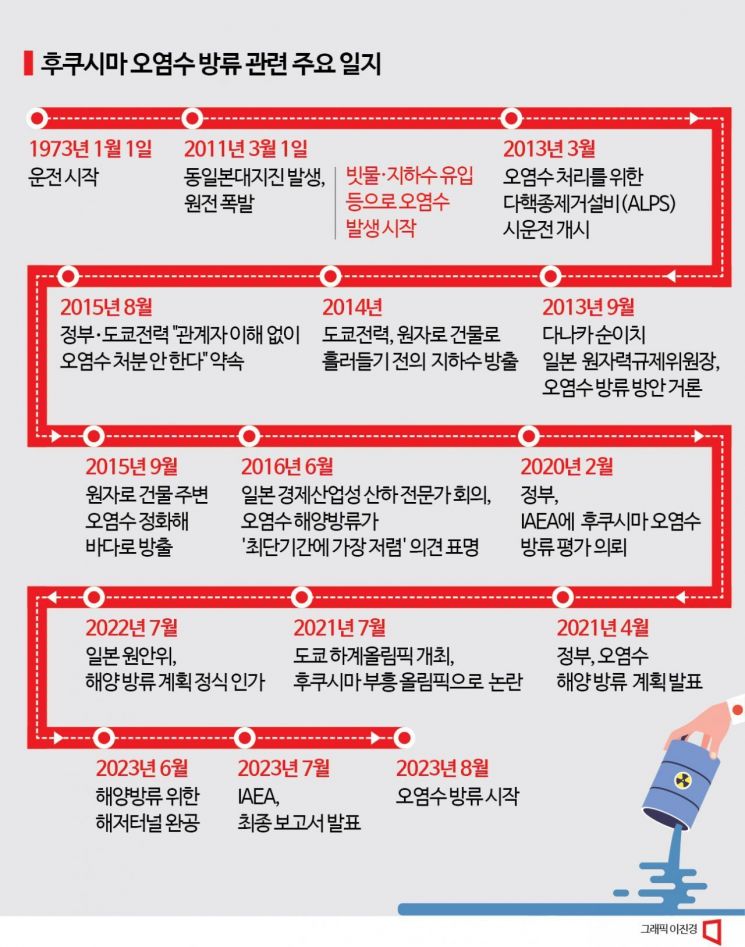
In February 2020, the Japanese government requested the International Atomic Energy Agency (IAEA) to evaluate whether the contaminated water discharge method was appropriate. Conscious of opposition from neighboring countries, Japan sought legitimacy for the discharge by passing IAEA safety standards.
In April 2021, the government officially announced the plan for ocean discharge of contaminated water. The stance was that since the inspection was requested from the credible IAEA, if the IAEA judged there were no problems, the discharge would proceed. However, the IAEA's successive reports stated that TEPCO's contaminated water treatment methods had no issues, leading to criticism that this was effectively a permit process.
The controversy in South Korea intensified during the Tokyo Summer Olympics held in July 2021. Postponed by one year due to COVID-19, the Olympics were promoted under the slogan "Fukushima Reconstruction Olympics," drawing criticism as the "Radioactive Olympics." Some events were held in Fukushima, unrelated to Tokyo, and Fukushima-sourced ingredients were served in the athletes' village, fueling controversy.
Nevertheless, the Japanese government continued the process for contaminated water discharge. In July 2022, the Nuclear Regulation Authority officially approved the ocean discharge plan. TEPCO then began construction of discharge facilities such as undersea tunnels and completed them in June this year.
Last month, the IAEA issued a final report stating that TEPCO's discharge of Fukushima contaminated water complies with international practices from a technical perspective. This effectively granted approval for the Japanese government's contaminated water discharge.
Japan actively appeases fishermen... 730 billion yen support
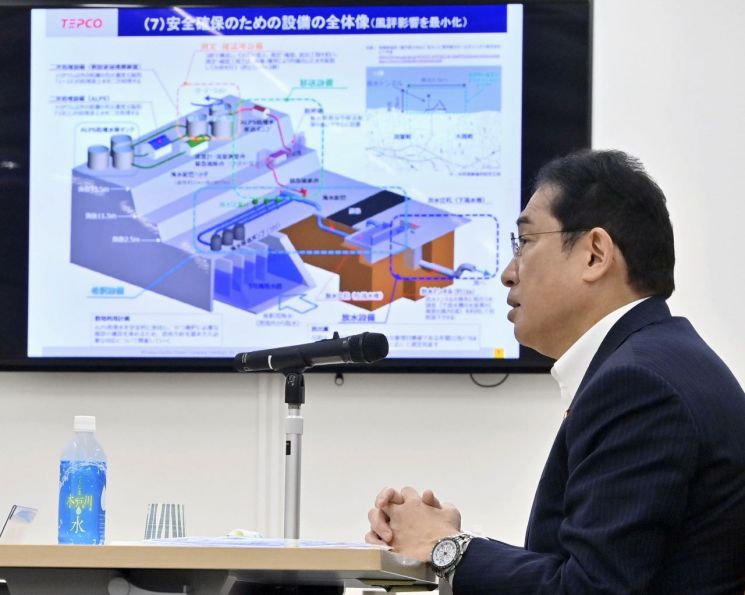
The Japanese government plans to implement measures to appease domestic fishermen's opposition and respond to potentially strengthened import restrictions. When the contaminated water discharge plan was formulated in 2021, the government established a fund of 80 billion yen to address rumor damage, which it now intends to use to minimize fishermen's losses.
According to the Sankei Shimbun, the Japanese government plans to invest 30 billion yen in promoting and supplying Japanese seafood to companies and restaurants and use 50 billion yen to support fishermen's fisheries. Additionally, TEPCO will establish a project team to appropriately compensate fishermen if damages occur.
Regarding import restrictions from countries like China, Japan is expected to demand early lifting of restrictions while simultaneously expanding domestic seafood production and developing new export markets.
Minister of Economy, Trade and Industry Yasutoshi Nishimura and Minister for Reconstruction Hiromichi Watanabe attended the meeting. Minister Nishimura plans to visit Fukushima Prefecture afterward to explain the government's decision on contaminated water discharge.
With this announcement, the discharge is set to begin two years and four months after then-Prime Minister Yoshihide Suga officially decided on ocean discharge of contaminated water in April 2021. Counting from the Fukushima nuclear accident caused by the Great East Japan Earthquake on March 11, 2011, it will be about 12 years.
© The Asia Business Daily(www.asiae.co.kr). All rights reserved.
![Clutching a Stolen Dior Bag, Saying "I Hate Being Poor but Real"... The Grotesque Con of a "Human Knockoff" [Slate]](https://cwcontent.asiae.co.kr/asiaresize/183/2026021902243444107_1771435474.jpg)


















