Service Industry Up 2.8%, Retail Sales Down 0.3%
In the second quarter of this year, nationwide manufacturing production decreased by more than 7%. Consumer prices rose by over 3% in all regions across the country.
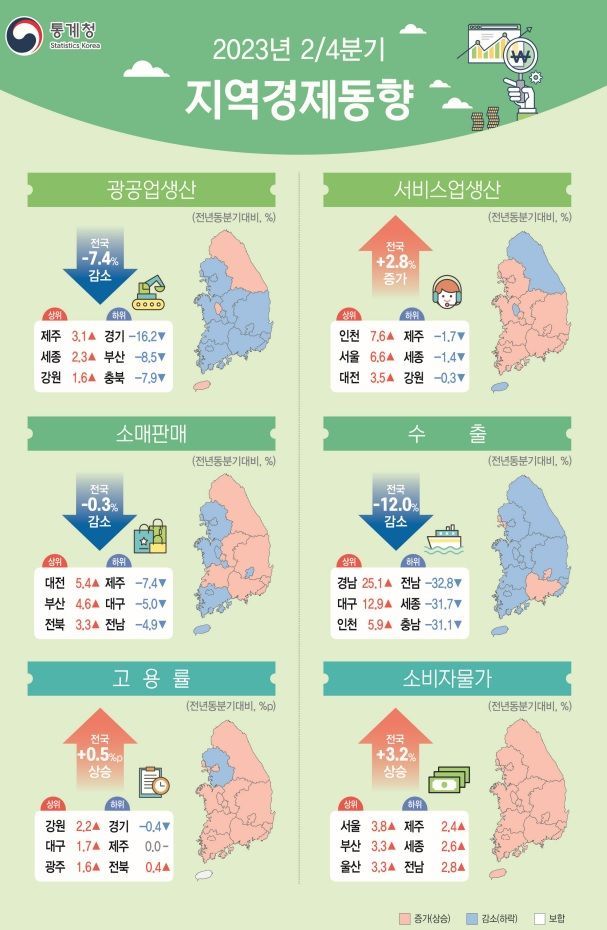
According to the regional economic trends for the second quarter released by Statistics Korea on the 21st, nationwide manufacturing production in the second quarter of this year fell by 7.4% compared to the same period last year. Although the decline narrowed by 2.3 percentage points from the first quarter (-9.7%), production has decreased for three consecutive quarters since the fourth quarter of last year.
By item, the largest production decline was seen in semiconductors and electronic components (-19.0%), followed by chemical products (-16.0%) and rubber and plastics (-10.3%).
By region, Jeju (3.1%), Sejong (2.3%), and Gangwon (1.6%) saw increases due to higher production in electricity and gas industries and electrical equipment. However, Gyeonggi (-16.2%), Busan (-8.5%), and Chungbuk (-7.9%) experienced declines due to reduced production in semiconductors, electronic components, and electricity and gas industries.
Service industry production increased by 2.8% compared to the same period last year. Growth was centered on finance and insurance (9.2%), transportation and warehousing (9.3%), and health and welfare (3.5%). Incheon (7.6%), Seoul (6.6%), and Daejeon (3.5%) showed production increases, while Jeju (-1.7%), Sejong (-1.4%), and Gangwon (-0.3%) saw declines in information and communication, real estate, and accommodation and food services.
Nationwide exports decreased by 12.0% year-on-year due to reduced exports of memory semiconductors, diesel, and computer peripherals. Exports increased in Gyeongnam (25.1%), Daegu (12.9%), and Incheon (5.9%) with growth in shipbuilding, other organic and inorganic compounds, and passenger cars. Conversely, Jeonnam (-32.8%), Sejong (-31.7%), and Chungnam (-31.1%) experienced declines.
Retail sales, which indicate consumption trends, fell by 0.3% compared to the same period last year. Sales decreased in duty-free shops (-24.4%), specialty retail stores (-1.4%), and convenience stores (-4.1%).
Consumer prices rose by 3.2% year-on-year due to increases in public utility charges such as electricity, gas, and water, as well as higher dining-out prices. Seoul (3.8%), Busan (3.3%), and Ulsan (3.3%) saw increases above the national average due to rises in electricity, gas, water, and dining costs, while Jeju (2.4%), Sejong (2.6%), and Jeonnam (2.8%) had lower increases than the national average.
The national employment rate was recorded at 63.2%. Employment rates rose among those in their 30s, those aged 60 and over, and those in their 50s, increasing by 0.5 percentage points compared to the same period last year. The national unemployment rate was 2.7%, with decreases in unemployment rates among those aged 15?29 and those aged 60 and over, falling by 0.3 percentage points during the same period.
© The Asia Business Daily(www.asiae.co.kr). All rights reserved.


















