Camp David Adopts Three Commitments on 'Spirit,' 'Principles,' and 'Tripartite Consultations'
Plans to Discuss Establishing Meetings for Foreign Affairs, Defense, Industry, and Security Chiefs
Reaffirms Immediate Resolution Willingness on Abductees, Detainees, and POW Issues
Direct Criticism of China on South China Sea Issues
Cooperation on Economic Security, Advanced Technology Supply Chains, and Technology Theft Issues
The leaders of South Korea, the United States, and Japan agreed to strengthen security cooperation by consulting and preparing response measures if a joint threat arises among the three countries concerning security in the Indo-Pacific region, including North Korea's nuclear and missile threats. Regarding regional peace, the three countries conduct annual joint exercises and directly criticized China for escalating tensions in the South China Sea.
On the 18th (local time), President Yoon Suk-yeol held a trilateral summit with U.S. President Joe Biden and Japanese Prime Minister Fumio Kishida at Camp David, the U.S. presidential retreat, and adopted the "Commitment to Consult" containing cooperation measures against joint threats among the three countries, the presidential office reported.
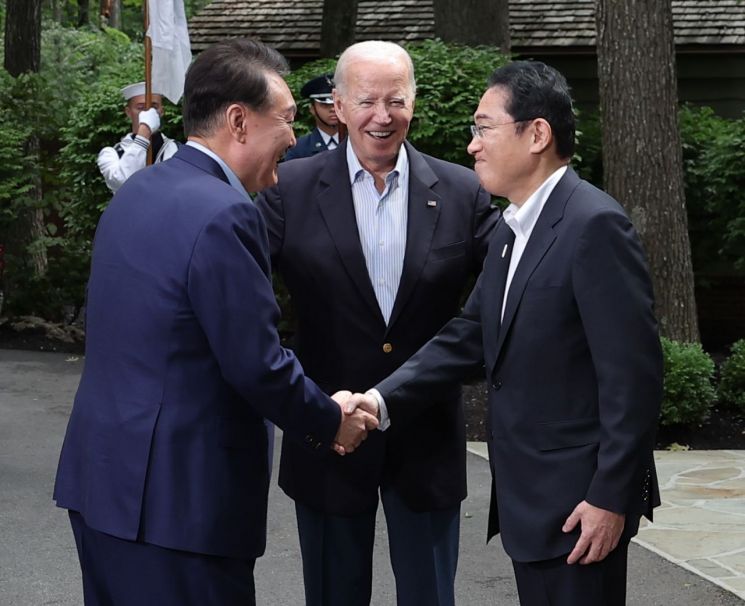
Yoon: "The Three Countries Must Strengthen Their Will to Cooperate on Challenges Threatening Regional Security"
In his opening remarks at the South Korea-U.S.-Japan summit held at Camp David near Washington DC that morning, President Yoon said, "I am honored to open a new chapter of trilateral cooperation at Camp David, which holds great symbolic significance in modern diplomatic history." He also expressed his pleasure at meeting Presidents Biden and Kishida again just over a month after the NATO summit in July, stating, "I am very pleased to see both of you again so soon after the NATO summit in July," and reiterated the significance of opening a new chapter of trilateral cooperation at Camp David.
President Yoon quoted former President Franklin Roosevelt's saying, "Freedom is not given; it is won," emphasizing, "Our three countries must unite firmly so that our individual freedoms are not threatened or infringed upon." He particularly noted, "This is a promise and responsibility for future generations," and defined this trilateral summit as "a historic day that will be recorded for solidifying the institutional foundation and determination to promote trilateral cooperation."
Before President Yoon, President Biden began his remarks by saying, "It is an honor to host the two leaders," and added, "This is the first time I have welcomed foreign leaders at Camp David," emphasizing, "I believe there is no better way to open a new chapter of triangular cooperation among our three countries." This is the first time the South Korea-U.S.-Japan summit has been held independently rather than as part of a multilateral meeting.
He stressed, "This meeting is the first summit held separately by South Korea, the U.S., and Japan," and added, "The unity of our democracies has strengthened. We will become stronger, and the world will become safer. This is the shared belief we three hold."
President Biden expressed, "I want to emphasize that this is a historic effort to lay the foundation for facing the future together," and said, "I appreciate the leadership of the two leaders and look forward to starting a new era of cooperation with them and renewing our resolve to be a force for good across the Indo-Pacific."
Finally, Prime Minister Kishida, before his remarks, mentioned the wildfires on Maui Island, Hawaii, and the passing of President Yoon's father, offering his condolences. He then stated, "To unlock the potential of South Korea-U.S.-Japan strategic cooperation, we aim to elevate trilateral security cooperation to a new level by strengthening cooperation between the South Korea-U.S. alliance and the U.S.-Japan alliance," and added, "We intend to expand cooperation in broad areas including economic and security fields, such as consolidating supply chains for important emerging technologies, while further strengthening cooperation in responding to North Korea."
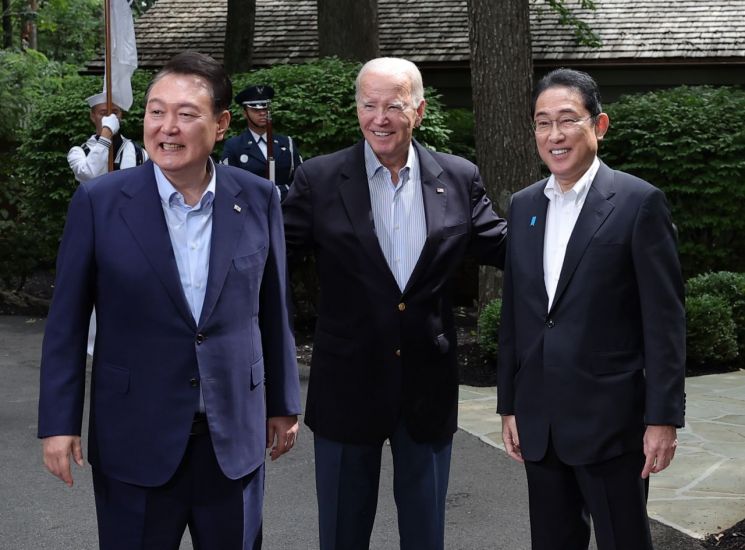
Adoption of Three Documents: 'Spirit of Camp David,' 'Camp David Principles,' and 'Commitment to Consult'
Along with the Commitment, the South Korea-U.S.-Japan leaders also adopted the 'Spirit of Camp David' and the 'Camp David Principles,' which document the agreements reached at the summit. The Commitment includes a pledge to "consult promptly to coordinate responses to regional challenges, provocations, and threats affecting the common interests and security of South Korea, the U.S., and Japan."
A senior official from the presidential office told reporters at a press center in a hotel in Washington DC, "The separate document on immediate trilateral consultation and cooperation on joint regional and extraregional threats in the joint press statement of the South Korea-U.S.-Japan summit is a political commitment to strengthen consultations within and beyond the region." However, the Commitment does not infringe upon the commitments of the South Korea-U.S. alliance or the U.S.-Japan alliance. Furthermore, it does not create new rights or obligations under international or domestic law.
The 'Spirit,' which also serves as the joint summit statement, encompasses comprehensive cooperation measures among the three countries, while the 'Principles' document outlines the principles to be upheld in pursuing future trilateral cooperation.
At the summit, the three countries established a foundation to institutionalize cooperation by regularizing meetings and creating new consultative bodies. First, the South Korea-U.S.-Japan leaders agreed to hold summits at least once a year. Additionally, ministerial-level consultations among foreign ministers, defense ministers, commerce and industry ministers, and national security advisors will be held at least once annually, and a finance ministers' meeting will be newly established to discuss annualization.
A dialogue on the Indo-Pacific involving senior officials at the deputy minister and director-general level will be launched. The three countries will coordinate approaches and cooperation areas regarding the Indo-Pacific region. In security cooperation, a real-time sharing system for North Korean missile warning information will be operational by the end of this year, and enhanced ballistic missile defense cooperation will be pursued in response to North Korea's nuclear and missile threats. The three countries agreed to conduct annual joint exercises to coordinate capabilities and enhance cooperation.
Regarding joint measures on North Korea, the leaders agreed on supporting North Korea's complete denuclearization and a free and peaceful reunification of the Korean Peninsula, expressing concern over North Korea's illegal cyber activities used to fund illicit weapons of mass destruction and ballistic missile programs, and reaffirming their determination to promptly resolve issues related to abductees, detainees, and prisoners of war. They also agreed to coordinate efforts to respond to increasing threats from overseas information manipulation and misuse of surveillance technologies. Given North Korea's recent illegal hacking and cryptocurrency transactions to develop nuclear and missile capabilities, the three countries are expected to devise effective countermeasures.
Beyond North Korea, regarding regional peace, the three leaders directly criticized China, which is increasing the possibility of a military invasion of Taiwan in the South China Sea. In the 'Spirit,' the leaders stated, "We strongly oppose any unilateral attempts to change the status quo in the Indo-Pacific region related to dangerous and aggressive actions supporting the People's Republic of China's illegal maritime claims in the South China Sea." They further declared, "In particular, we firmly oppose the militarization of reclaimed areas, the dangerous use of coast guard and maritime militia vessels, and coercive actions," and added, "We are also concerned about illegal, unreported, and unregulated fishing. We reaffirm our firm commitment to international law, including freedom of navigation and overflight as reflected in the United Nations Convention on the Law of the Sea," urging a peaceful resolution of cross-Strait issues.
In economic security and advanced technology fields, the agreements included supply chain resilience covering semiconductors and batteries, technology security and standards, clean energy and energy security, biotechnology, critical minerals, pharmaceuticals, artificial intelligence (AI), quantum computing, and scientific research. They launched a pilot early warning system project to expand information sharing and enhance policy coordination against potential global supply chain disruptions, and agreed to continue trilateral cooperation for the successful conclusion of the Indo-Pacific Economic Framework (IPEF) negotiations. Furthermore, they agreed to expand joint research and development and personnel exchanges among national research institutes of the three countries, strengthen cooperation to prevent the leakage of innovative technologies by engaging with the U.S. 'Innovation Technology Task Force,' enhance cooperation on technology security and standards, strengthen trilateral AI governance, deepen financial cooperation, and consolidate cooperation on critical minerals.
For regional and global cooperation, they agreed on ▲supporting ASEAN and Pacific island countries through the South Korea-U.S.-Japan 'Maritime Security Cooperation Framework,' ▲promoting the Resilient, Inclusive, and Sustainable Economies (RISE) partnership to strengthen supply chains, and ▲holding the 'South Korea-U.S.-Japan Cancer Policy Dialogue' to conquer cancer. Additionally, they committed to strengthening people-to-people ties among the three countries' citizens, including youth and students, and to efforts to build an inclusive economy empowering women.
© The Asia Business Daily(www.asiae.co.kr). All rights reserved.
!["The Woman Who Threw Herself into the Water Clutching a Stolen Dior Bag"...A Grotesque Success Story That Shakes the Korean Psyche [Slate]](https://cwcontent.asiae.co.kr/asiaresize/183/2026021902243444107_1771435474.jpg)

















