KIST Research Team
Develops Simple Surface Molecular Distribution Prediction Method
Enables Quality Control in Production Process
Opens Path to Mass Production
Domestic researchers have opened the way to mass-produce the "dream material" MXene.
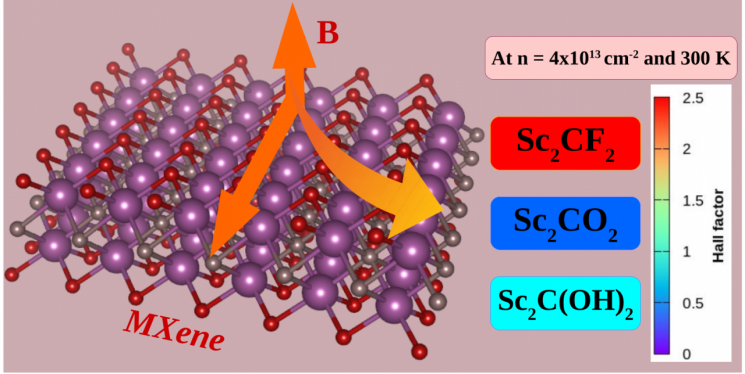 Predicted Hall Scattering Factor in Maxine
 As a method to measure the Hall scattering factor in Maxine, B represents the direction of the magnetic field, and electrons that should originally travel in a straight line bend to the right according to the magnetic field, but the degree of bending varies depending on the surface functional groups. Photo by KIST
The Korea Institute of Science and Technology (KIST) announced on the 17th that Dr. Seungcheol Lee's research team at the Korea-India Cooperation Center developed a method to predict the molecular distribution on the surface of MXene by utilizing its magnetoresistance properties. By applying this method, it becomes possible to analyze the molecular distribution of MXene with simple measurements, enabling quality control during the production process and opening the path to mass production that was previously impossible.
Developed in 2011, MXene is a two-dimensional nanomaterial composed of alternating metal and carbon layers. It possesses high electrical conductivity and can be combined with various metal compounds, making it a material applicable in diverse industries such as semiconductors, electronic devices, and sensors. To properly utilize MXene, it is important to know the type and amount of molecules covering its surface. For example, if the surface molecules are fluorine, MXene’s electrical conductivity decreases, reducing its electromagnetic shielding efficiency. However, since the thickness is only 1 nm (nanometer, one billionth of a meter), analyzing molecules attached to the surface requires high-performance electron microscopes and takes several days, making mass production impossible until now.
The research team focused on the fact that electrical conductivity or magnetic properties would vary depending on the molecules attached to the surface and developed a property prediction program for two-dimensional materials. As a result, by calculating the magnetoresistance properties of MXene, they succeeded in analyzing the type and amount of molecules adsorbed on the MXene surface at atmospheric pressure and room temperature without any additional devices.
Using the developed property prediction program to analyze the MXene surface, they predicted that the Hall Scattering Factor, which affects magnetoresistance, dramatically changes depending on the type of surface molecules. The Hall Scattering Factor is a physical constant representing the charge transport characteristics of semiconductor materials. Even when manufacturing the same MXene, the Hall Scattering Factor was confirmed to be highest at 2.49 for fluorine, 0.5 for oxygen, and 1 for hydroxide, enabling analysis of molecular distribution.
The application fields of MXene vary according to the Hall Scattering Factor value. When the value is below 1, it can be used in high-performance transistors, high-frequency generation devices, high-efficiency sensors, and photodetectors. When the value is above 1, it can be applied to thermoelectric materials and magnetic sensors. Considering that the size of MXene is below a few nanometers, this can drastically reduce the size and power requirements of applicable devices.
The center director stated, “Unlike previous studies focused on the manufacturing and characteristics of pure MXene, we developed a new method for surface molecule analysis to easily classify manufactured MXene,” and added, “Based on this achievement, mass production of MXene with uniform quality is expected to become possible.”
The research results were selected as a notable paper of the year (2023 Hot Article Collection) in the international nanoscience journal Nanoscale (IF 6.7) and published on June 28.
© The Asia Business Daily(www.asiae.co.kr). All rights reserved.
![Clutching a Stolen Dior Bag, Saying "I Hate Being Poor but Real"... The Grotesque Con of a "Human Knockoff" [Slate]](https://cwcontent.asiae.co.kr/asiaresize/183/2026021902243444107_1771435474.jpg)















