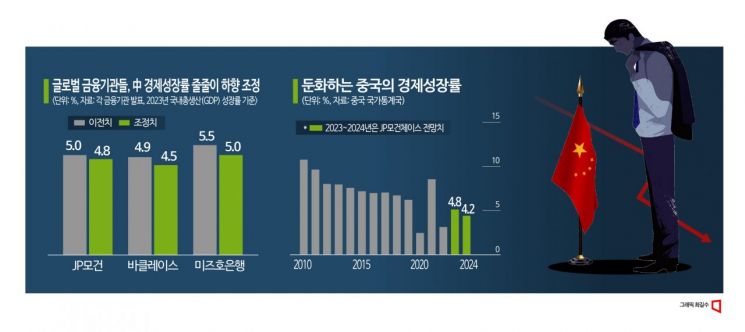
As concerns grow over the acceleration of China's economic slowdown due to the default crisis of real estate developer Country Garden (Biguoyuan), the market is focusing on the government's response. In addition to expected policies such as interest rate cuts and easing of real estate regulations, there are calls for the need to supply liquidity through direct cash support, which has been avoided until now. Before entering a prolonged economic downturn, it is argued that Japan-style policy responses?quantitative easing, increased fiscal spending, and deregulation, known as the ‘three arrows’?should be launched.
According to China Central Television (CCTV) on the 16th, Premier Li Chang presided over a plenary meeting and emphasized achieving the annual economic target (around 5.0%) through strong macroeconomic control and enhanced policy coordination. Premier Li expressed his determination to stimulate domestic demand through reforms in the state-owned sector and continuous support for the private sector. However, he did not mention specific details such as the measures expected by the market or the direction of policy coordination.
Following Interest Rate Cuts, Central Bank Intervention ‘Accelerates’
Concerns Over Weakening Yuan...Value Drops Against the Dollar
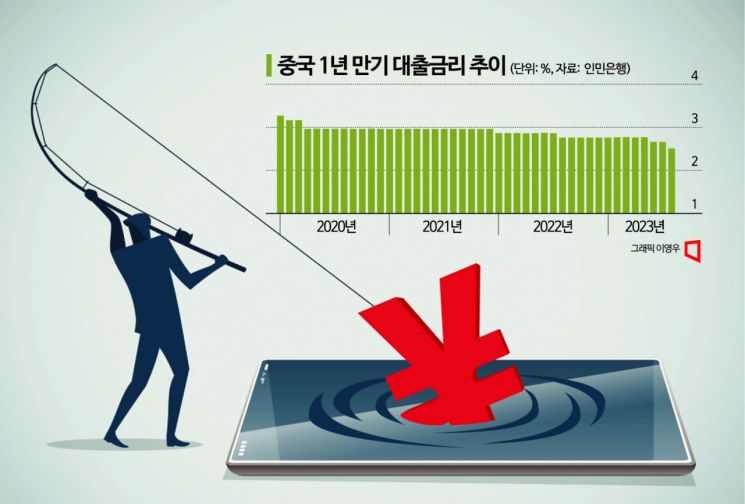
The market’s attention is on the People’s Bank of China (PBOC), which has already begun to take action. On this day, the PBOC injected 297 billion yuan (approximately 51 trillion won) into the market through a 7-day reverse repurchase agreement (reverse repo). This is the largest short-term fund supply since February, following a 0.1 percentage point cut in the 7-day reverse repo rate from 1.9% to 1.8% the previous day.
On the 15th, the PBOC also lowered the policy rate for the 1-year Medium-term Lending Facility (MLF) loans by 0.15 percentage points, from 2.65% to 2.50%. This is the first rate cut in two months since the June rate reduction. Following convention, the Loan Prime Rate (LPR), which will be announced on the 21st, is also expected to be lowered. In China, the LPR effectively serves as the benchmark interest rate. The market anticipates further interest rate cuts and reserve requirement ratio reductions in the second half of this year.
However, it is difficult for the PBOC to continue injecting cash. With the yuan recently falling to its lowest level in 16 years against the dollar, it could be detrimental to exchange rate defense. The Wall Street Journal (WSJ) diagnosed that the yuan’s depreciation amid growing concerns over the real estate crisis and falling prices is a headache for China. In the Asian offshore foreign exchange market the previous morning, the yuan exchange rate surged to 7.34 yuan per dollar, approaching the all-time low of 7.38 yuan recorded in October last year.

Market Warning Lights Already On...Urgent Need to Ease Real Estate Regulations
From Evergrande and Biguoyuan to Zhongrong Trust Crisis
The most urgent area for government policy response is the ‘real estate’ sector. Investment sentiment has frozen due to a continuous transaction cliff and price declines, compounded by the default risk crisis of Biguoyuan. Additionally, concerns over a chain default are growing as real estate trust company Zhongrong International Trust recently delayed cash payments to investors. As of August, the default balance in China’s real estate industry, including repayment extensions, has reached 235.3 billion yuan.
Especially since the Evergrande crisis that began in 2021 has not been fully resolved, the domino effect of defaults is raising concerns. Coupled with the fact that China’s economic strength has rapidly weakened since the COVID-19 pandemic, voices warning of adverse impacts on the overall Chinese economy are increasing.
China’s authorities’ attempt last month to shift away from a ‘regulation-only’ approach regarding the real estate market through the Central Political Bureau meeting can be seen as a response to this market situation. The authorities have shown their intention to guide a soft landing of the market by easing high-intensity regulations and loosening loan standards. However, despite continuous interest rate cuts by the central bank and changes in government perception, the market situation shows no signs of improvement, prompting calls for more proactive measures. There is a need to reduce regulatory intensity in various areas, including direct real estate development, easing sales standards in first-tier cities, and simplifying liquidation standards for distressed real estate.
Will Xi Jinping Take the Hesitated Step of Cash Handouts?
"All Means to Put Money in People’s Pockets Must Be Used"
The most certain way to boost sluggish domestic demand is for the government to directly provide cash support. This was a representative measure taken by major countries during the COVID-19 outbreak. However, Chinese President Xi Jinping has been reluctant to hand cash directly to the people.
The Sydney Morning Herald in Australia analyzed on the 16th (local time) that amid recent deflation, export contraction, and the spreading real estate crisis, pressure is mounting for Xi Jinping to take action in two areas he has hesitated on: ‘support for the real estate sector’ and ‘cash payments to consumers.’ The report explained, "If trust is not restored, there is a risk of economic pain that could damage Communist Party leaders." Drew Thompson, a researcher at the Lee Kuan Yew School of Public Policy at the National University of Singapore, told Bloomberg News, "Economic slowdown sharply increases the risk of (political and social) instability, and the Chinese Communist Party must defend against this."
Such voices are also emerging within China. Cai Fang, a member of the People’s Bank of China Monetary Policy Committee, recently urged, "It is necessary to use all reasonable, legal, and economic means to put money into the pockets of residents."
© The Asia Business Daily(www.asiae.co.kr). All rights reserved.



















