Broker Alliance Partnered with Kamo and Role Sharing
Middle Mile Becomes Battleground... Analog Operations Digitalized
Kakao Mobility plans to launch a freight truck driver application (app) this October and make a full-scale entry into the middle-mile logistics market. The middle mile refers to the stage of transporting manufactured goods from factories to logistics centers or dealerships. Since IT and logistics companies such as KT, T Map Mobility, and CJ Logistics have already entered this market, competition is expected to become even fiercer.
According to industry sources on the 17th, Kakao Mobility is scheduled to release a freight truck driver app called 'Kakao T Trucker' around October. This platform connects cargo owners who send freight with truck drivers who transport it. Similar to the Kakao T taxi driver or designated driver apps, it provides truck drivers with cargo volume information from cargo owners and supports freight fee calculation and settlement.
The Korea Federation of Freight Truck Transportation Brokerage Associations (the Federation), which partnered with Kakao Mobility, operates the program used by brokers. Brokers receive calls from cargo owners and post the information on the network. Previously, the Federation operated both the broker program and the driver app, but the latter will now be managed by Kakao Mobility. The Federation holds exclusive usage rights for both platforms. This approach secures customers (cargo owners and truck drivers) from the start while avoiding conflicts with existing operators (the Federation). To this end, Kakao Mobility acquired a 49% stake in the freight transportation platform 'Hwamul Madang,' operated by the Federation, in October last year, becoming the second-largest shareholder.
Kakao Mobility plans to apply the technology accumulated from existing mobility services such as taxis to middle-mile logistics. This includes using artificial intelligence (AI) to set real-time freight rates based on supply and demand and efficiently dispatching trucks according to the type of goods. It is also possible to guide optimal freight transport routes by linking with Kakao Navi.
With Kakao's entry, competition in the middle-mile market is expected to intensify further. Mobility competitors and logistics companies have already entered the market. T Map Mobility acquired 100% of the middle-mile brokerage startup YLP last year and launched 'T Map Freight' in February this year. CJ Logistics piloted the middle-mile platform 'The Unban' at the end of last year and started full-scale service in July. KT established the digital logistics subsidiary 'RollLab' in 2021 and launched the brokerage platform 'Brocarry' last year, recently significantly enhancing its AI capabilities.
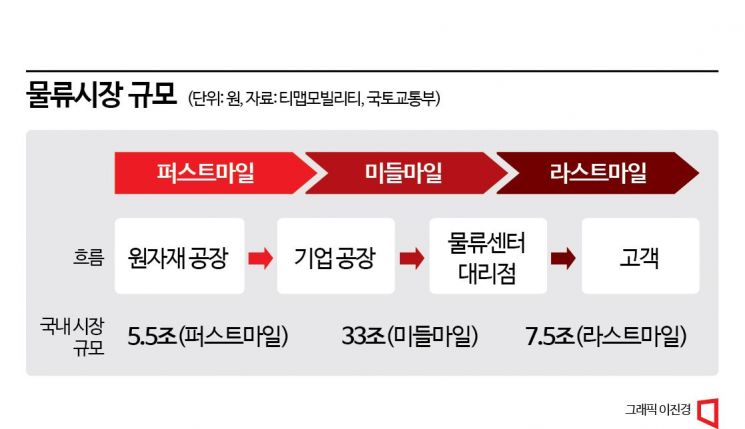
The reason these companies have entered the business is profitability. The middle-mile market is estimated to be worth 33 trillion won. It is larger than the first mile, which moves goods from production sites to warehouses, or the last mile, which delivers to the final consumer. Unlike the last mile, which has rapidly undergone digital transformation due to the growth of e-commerce companies like Coupang and Naver, the middle mile still remains in the past. It relies on phone calls and manual processes to connect cargo owners and truck drivers. When a brokerage company posts cargo volume information received from cargo owners on the network, truck drivers apply via app or phone. This analog method still prevails, leaving many areas for IT technology to penetrate, but there is no dominant operator yet. The middle-mile market is attractive to Kakao Mobility as well. Kakao Mobility posted a net loss of 27.7 billion won last year, turning to a deficit. This was largely due to a provisional fine of 27.6 billion won imposed by the Fair Trade Commission for preferential taxi call allocation. Revenue growth has also slowed. The taxi fare increase starting late last year and the economic downturn have had an impact.
© The Asia Business Daily(www.asiae.co.kr). All rights reserved.
![Clutching a Stolen Dior Bag, Saying "I Hate Being Poor but Real"... The Grotesque Con of a "Human Knockoff" [Slate]](https://cwcontent.asiae.co.kr/asiaresize/183/2026021902243444107_1771435474.jpg)
















