Emergency Economic Ministers' Meeting and Export Investment Measures Meeting on the 17th
On-site Issues Confirmed in 7 Areas of 'New Growth 4.0 Major Projects'
The government is taking steps to resolve difficulties faced by the AI (artificial intelligence) semiconductor industry. As AI technologies like Chat GPT are expected to expand into everyday life, global AI semiconductor industry growth is anticipated. However, Korea has only recently begun developing domestic AI semiconductors primarily through startups. Reflecting the challenges faced by the industry and field, the government plans to strengthen various supports such as data center construction, prototype production cost assistance, and promotion of collaboration with demand companies.
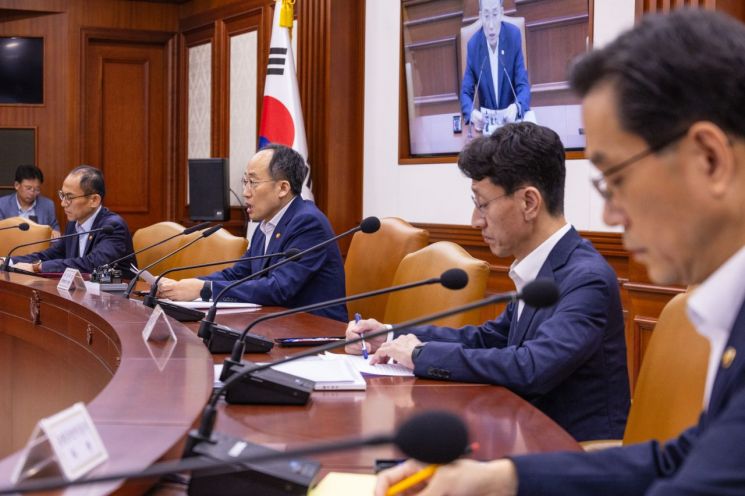 Deputy Prime Minister and Minister of Economy and Finance Choo Kyung-ho is speaking about the recent economic situation at the Emergency Economic Ministers' Meeting and Export Investment Measures Meeting held at the Government Seoul Office in Jongno-gu, Seoul, on the morning of the 17th.
 [Photo by Yonhap News]
On the 17th, the government prepared measures to resolve difficulties across the industry at the Emergency Economic Ministers' Meeting and Export Investment Countermeasures Meeting. The government explained that it operated public-private consultative bodies to identify and address challenges in seven key areas of the ‘New Growth 4.0 Major Projects.’ The seven areas are ▲ AI semiconductors ▲ Urban Air Mobility (UAM) ▲ Hydrogen ▲ Autonomous driving ▲ Batteries ▲ Medical MyData ▲ Simplification of R&D research equipment import procedures.
First, the government decided to strengthen overall support measures for the AI semiconductor industry. It will promptly establish data centers utilizing domestic AI semiconductors to provide a demonstration base for fabless (design) and service companies. Since most domestic demand companies currently prefer foreign AI semiconductors with proven compatibility and stability, this aims to create a foundation for domestic AI semiconductor companies to secure performance records. The government plans to expand support such as the AI semiconductor application demonstration support project to help these companies build successful demonstration histories.
For fabless semiconductor companies burdened with prototype semiconductor production costs, the government plans to expand the scale of prototype production support starting next year. To promote collaboration with AI semiconductor demand companies such as cloud companies, additional points will be awarded to companies using domestic AI semiconductors when selecting AI R&D project operators. AI semiconductors are non-memory semiconductors that execute large-scale computations required for AI service implementation at ultra-high speeds.
The reason the government is addressing difficulties and strengthening support for the AI semiconductor industry is the growing market for generative AI like Chat GPT. According to global market research firm Gartner, as AI such as Chat GPT spreads into daily life, the AI semiconductor market is expected to grow rapidly at an average annual rate of 16%, reaching $86.1 billion by 2026. The core of generative AI like Chat GPT is the ability to provide accurate answers to questions through large-scale data learning, which inevitably increases demand for AI semiconductors capable of processing large-scale data. However, Korea’s semiconductor industry is at a disadvantage in the global market for non-memory businesses such as AI semiconductors. Currently, the AI semiconductor market is dominated 95% by global company Nvidia, and Korea has only recently begun developing domestic AI semiconductors mainly through startups.
Establishing a Safe UAM Operation System and Building a Clean Hydrogen Cluster
Additionally, regarding the Urban Air Mobility (UAM) industry, the government plans to launch a joint task force among related ministries to establish frequencies for UAM and create a safe UAM operation system. It will also promote phased frequency discovery for UAM operations, including securing 5G networks to enhance security.
In the hydrogen industry, the government will promote the development of clean hydrogen production technologies and cluster construction necessary for carbon neutrality. Safety standards will also be established for new clean hydrogen production facilities under development by companies. The government stated, “Recently, global competition to secure early market dominance in clean hydrogen production and power generation technologies with low greenhouse gas emissions has intensified to achieve carbon neutrality.” It explained that support will be strengthened to reduce the technology gap with advanced countries.
In the autonomous driving sector, regulatory sandbox special provisions will be relaxed on the premise of safety measures, allowing the use of unstructured data containing vehicle numbers or human faces within designated zones. Furthermore, a ‘pseudonymization guideline’ will be established so that companies can use pseudonymized video data even outside regulatory sandbox zones. Regarding the battery industry, the government plans to establish an ‘Integrated Management System for Used Batteries’ early through consultations among related ministries. Used batteries with low toxicity and economic feasibility will be promoted for early designation as ‘recyclable resources.’
© The Asia Business Daily(www.asiae.co.kr). All rights reserved.
!["The Woman Who Threw Herself into the Water Clutching a Stolen Dior Bag"...A Grotesque Success Story That Shakes the Korean Psyche [Slate]](https://cwcontent.asiae.co.kr/asiaresize/183/2026021902243444107_1771435474.jpg)
















